The point
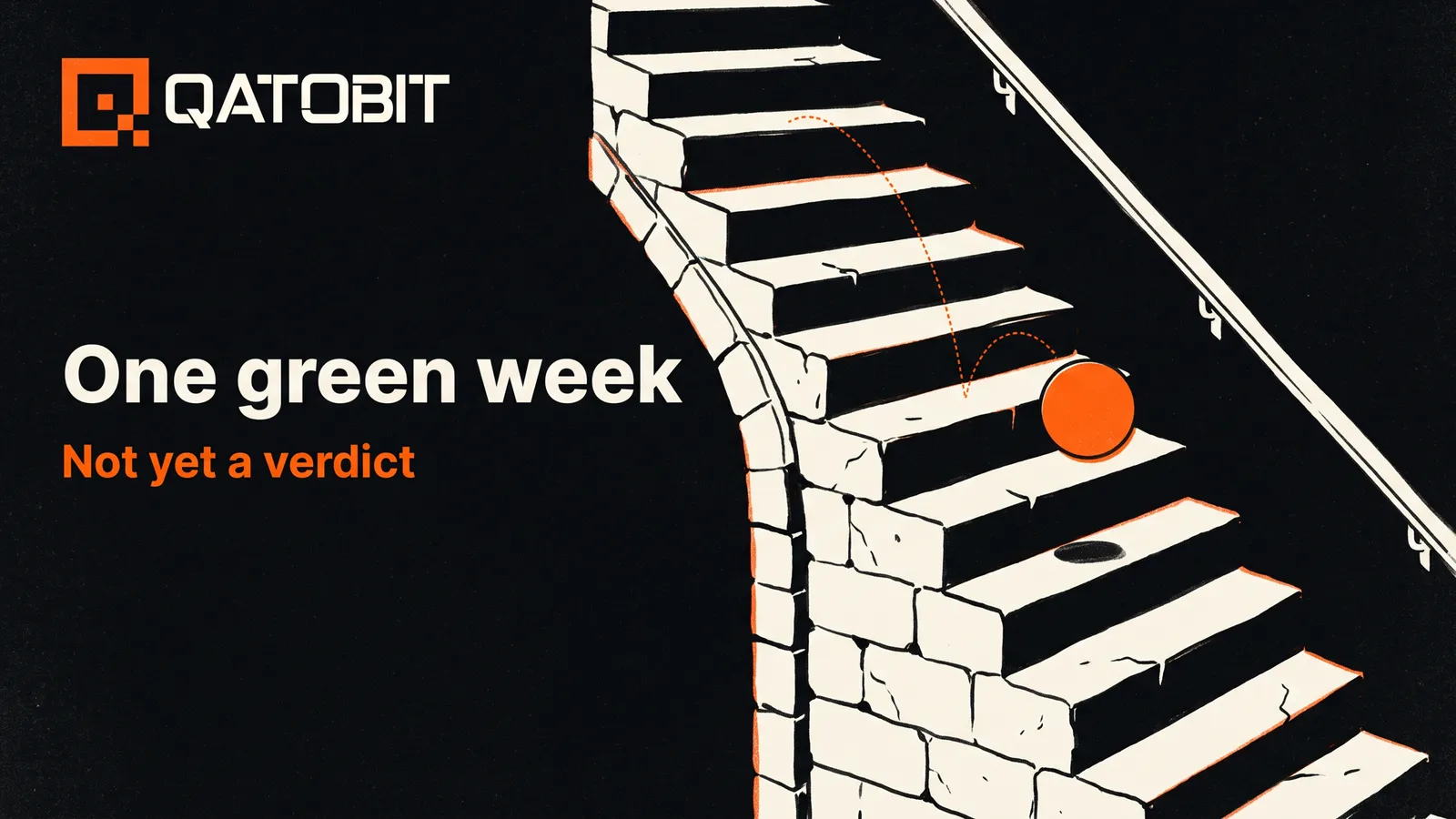
A dead cat bounce is a small, brief recovery in the price of an asset that is falling. It earns the name only if the fall then resumes, so nobody can label a rally correctly while it is happening. The honest reading of a green week after a long red run is that it settles nothing.
What is a dead cat bounce?
A dead cat bounce is a small, brief recovery in the price of a declining asset. Wikipedia, read on 10 October 2026, traces the phrase to the saying that even a dead cat will bounce if it falls from a great height.
Dictionary.com, read the same day, defines it as a temporary recovery in prices after a steep decline, often driven by the purchase of securities that were sold short. The British entry it quotes adds that the cause is speculators buying back what they already sold, and not a genuine reversal of the downward trend.
The word "dead" carries the meaning: the bounce is a pause inside a fall, and the fall carries on afterwards.
Why can it only be named in hindsight?
Wikipedia says the pattern is difficult to identify at the time of occurrence and, like market peaks and troughs, is usually recognised only with hindsight. The price recovers, then fails to continue upward and falls again, often past the previous low.
By that definition, a bounce becomes a dead cat bounce only after the second leg down. If the price keeps rising instead, the same green week gets a different name, a recovery.
So the label is a verdict on what came next. Anyone who calls a live rally a dead cat bounce is guessing, and so is anyone who calls it the bottom. The first green week looks identical in both stories.
What causes a bounce inside a fall?
Wikipedia lists four causes, and it marks the first three as needing better citation, so treat them as common explanations and not as proven mechanics.
- Short covering. Traders who bet on a fall buy the asset back to close the bet, and that buying lifts the price for a while.
- Dip buying. Buyers who think the price is still moving between a floor and a ceiling see a low price as a bargain.
- Good news. A partnership or a product launch lifts sentiment, though the cause of the decline has not changed.
- Manipulation. A pump-and-dump produces a short-lived rise for the benefit of whoever started it.
Each cause is temporary by nature. Demand that comes from closing a bet, or from one headline, runs out when the bet is closed or the headline is old.
How much does a bounce actually repair?
Take a position of ₹5 lakh, as an illustration with made-up numbers. The asset falls from ₹100 to ₹60, so the position is now worth ₹3,00,000. That is a 40 percent fall.
Now the price bounces 20 percent from the low, to ₹72.
- The position is worth ₹3,00,000 × 1.20 = ₹3,60,000.
- That is a gain of ₹60,000 from the low, and it still leaves the position ₹1,40,000 below ₹5,00,000.
- To get back to ₹100 from ₹60 the price needs to rise ₹40 on ₹60, which is 66.7 percent.
A 20 percent bounce covers 30 percent of the way back in rupees, since ₹60,000 is 30 percent of the ₹2,00,000 lost. The headline "up 20 percent" and the distance still to travel are two different numbers. The second one decides how the position stands.
What does a bounce do to a monthly instalment?
A fixed monthly instalment does not need to know which kind of rally this is. Say ₹25,000 goes in each month at prices of ₹100, ₹80 and ₹60 over three months, again made-up numbers.
- At ₹100 the instalment buys 250 units.
- At ₹80 it buys 312.5 units.
- At ₹60 it buys 416.67 units.
That is 979.17 units for ₹75,000, an average cost of ₹75,000 ÷ 979.17 = ₹76.60 a unit. The average sits below the simple average of the three prices, ₹80, because the same rupees buy more units when the price is low. This is arithmetic about cost, and it says nothing about where the price goes next.
What the instalment does not need is a view on the bounce. It buys the same rupees in a green month and in a red one, so a decision made before the fall is not remade after each rally. The how a crypto SIP works page covers the mechanics.
What is a better question than "is this a bounce"?
The useful question is what the position was meant to do before the fall started. A holder with a written thesis, a horizon and a rule for adding or trimming already has the answer to a green week. A holder without those is reading the chart for permission.
An allocation rule shows what that looks like. A QSI index rebalances monthly on a published methodology, so the date of each trade is fixed before the price moves. The rebalance does not wait for a rally to be confirmed, and it does not wait for a bounce to be ruled out. The crypto index rebalance during a market crash piece walks through a fall. The flash crash piece covers a market with no buyers for minutes.
A fixed rule has a cost. It will sometimes add into a leg that keeps falling. Judging each green week by hand has the same cost with more stress attached, because the holder still has to guess which week is which.
Sources and how they were read
These pages were read for this article on 10 October 2026:
- Wikipedia, Dead cat bounce, for the definition, the origin of the phrase, the hindsight point and the causes.
- Dictionary.com, dead-cat bounce, for the dictionary definition and the short-covering explanation.
Prices, quantities and percentages in the worked examples are invented to show the arithmetic.
Frequently asked questions
What is a dead cat bounce?
A dead cat bounce is a small, brief recovery in the price of an asset in decline, after which the fall resumes. It is named by what happens next, not by how it looks.
Can you tell a dead cat bounce from a real recovery?
Not while it is happening. Wikipedia says the pattern is difficult to identify at the time and is usually recognised only in hindsight, once the price falls again.
What causes a dead cat bounce?
Common explanations are traders buying back short positions and buyers treating a low price as a bargain. Another is good news that does not change why the price fell.
How much does a 20 percent bounce recover after a 40 percent fall?
Less than the headline figure suggests. A ₹5 lakh position that falls 40 percent to ₹3,00,000 and then rises 20 percent is worth ₹3,60,000, still ₹1,40,000 below where it started.
Does a monthly instalment depend on spotting a bounce?
No. A fixed instalment buys the same rupees at whatever the price is that month, so the schedule is set before the fall and is not revised after each rally.
Crypto investments are subject to market risk. Not financial advice.
“A better allocation begins with a better explanation.”
Qatobit principle
Published construction. Fixed cadence. Versioned control.