The point
A Fed rate hike reaches an Indian portfolio through the dollar, not through India's own interest rates. After the US jobs report of Friday 6 November 2026, CME's FedWatch tool put the odds of a December hike at 81 percent, up from 72.8 percent. The dollar index was up 0.77 percent at 102.26. Anything priced in dollars then costs more rupees.
What moved after the US jobs report?
Four numbers moved together. The US Labor Department reported that nonfarm payrolls rose by 165,000 jobs in October, against a 65,000 estimate in a Reuters poll of economists. The unemployment rate dipped to 4.1 percent, and September's gain was revised up to 60,000. These figures are from Reuters via The Economic Times, read on 8 November 2026.
The market then repriced the Federal Reserve's next step. A second Reuters report put the chance of a December hike at 81 percent, against 72.8 percent before the report. That is a rise of 8.2 percentage points (81 minus 72.8) in one session.
The dollar index, which measures the dollar against a basket of currencies, was up 0.77 percent at 102.26 when the report was written. The 10-year US Treasury yield rose 1.6 basis points to 4.85 percent, and the 2-year yield rose 4.1 basis points to 4.52 percent. A basis point is one hundredth of a percentage point.
The short end moved more than the long end. That fits a report about the very next decision, since a two-year yield leans on the near-term path of the policy rate more than a ten-year yield does.
For a reader who wants the report itself explained, our piece on what non-farm payrolls count and why revisions follow covers what the 165,000 is made of.
What is a rate hike, and what does it decide?
The Federal Open Market Committee, the FOMC, decides where to aim the federal funds rate. That is the interest rate banks pay to borrow reserve balances from each other overnight. A hike raises the target.
The Fed's own explainer on how monetary policy works lists what follows. Short-term rates on Treasury bills and floating-rate loans move closely with the target. Longer-term rates follow expectations of where policy will go, so a hint from the Fed can move them on a day the target stays put.
The same page adds two channels that matter outside the United States. Interest rate changes affect stock prices by changing how attractive equity is as a way of holding wealth. And changes in how attractive US assets are, compared with similar investments in other countries, move exchange rates and affect the dollar value of assets held in other currencies.
For an Indian holder, that second sentence is the one to read twice. The rate reaches you through a price you pay every day: rupees per dollar.
How does a US rate decision reach a rupee portfolio?
There are three channels, and each one can be checked on a screen: the dollar first, yields second, risk appetite third.
Channel 1: the dollar
When US rates are expected to rise, US assets pay more, and money moves toward the dollar. On 6 November the dollar index was on track for its biggest daily percentage gain since 17 June, per the Reuters report above. A stronger dollar has a plain consequence for an Indian: every dollar-priced thing costs more rupees, whatever its own price did.
Take an illustrative portfolio of ₹1 crore with 20 percent in assets priced in dollars. That is ₹20 lakh. Say the rupee weakens 1 percent against the dollar. If the dollar prices stay put, the ₹20 lakh becomes ₹20,00,000 × 1.01 = ₹20,20,000, a gain of ₹20,000 (0.2 percent of the whole portfolio). The numbers are round and chosen for the arithmetic. They forecast no exchange rate.
The first channel helps a dollar-priced holding when the rupee falls. The next one can take the gain back.
Channel 2: yields
Higher US yields raise the return on holding a safe US asset. Every other asset has to look better than that yield to attract money. The second Reuters report names this opportunity cost when it says higher rates make holding non-yielding bullion less attractive.
The 10-year yield sat at 4.85 percent on the day. Read that as the floor a risk asset is measured against, as of 6 November 2026.
Channel 3: risk appetite
Rate expectations also change how willing investors are to hold things that can fall. The Reuters report describes the same Friday. The S&P 500 wiped out about $3 trillion in market value on Thursday 5 November, and the Nasdaq had its biggest one-day percentage drop in 19 months. Expectations of a December hike had fallen to about 67 percent on that Thursday, then moved back toward 80 percent after the payrolls report.
So the market was pricing the Fed and the stock selloff against each other in one day. A hike expectation is one input into risk appetite, and a selloff is another, and the two do not always agree.
Our piece on what hawkish means and what it does to a rupee portfolio goes deeper on that third channel.
What does the two-door arithmetic look like in rupees?
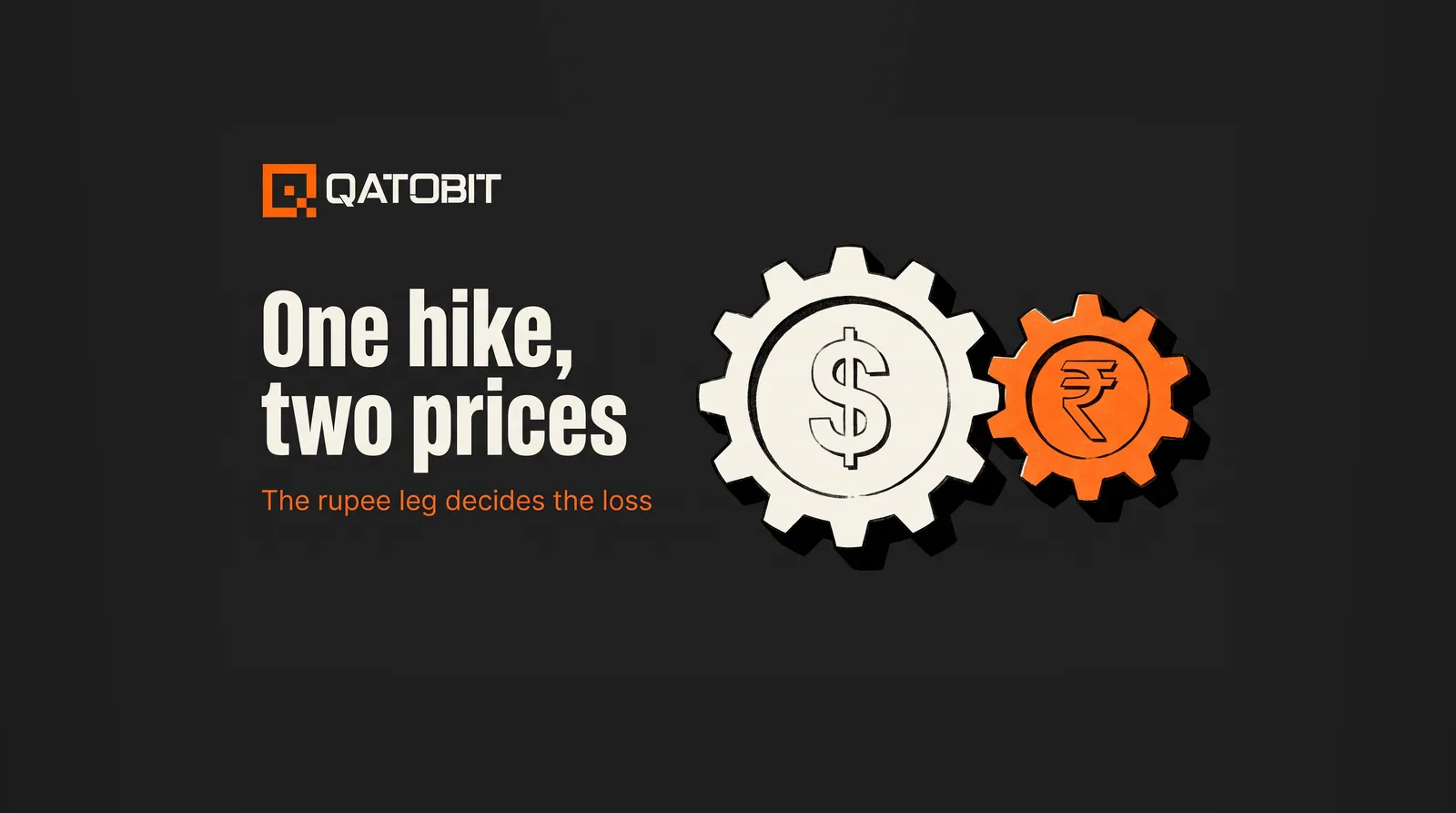
A dollar-priced holding has two prices stacked on each other: the dollar price and the exchange rate. A hike can move both, in either direction.
Stay with the ₹20 lakh dollar-priced sleeve. Suppose its dollar price falls 3 percent while the rupee weakens 1 percent. The factor is 0.97 × 1.01 = 0.9797, so the sleeve is worth ₹20,00,000 × 0.9797 = ₹19,59,400. That is a fall of ₹40,600, or about 0.41 percent of the ₹1 crore portfolio.
Now suppose the rupee strengthens 1 percent instead. The factor is 0.97 × 0.99 = 0.9603, so the sleeve is worth ₹19,20,600, a fall of ₹79,400 (about 0.79 percent of the portfolio). The dollar price did the same thing both times, and the rupee leg decided whether the loss shrank or grew.
Know how much of the portfolio sits on a dollar price, because that share is the part a Fed headline can touch. Our piece on what a weaker rupee does to your holdings walks the exchange-rate leg in more detail.
Does the RBI follow the Fed?
No. The Reserve Bank of India sets the repo rate through its own monetary policy committee, with its own mandate and its own calendar. A Fed hike does not change an Indian loan rate by itself. Our explainer on what a repo rate hike passes through to a portfolio covers the Indian side.
The two central banks can move the same way, opposite ways or on different dates. What links them for an investor is the exchange rate and the movement of money between markets.
What should a monthly investor do with a hike headline?
A hike headline is a prompt to read your allocation first. The odds had already moved from about 67 percent to 72.8 percent to 81 percent in a few sessions. A reader who acts on the headline acts after the price has absorbed it.
A fixed schedule does not need a fresh decision at every headline. A ₹25,000 monthly SIP buys a set rupee amount whatever the price. At an illustrative price of ₹100 a unit it buys 250 units. If the price falls to ₹90 the same instalment buys 25,000 ÷ 90 = 277.78 units, and if it rises to ₹125 it buys 200 units.
A Bitcoin SIP, an Ethereum SIP or a Solana SIP on Qatobit runs weekly, biweekly or monthly, on a cadence you set. A QSI Crypto Index is rebalanced monthly on its published methodology, so the weights reset on a schedule and not on the day of a jobs report. Bitcoin is priced in dollars worldwide, which makes it a position that sits on both of the doors above. Our piece on how the FOMC reaches bitcoin follows that route.
Before any jobs report, check three things:
- The share of the portfolio priced in dollars, in rupees and as a percentage.
- The dates of every scheduled instalment.
- The size of one position you would not want to see fall 10 percent, using portfolio rebalancing when one holding falls 10 percent as the worked case.
Where this leaves you
A Fed rate hike changes three prices an Indian holder meets. These are the rupee cost of a dollar, the yield every risk asset is measured against, and the appetite for holding things that can fall. The ₹1 crore example showed the same 3 percent dollar fall costing 0.41 percent of the portfolio with a weaker rupee and 0.79 percent with a stronger one.
Know your dollar-priced share before the headline arrives. That share decides how much of the day reaches you.
Frequently asked questions
How does a Fed rate hike affect India?
It reaches India mainly through the exchange rate and the movement of money between markets. The Fed says changes in the attractiveness of US assets move exchange rates and the dollar value of assets held in other currencies. It does not set India's repo rate.
What did the dollar do after the US jobs report?
The dollar index was up 0.77 percent at 102.26 on 6 November 2026, according to Reuters via The Economic Times. It was on track for its biggest daily percentage gain since 17 June. The 10-year US Treasury yield rose to 4.85 percent.
What are the odds of a December Fed hike?
As of 6 November 2026, CME's FedWatch tool put the odds of a hike in December at 81 percent, up from 72.8 percent before the jobs report. An odds figure is a market reading on a given day, not a promise of what the Fed will do.
Does a stronger dollar always make an Indian portfolio fall?
No. A stronger dollar raises the rupee cost of dollar-priced assets, which helps the rupee value of those holdings if their dollar price is steady. If the dollar price falls at the same time, the rupee move can shrink or enlarge the loss, as the ₹20 lakh example showed.
Should I change my investments on a rate hike headline?
A headline is a prompt to check your allocation and your instalment dates. A fixed SIP schedule is built so that it does not need a new decision at each headline, and a rebalancing rule resets weights on a set date.
Crypto investments are subject to market risk. Not financial advice.
“A better allocation begins with a better explanation.”
Qatobit principle
Published construction. Fixed cadence. Versioned control.