The point
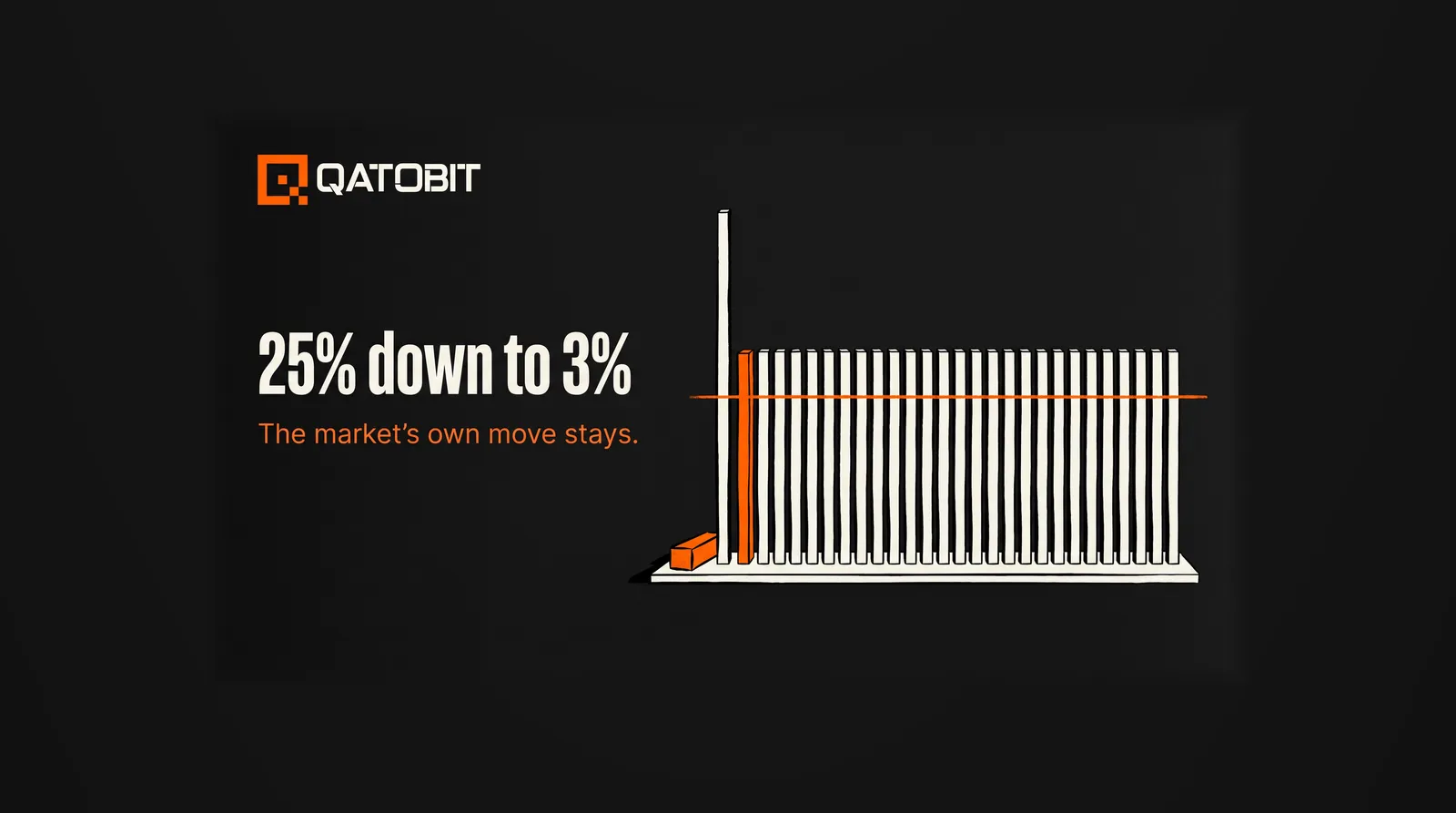
Cut one holding from 25 percent of a ₹1 crore portfolio to 3 percent. A 40 percent fall in that company then costs ₹1.2 lakh instead of ₹10 lakh. The same step does nothing on a day the whole market falls. Diversification removes the risk that belongs to a single holding and leaves the risk that belongs to the market.
What does diversification remove?
Diversification is spreading money across holdings that do not move in step, so that one holding's bad outcome becomes a small part of the whole. Wikipedia puts the mechanism this way. If asset prices do not change in perfect synchrony, a diversified portfolio has less variance than the weighted average of its parts.
Source: Wikipedia, Diversification (finance)), read 2026-10-05.
In plain terms, the ups and downs of different holdings partly cancel, so the total moves less than the parts. Three effects follow, and each one has a limit.
One name stops deciding the outcome
Take a ₹1 crore portfolio. If one company is 25 percent of it, that is ₹25,00,000 in a single name. A 40 percent fall in that company is a ₹10,00,000 loss, which is 10 percent of the whole portfolio (₹25,00,000 × 40% = ₹10,00,000).
Cut the same company to 3 percent and the position is ₹3,00,000. The same 40 percent fall costs ₹1,20,000, or 1.2 percent of the portfolio (₹3,00,000 × 40% = ₹1,20,000). The 40 percent is an illustration, not a forecast. The point is the ratio: the loss shrinks by the same factor as the position, from ₹10,00,000 to ₹1,20,000.
The range of outcomes narrows
Wikipedia states the trade plainly. A diversified portfolio's return can never exceed the best holding's and will always sit above the worst holding's. You give up the chance of having owned only the winner, and you also avoid owning only the loser. The article calls this narrowing the role of diversification, and adds that it need not help or hurt expected returns by itself.
So diversification works on the width of the outcome, and by itself need not move its centre. Anyone selling it as a way to earn more is selling something else.
The effect runs out
There is no magic count. Wikipedia notes that 30 stocks is a quoted figure and that carefully chosen sets can work with as few as 10. A 1985 book it cites reported that most of the benefit arrives with the first 15 or 20 holdings. It also notes that having many baskets can raise costs.
Past a point, the fortieth name adds a line to the statement and almost no protection.
What can diversification not remove?
Three things stay in the portfolio after the spreading is done.
The first is the market's own move. India's Q1 FY27 GDP growth was 7.8 percent, released on 31 August 2026, and it beat the estimates cited at the time. The Nifty 50 still slipped below 24,000 for the first time in weeks. It closed at 24,080.40 on 31 August and 23,914.45 on 2 September (source: Multibagg AI, 17 September 2026, read 2026-10-05). Good economic news did not hold the index up. A portfolio spread across fifty large companies owns that move in full.
Put numbers on a hypothetical. If the Nifty 50 fell 6 percent in a month, ₹1 crore held in index proportion would become ₹94,00,000 (₹1,00,00,000 × 6% = ₹6,00,000 lost). Adding a fifty-first company would not change that figure, because the fall comes from the market and not from any company in it.
The second is concentration hidden inside a long list. As of August 2026, the NIFTY 50 gives 36.47 percent to financial services and 9.52 percent to oil and gas. Information technology carries 8.48 percent, automotive 7.06 percent and fast moving consumer goods 5.41 percent (source: Wikipedia, NIFTY 50, read 2026-10-05). The index has 50 companies across 13 sectors, and five sectors carry 66.94 percent of it (36.47 + 9.52 + 8.48 + 7.06 + 5.41).
On ₹1 crore in index proportion, that is ₹36,47,000 behind one sector. A 10 percent fall in financial services alone would cost ₹3,64,700 (₹36,47,000 × 10%), before any other sector moves, on a list of fifty names.
The third is holdings that move together. Everything above rests on holdings not moving in step. When they do move in step, the cancelling stops and the portfolio behaves like one position. Owning ten stocks in the same sector, or ten coins that rise and fall on the same news, is a count of ten and an exposure of one.
Does the same logic hold inside a crypto sleeve?
It holds, with the same limits. Spreading a sleeve across several crypto assets removes the risk of any one coin. It does not remove the risk of crypto as an asset class, because the assets in it tend to be driven by the same forces.
That is a construction question, and Qatobit's indexes answer it in how they are built. QSI Core holds Bitcoin, Ethereum, Gold and a stable reserve. QSI Growth holds Bitcoin, Ethereum, Solana, Gold and a stable reserve. Both are rebalanced monthly. Holding Gold and a stable reserve alongside the crypto assets widens what the basket is exposed to. It guarantees no outcome, and a crypto index still carries market risk.
Three of Qatobit's four indexes hold crypto. The fourth, QSI GEQ8, holds eight global companies, which is a different exposure again.
What should a holder check?
My view: count exposures, not names. A portfolio is diversified to the degree that its largest single risk is a small share of it, and the number of tickers is a poor stand-in for that.
Four checks take ten minutes with a statement open.
- The largest single holding as a share of the portfolio. In the example above, 25 percent and 3 percent behave very differently.
- The largest sector or theme as a share of the portfolio. In the NIFTY 50, it is 36.47 percent.
- How many holdings would fall together on the same piece of news. If the honest answer is most of them, the list is shorter than it looks.
- What the portfolio would look like after a 6 percent market fall and a 40 percent fall in the largest holding, both at once. Diversification only reduces the second figure.
The checks do not say what to own. They show which risk you carry on purpose and which one you carry by accident.
Where this fits in the wider allocation
Diversification works inside an allocation that has already decided how much goes where. What asset allocation is and what it decides before any pick covers that first decision. What a portfolio is and the job each holding is hired for covers the job each holding has once it is in. What an investment objective is and how it decides an allocation covers the question that comes before both.
Diversification answers one question: how much of the portfolio depends on any single thing going right. The next question is how much of it depends on the market going right, and no spreading answers that one.
Frequently asked questions
What does portfolio diversification actually reduce?
It reduces the risk tied to any single holding. A 40 percent fall in a company that is 3 percent of a ₹1 crore portfolio costs ₹1,20,000, against ₹10,00,000 at 25 percent. It does not reduce the risk of the whole market falling.
How many stocks make a portfolio diversified?
There is no fixed number. Wikipedia notes 30 is a quoted figure, as few as 10 can work if carefully chosen, and most of the benefit arrives with the first 15 or 20 holdings. Sector spread matters as much as the count.
Can a diversified portfolio still lose money?
Yes. Diversification narrows the range of outcomes and does not remove the market's own move. A 6 percent market fall turns ₹1 crore held in index proportion into ₹94,00,000, however many companies are in it.
Is holding all 50 Nifty companies the same as being diversified?
Not fully. As of August 2026, financial services carry 36.47 percent of the NIFTY 50, so ₹1 crore in index proportion has ₹36,47,000 behind one sector.
Does diversification apply to crypto?
The logic applies, with limits. Spreading across several crypto assets removes single-coin risk and leaves the risk of crypto as an asset class. QSI Core and QSI Growth also hold Gold and a stable reserve, and both are rebalanced monthly.
Crypto investments are subject to market risk. Not financial advice.
“A better allocation begins with a better explanation.”
Qatobit principle
Published construction. Fixed cadence. Versioned control.