The point
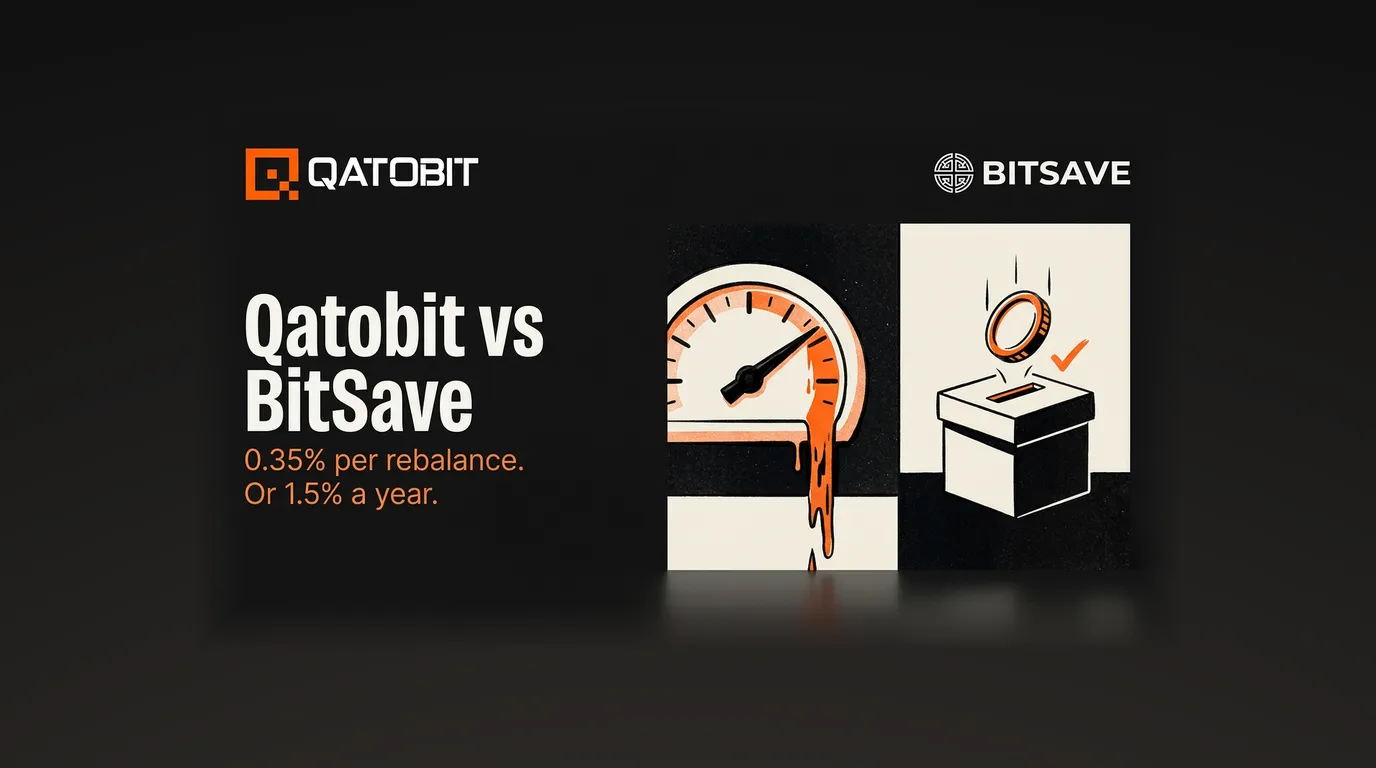
Qatobit's QSI indices and BitSave's Crypto Index Product both let an Indian investor hold a basket of large-cap crypto assets instead of picking coins. BitSave charges 1.5 percent a year on the value held, taken daily. Qatobit charges 0.35 percent only when a rebalance happens, with no annual fee. Qatobit suits an investor who wants four permanent allocation options and the lowest possible standing cost. BitSave suits an investor who wants one Bloomberg-tracked product and a named person to call on WhatsApp.
Last verified: 8 September 2026
What each product is
BitSave describes its Crypto Index Product as one that replicates the Bloomberg Galaxy Crypto Index, a portfolio of leading crypto assets held in Bloomberg's own proportions. The plan rebalances monthly. Its own page states the NAV is "published once a day, just like an Index fund."
Source: BitSave Crypto Index Product, read 8 September 2026.
Qatobit is a crypto index investing platform in India: investors hold a curated basket of digital assets, rebalanced on a published methodology, rather than picking coins. Four QSI indices are on sale today: QSI Core, QSI Growth, QSI VRION and QSI GEQ8.
BitSave at a glance against Qatobit
- Minimum first-time investment: BitSave's homepage pricing card shows a $50 USD one-time minimum. Qatobit's minimum is ₹2,000 per index.
- Minimum SIP: BitSave's SIP starts at $10 USD a month. Qatobit's SIP into an index starts at ₹2,000 per cadence.
- Annual fee: BitSave charges 1.5 percent a year, taken daily on NAV. Qatobit charges no annual fee, on any index.
- Fee per rebalance or transaction: BitSave's 1.5 percent already covers its monthly rebalancing inside that same NAV charge. Qatobit charges 0.35 percent of the transaction amount, only when a rebalance, buy or sell happens.
- Exit or redemption fee: BitSave charges 1 percent if you redeem inside 30 days of purchase, none after. Qatobit charges no exit fee, at any holding period.
- What's inside, published: BitSave's Crypto Index Product tracks the Bloomberg Galaxy Crypto Index, up to 15 large-cap assets from the top 25 by market cap. Qatobit names every holding in all four indices on its own product pages.
- Weighting rule: BitSave's weights are set by Bloomberg's own methodology. Qatobit's weights are documented per index, with hard caps on QSI GEQ8 (no holding above 15 percent or below 3 percent).
- Rebalance cadence: both monthly.
- SIP: BitSave's SIP runs weekly or monthly from $10 USD. Qatobit's SIP into an index runs weekly, biweekly or monthly, from ₹2,000 per cadence.
- INR rails: BitSave's trust page states its payments run in rupees through an India-registered entity. Qatobit deposits and withdraws by bank transfer (NEFT, RTGS, IMPS), ₹200 minimum either way, no fee.
- Custody, as each states it: BitSave says investment units are held by "a regulated, institutional custodian" in "institutional cold storage." Qatobit states institutional custody. Neither page names its custody partner.
- Proof of reserves, as published: BitSave publishes what it calls "proof of reserves and liabilities," described as on-chain and verifiable 24/7. Qatobit's proof of reserves is live, available at any time.
Source: BitSave Crypto Index Product, BitSave homepage, BitSave Trust & Security, all read 8 September 2026; Qatobit figures from Brand/PRODUCT_KNOWLEDGE.md.
How much does a year of holding actually cost?
BitSave's fee is an expense ratio: a slice taken from the value you hold, every day, whether you touch your investment or not. Qatobit's fee is a transaction charge: it applies only to the rupee amount you buy, sell or rebalance, and nothing is taken on the days in between.
Put ₹2,000 a month into each for a year. Ignore any price movement, so the comparison stays fees only, never performance. Under BitSave's schedule, the 1.5 percent a year applies to the value sitting in the account. That account balance grows every month as more SIP instalments land, so the rupee amount taken rises right along with it. Under Qatobit's schedule, 0.35 percent applies once, to that month's ₹2,000 instalment, at the moment it rebalances. That is ₹7 on a ₹2,000 rebalance, twelve times over: ₹84 for the year on the SIP instalments alone. BitSave's daily NAV charge has no single flat figure to match against that, because it scales with a balance that keeps changing. The honest comparison is structural: one fee is taken from everything you hold, every day; the other is taken only from what moves.
What does each one actually hold?
BitSave's Crypto Index Product holds up to 15 large-cap crypto assets, chosen by Bloomberg's own methodology from the top 25 by market cap. No single asset can sit above 35 percent or below 1 percent of the basket. Bloomberg's index team picks the constituents. BitSave does not choose them itself.
Qatobit runs four indices instead of one blended basket, each built and rebalanced by Qatobit itself. Bitcoin, Ethereum, Gold and a stable reserve make up QSI Core. Adding Solana to that same base gives QSI Growth its five assets. Three assets and no hedge layer, Bitcoin, Ethereum and Solana, define QSI VRION. Eight global companies across three sleeves, Apple, Amazon, Alphabet, Meta Platforms, NVIDIA, Coinbase, Robinhood Markets and Tesla, none above 15 percent or below 3 percent, make up QSI GEQ8. An investor picks the allocation that matches their own risk appetite, rather than holding one blended product.
Where BitSave is genuinely stronger
BitSave's index tracks a benchmark administered outside the company itself. Its own page states: "Bloomberg's index experts decide what's in the index and at what weight," by a published methodology. An independently administered benchmark is a real form of oversight. A self-built methodology cannot carry the same outside check. Source: BitSave Crypto Index Product, read 8 September 2026.
BitSave states an insurance claim on its own cold-storage holdings: "Lloyd's of London cover." Its trust page also names several third-party firms behind its custody, liquidity and compliance infrastructure. We are not repeating those names here, because one of them is also a Qatobit partner, and this page names no Qatobit partner either. Source: BitSave Trust & Security, read 8 September 2026.
BitSave assigns "a real person to guide you, assigned on WhatsApp," a named relationship manager for every investor. Qatobit's equivalent is Qai, an in-app AI companion. Source: BitSave homepage, read 8 September 2026.
BitSave states its holdings passed "26 of 26 cybersecurity domains assessed and compliant," an audit it describes as "FIU-IND mandated" and conducted by Grant Thornton Bharat LLP under CERT-In requirements. That is BitSave's own statement about its own audit, quoted here as published. It says nothing about Qatobit's own status. Source: BitSave Trust & Security, read 8 September 2026.
Where Qatobit is stronger
Qatobit charges nothing to hold an index for a day, a year or five years. There is no annual management fee on any QSI index, no exit fee and no lock-in at any holding period, on any index. The only charge is 0.35 percent when a rebalance, buy or sell happens.
Qatobit offers four permanent allocation products, from QSI Core's Gold-buffered conservative construction to QSI VRION's full-conviction three-asset build, rather than one blended basket. Every holding in every index is named on Qatobit's own product pages. The weighting rule for each index is documented and published before launch.
Qatobit's INR rails carry no fee in either direction: ₹200 minimum to deposit or withdraw, by bank transfer, nothing taken.
The QSI indices, in full
Qatobit runs four QSI Crypto Indices. Bitcoin, Ethereum, Gold and a stable reserve (USDT Earn) make up QSI Core. Solana joins that same base to build QSI Growth's five assets. QSI VRION strips the hedge away entirely: Bitcoin, Ethereum and Solana, nothing else. QSI GEQ8 holds eight global companies across three sleeves: Apple, Amazon, Alphabet, Meta Platforms and NVIDIA for platform, Coinbase and Robinhood Markets for digital finance, Tesla for innovation. No holding sits above 15 percent or below 3 percent, and the composition gets a quarterly review.
All four rebalance monthly, on a methodology documented and published before launch. The minimum per index is ₹2,000, matched by a Crypto SIP into an index from ₹2,000 per cadence. The only charge on any index is 0.35 percent of the transaction amount, applied when a rebalance, buy or sell happens. There is no annual management fee, no exit load and no minimum holding period, on any index. Deposits and withdrawals run through bank transfer (NEFT, RTGS, IMPS), with a ₹200 minimum either way and no fee.
A closer look at what a crypto index actually is covers the mechanics behind all four.
Who should choose which
An investor who wants a single product tracking a widely recognised external benchmark has a real reason to choose BitSave's Crypto Index Product. The same goes for someone who wants a named person to message on WhatsApp and is comfortable with a fee taken daily on the balance.
An investor who wants to choose between four distinct allocations has a real reason to choose a Qatobit QSI index instead. So does someone who wants every holding published by the platform itself, and a fee only when something actually happens to their money.
Neither product suits someone who wants to pick individual coins or buy and sell often. Both are built for holding.
How this page was checked
Every BitSave figure here was read from BitSave's own live pages on 8 September 2026: bitsave.club/products/crypto-index, bitsave.club/trust and the BitSave homepage. A figure that did not appear on the day of writing was not carried over from any other source. This page is rechecked against BitSave's own pages roughly once a month, and the "Last verified" line above changes in place at every recheck.
Qatobit's own figures come from how a crypto index rebalances during a market crash and the four QSI indices' shared methodology. Whether rebalancing itself triggers tax under current Indian rules is worth reading too, before choosing either product.
Frequently asked questions
What is BitSave's Crypto Index Product?
It is a managed crypto investment offering that tracks the Bloomberg Galaxy Crypto Index, up to 15 large-cap crypto assets from the top 25 by market cap. It rebalances monthly, publishes NAV once a day and carries no lock-in.
What is a Qatobit QSI index?
A permanent allocation product built and rebalanced by Qatobit on a documented, published methodology. Four are on sale: QSI Core, QSI Growth, QSI VRION and QSI GEQ8, each with a different mix of assets.
Does BitSave's 1.5 percent annual fee cost more than Qatobit's 0.35 percent rebalance fee?
BitSave's 1.5 percent a year is charged daily on the full balance held, whether anything happens or not. Qatobit's 0.35 percent applies only to the rupee amount of a buy, sell or rebalance, with no annual charge in between.
Can I exit either product without a fee?
BitSave charges 1 percent if you redeem within 30 days of purchase, and nothing after. Qatobit charges no exit fee and holds no lock-in, on any index, at any holding period.
Is a crypto index the same as a crypto mutual fund?
People search for products like these as a "crypto mutual fund," but neither BitSave's Crypto Index Product nor a Qatobit QSI index is a mutual fund. BitSave calls its offering a managed crypto investment product; Qatobit calls its products baskets or indexes. Both hold a basket of assets on a published methodology, which is the part of a mutual fund the name is really reaching for.
Crypto investments are subject to market risk. Not financial advice.
“A better allocation begins with a better explanation.”
Qatobit principle
Published construction. Fixed cadence. Versioned control.