The point
USD/INR, the number of rupees one US dollar buys, read 94.82 as of 9 September 2026, up 0.34 percent on the previous close of 94.50 (ET Markets). The rupee logged its sharpest one-day fall in over a month on 8 September, as Brent crude pushed toward 100 dollars a barrel on the Iran war (Reuters). A weaker rupee does not only change what a dollar costs. It changes what every dollar-priced asset an investor holds, Bitcoin included, is worth in rupees, for a reason that has nothing to do with the asset itself.
Why the rupee is falling
Three forces pushed USD/INR to 94.82 by 9 September 2026, and none of them are about India's crypto market.
Brent crude climbed toward 100 dollars a barrel for a third straight session. The Iran war and attacks on Saudi energy facilities raised fears of a supply disruption (Reuters, 8 September 2026). India imports most of its crude. Oil companies buy more dollars to pay for the same barrels, and that dollar demand presses on the rupee directly.
Foreign investors sold Indian assets on the same day. Selling converts rupee proceeds back into dollars to leave the market, adding to that dollar demand.
The dollar itself was broadly firm. The Thai baht and the South African rand each eased about 0.4 percent in the same session, a sign the pressure was not specific to India (Reuters, 8 September 2026).
Traders said dollar sales from state-run banks, most likely on behalf of the Reserve Bank of India, cushioned the rupee's fall. The sales were not aimed at defending a specific level. The rupee had touched a more than two-month high the previous week on the same kind of intervention. Renewed oil pressure and importer hedging demand pushed it back from there (Reuters, 8 September 2026).
What a weaker rupee does to a fixed rupee amount
Take a fixed Rs 2,000 amount, the size of a Qatobit Crypto SIP into an index. At today's rate of 94.82, that buys about 21.09 US dollars' worth of a dollar-priced asset. At the previous close of 94.50, the same Rs 2,000 bought about 21.16 dollars' worth, about 7 cents more.
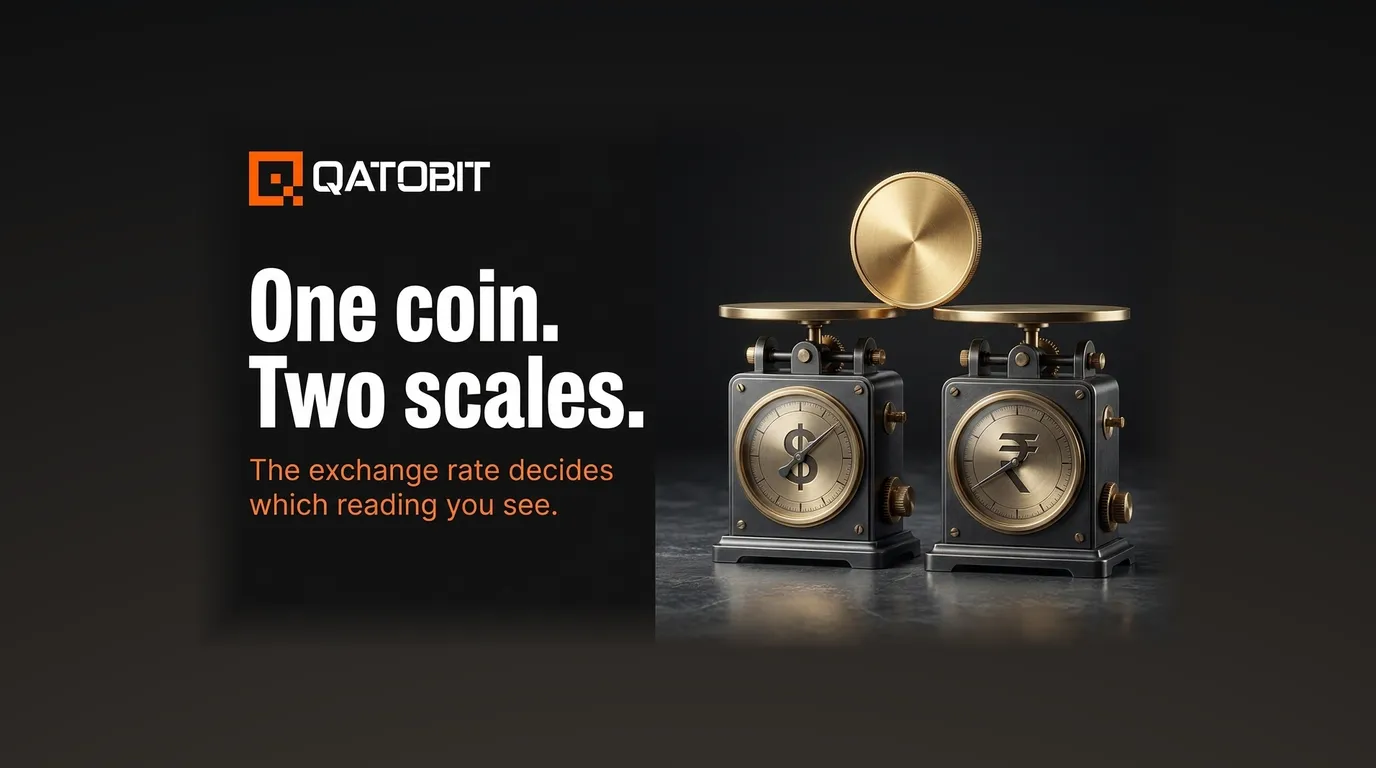
Nothing about the asset changed between those two rates. The rupee did. A weaker rupee means the same fixed amount buys a little less dollar-denominated exposure. A stronger rupee means it buys a little more. The rate on the day the money moves is what decides that.
The same check works on any rupee amount. Divide it by today's USD/INR rate, then divide it by the previous close. The difference between the two answers is what that one day's currency move was worth in dollar terms, before the asset itself even enters the calculation.
Why Bitcoin's rupee price and its dollar price disagree
Bitcoin read 78,878 US dollars as of 9 September 2026, 07:35 IST, down 0.63 percent over the previous 24 hours. Over that same 24 hours it read Rs 74,79,865 in rupees, down only 0.28 percent, less than half the dollar fall (CoinGecko, accessed 9 September 2026). Ethereum showed the same gap running the other way: down 0.15 percent in dollars over the same window, but up 0.20 percent in rupees (CoinGecko, accessed 9 September 2026).
The mechanism is arithmetic, built from two numbers moving at once. The rupee price of any dollar-priced asset is the dollar price multiplied by the USD/INR rate. If the rupee weakens against the dollar in the same window, part of a dollar-denominated fall is offset in rupee terms. A small enough dollar-denominated fall can even turn into a rupee gain, which is what happened to Ethereum on this reading. A reader who checks only the rupee number sees one chart. The dollar price and the exchange rate are both moving inside it.
What a monthly rule does with all of this
None of this changes what a Crypto SIP does. Qatobit's Crypto SIP is a recurring, automated investment. The investor picks an asset or a Crypto Index, sets an amount, chooses a cadence of weekly, biweekly or monthly, and links a bank account. The platform then invests on schedule. A Crypto SIP into a Crypto Index starts at Rs 2,000 per cadence.
The schedule fires because a date arrived, not because the rupee or the dollar looked more favourable that day. It does not remove the arithmetic above: a fixed rupee amount still buys a little more or a little less dollar-denominated exposure depending on the rate on the day. What it removes is the decision of which chart to check first. The amount and the date were both fixed in advance.
The rupee's fall on 8 and 9 September 2026 traced to crude oil, foreign outflows and a broadly firm dollar. What it does to a crypto holding is pure arithmetic. The rupee price is the dollar price times the exchange rate. A reader who watches only one of those two numbers is reading half the chart. What a Crypto Index actually holds, and how it is built, is covered in what a crypto index is and how it works. The SIP cadence itself is covered in how a Crypto SIP works. The difference between averaging a fixed rupee amount in over time and investing it all at once is the difference between rupee cost averaging and lump-sum investing.
Frequently asked questions
Why is the rupee falling against the dollar?
Crude oil, foreign investor selling and a broadly firm dollar all pressed on the rupee in early September 2026. Brent crude neared 100 dollars a barrel on the Iran war, raising the dollars Indian oil importers need to buy. Foreign investors also sold Indian assets, converting the proceeds into dollars, while other emerging-market currencies eased on the same broad dollar strength (Reuters, 8 September 2026).
Does a weaker rupee make Bitcoin worth more in rupees?
Only if Bitcoin's dollar price stays flat or rises at the same time. The rupee price of Bitcoin is its dollar price multiplied by the USD/INR rate, so a weaker rupee cushions a dollar-denominated fall and adds to a dollar-denominated rise. It never changes Bitcoin's own dollar price.
Why do Bitcoin's dollar price and rupee price move by different amounts?
Because two numbers move at once: Bitcoin's own dollar price, and the USD/INR rate. As of 9 September 2026, Bitcoin read down 0.63 percent in dollars over 24 hours. Over that same window it read down only 0.28 percent in rupees, because the rupee itself weakened in that period (CoinGecko).
Does a Crypto SIP protect against rupee depreciation?
No. A Crypto SIP fixes the rupee amount and the investing date in advance. It does not fix the exchange rate and does not remove market risk. The same fixed amount buys whatever that day's rate allows, rather than the investor deciding day to day which currency's chart looks better.
Where can I check today's USD/INR rate?
Live market data pages such as ET Markets publish the USD/INR rate throughout market hours, alongside the previous close and the day's range. The rate moves continuously during market hours, so the number that matters for any calculation is the one read at the time the money actually moves.
Crypto investments are subject to market risk. Not financial advice.
“A better allocation begins with a better explanation.”
Qatobit principle
Published construction. Fixed cadence. Versioned control.