The point
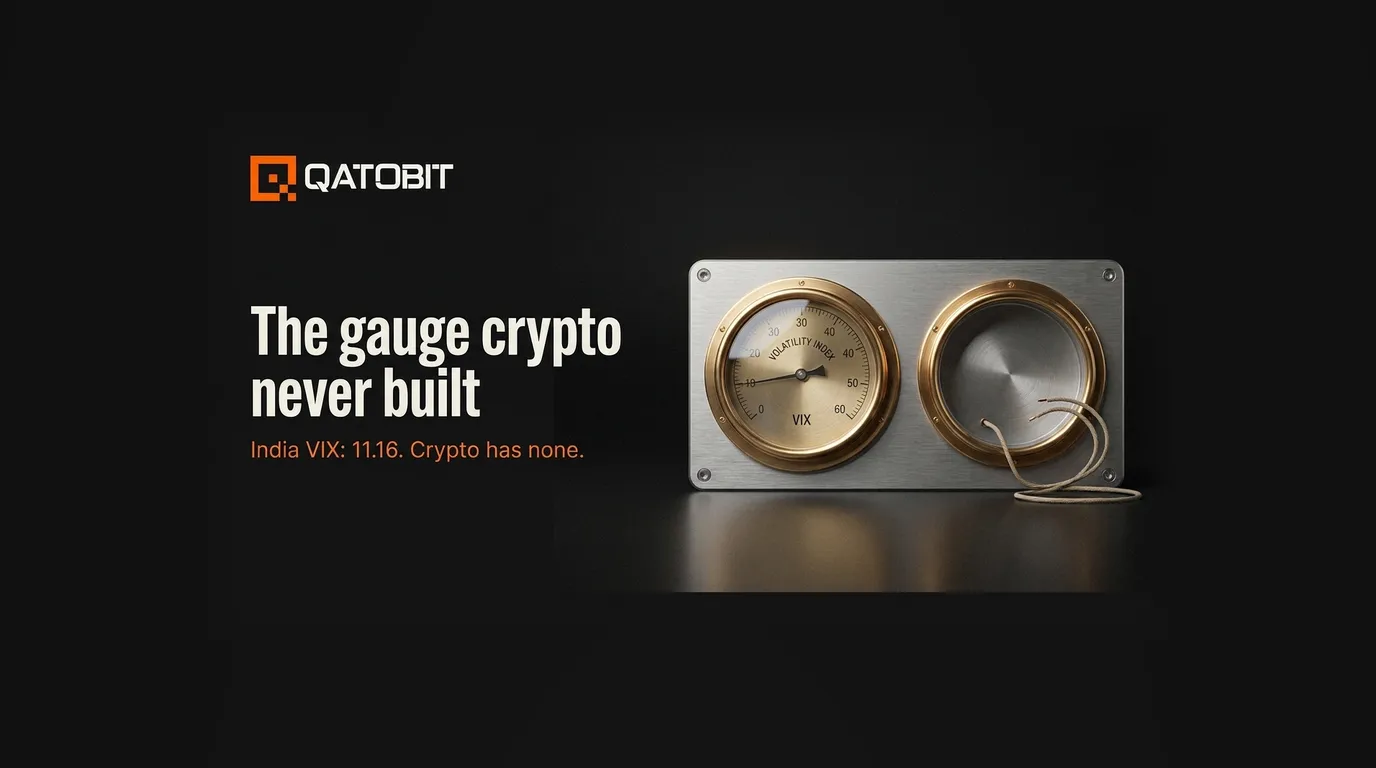
India VIX closed at 11.16 on 7 September 2026. That was up 4.49 percent from the previous close of 10.68. The Nifty fell 0.5 percent that day, and the Sensex fell about 380 points. India VIX is NSE's estimate of how far the Nifty could move over the next 30 days, built from Nifty option prices. Crypto has no single index that does the same job. The reason is structural, built into how the market works.
What India VIX measures
India VIX is NSE's volatility index. NSE calculates it from the best bid and ask prices on Nifty options. The figure is built from implied volatility: the market's own estimate of future price swings, priced into options today. NSE describes it as a measure of the market's expectation of movement over the near term. The methodology is adapted from the Chicago Board Options Exchange for the Nifty options order book (NSE, accessed 2026-09-07). The output is one annualised percentage figure. A reading of 11.16 means the options market is pricing in about 11.16 percent of annualised volatility over the next 30 calendar days. NSE runs the same formula continuously off the live order book. It publishes the result as an index, the same way it publishes the Nifty itself.
How to read the number as a range
An annualised figure has to be converted to mean anything over 30 days. Divide 11.16 by the square root of 12, since a year holds twelve 30-day stretches. The answer is close to 3.2 percent. That is the one standard deviation range. Statistically, the options market is pricing roughly a two in three chance. That chance is that the Nifty stays within about 3.2 percent of its current level over the next 30 days. The reading says nothing about direction. It only measures how wide a range the market is pricing. One dashboard tracking the index day to day marks a reading under 15 as stable. It marks 15 to 20 as volatile, and anything above 20 as fear (Data Vizzes, accessed 2026-09-07). On that scale, 11.16 sits inside the stable band even after the day's jump.
Why India VIX rose on 7 September 2026
On 7 September 2026, the Nifty closed at 23,779.15, down 0.5 percent. The Sensex closed at 76,132.81, down about 380 points. Brent crude climbed close to 97 dollars a barrel on US-Iran tensions. Stronger US jobs data also raised the odds of a Federal Reserve rate move (Equentis, accessed 2026-09-07). The Nifty IT index led the fall, down around 2.3 percent. Infosys, TCS, Wipro and HCLTech all closed lower on renewed worry about US technology spending. India VIX closed that day at 11.16, a rise of 4.49 percent from the previous close of 10.68 (Business Today, accessed 2026-09-07). The move reflects the options market pricing in a wider range of outcomes. The reason was dated and specific: crude, a US rate call and a weak IT sector, all on the same session.
Why crypto has no equivalent number
India VIX exists because Nifty options trade on one exchange, in one order book, with a fixed close every trading day. NSE reads the best bid and ask on those options and runs one formula off them. Crypto has no version of that single order book. Bitcoin trades continuously, on dozens of venues, with no shared close. No single options market exists that every price answers to.
That has not stopped anyone from trying. An offshore derivatives exchange called Deribit publishes DVOL, an index built from the implied volatility of its own Bitcoin and Ether options. It is expressed as an annualised 30-day figure, the same shape as India VIX (Deribit Insights, accessed 2026-09-07). Roughly nine in ten Bitcoin options traded anywhere in the world trade on that one platform, by Deribit's own account. That is exactly why DVOL can only describe options on Deribit, rather than the crypto market as a whole. The exchange itself avoids the phrase fear gauge. Bitcoin options can price a big move up as readily as a big move down. Deribit calls DVOL an action gauge instead (Deribit Insights, accessed 2026-09-07).
Crypto has one venue's volatility index for one asset, built the same way India VIX is built. No venue holds all the options the way NSE holds all of Nifty's. A number calculated from a single exchange's order book can only describe that exchange's order book. NSE can publish India VIX because Nifty options exist in exactly one regulated place. A single crypto-market VIX cannot exist, because crypto options never sit in one place to begin with.
What a monthly investor does with the number
For someone placing an equity order, India VIX matters directly: it prices how wide the near-term range might be. For someone investing crypto on a schedule, checking it changes nothing about what happens next. Crypto SIP, as Qatobit runs it, invests a set amount on a cadence the investor chooses: weekly, biweekly or monthly. A Crypto SIP into a Crypto Index starts at ₹2,000 per cadence. The schedule fires because a date on the calendar arrived. A volatility reading plays no role in that decision; the SIP was never built to wait on one. India VIX describes the Nifty options market on the day it is read. It has no bearing on what a Bitcoin, Ethereum or index unit does on the next SIP date. There is no single number linking the two markets in the first place.
The mechanics of what a Crypto Index actually holds and how it is built are covered in what a crypto index is and how it works. What happens to that same index during a sharp drawdown is covered in how a crypto index rebalances during a market crash. The gap between what an option prices in advance and what the market actually does afterward is the difference between implied and realized volatility. It is the same gap that separates a VIX reading from an actual outcome.
India VIX is a real number, built from a real, single order book. It says something true about what Nifty options expect over the next 30 days. Crypto has nothing built the same way, because the market it would need does not exist in one place. A monthly investor does not need that number before deciding whether to invest. The schedule was always the discipline. The gauge was never part of it.
Frequently asked questions
What does India VIX actually measure?
India VIX is NSE's estimate of how much the Nifty is expected to move over the next 30 calendar days. It is expressed as an annualised percentage, calculated from the best bid and ask prices on Nifty options. It says nothing about which direction the market will move.
Is a rising India VIX a signal to sell?
No. A rising India VIX means the options market is pricing a wider range of outcomes. It does not point to a specific direction. India VIX closed at 11.16 on 7 September 2026, up 4.49 percent, on a day the Nifty fell 0.5 percent. The rise reflects that wider pricing for one day. It says nothing about the fall that followed it.
Does crypto have anything like India VIX?
One venue does, for one asset. Deribit's DVOL index runs the same calculation on Bitcoin and Ether options traded on its own exchange. Deribit is one platform among many. DVOL describes that platform's order book rather than the crypto market as a whole.
Why did India VIX rise on 7 September 2026?
The Nifty closed down 0.5 percent and the Sensex fell about 380 points that day. Brent crude neared 97 dollars a barrel on US-Iran tensions, and stronger US jobs data raised expectations of a Federal Reserve rate move. India VIX rose from 10.68 to 11.16 as the options market priced in a wider range of outcomes.
Does India VIX affect a Crypto SIP?
No. A Crypto SIP invests on a schedule the investor sets: weekly, biweekly or monthly. That schedule is not tied to any volatility reading. India VIX describes the Nifty options market on the day it is read. A crypto asset or index moves on its own schedule, on the next SIP date.
Crypto investments are subject to market risk. Not financial advice.
“A better allocation begins with a better explanation.”
Qatobit principle
Published construction. Fixed cadence. Versioned control.