The point
Two SEBI releases, on 22 October 2026 and 23 November 2026, describe one pattern. It runs from a free group to planted praise, a fake app and a bank account that belongs to nobody registered. Each step looks harmless alone. SEBI's advice gives two checks, and a third completes them. All three run before any money moves.
What do the two SEBI releases actually describe?
They describe a sequence, and it helps to read it as one. In its release of 22 October 2026, SEBI cautioned against stock tips and trading calls in invitation-only WhatsApp groups. Business Today reports that these groups often run through overseas numbers and present their buy and sell calls as free investor education.
The release of 23 November 2026 covers the next stage. Moneylife reports that SEBI noticed WhatsApp groups impersonating registered intermediaries, to create an impression of legitimacy and persuade investors to open trading accounts. Those investors are then directed to register on unauthorised platforms and to transfer money to bank accounts held in the names of unregistered entities.
Put together, the first release is how the reader gets in, and the second is how the money gets out.
Sources, each read on 25 November 2026: Business Today on the release of 22 October 2026. Moneylife on the release of 23 November 2026.
How is a group built to look real?
The group does not ask for money at the start. It offers free recommendations, which is why a holder who is careful with money still stays to read. The trust is built before the ask, and it is built from four parts that SEBI names or describes.
The first is the invitation. Moneylife reports that the link arrives from an unknown source. Administrators may use numbers with international country codes such as +44 and +65, or Indian numbers beginning with +91.
The second is the audience. Business Today reports that SEBI calls the tactic astroturfing, which means fabricated support: some members work with the operators to post false profit claims and praise for the so-called experts. The reader sees what looks like other members winning, and it is staged.
The third is the pitch. Moneylife lists the phrases SEBI flagged: "recover your Indian portfolio loss from investments in foreign markets", "off-market negotiated block trades" and "institutional trades". Each one speaks to somebody who already holds a portfolio and has had a bad quarter.
The fourth is the borrowed credential. SEBI says fraudsters misuse screenshots of its website to show that an entity is registered, and use fake SEBI letterheads and stamps to certify bank accounts.
Why does the planted praise work on careful people?
Because it works through volume, and a single post has to convince nobody. Take a group of 400 members with 40 messages a day, and suppose five of them are planted profit posts. That is one message in eight, and a reader who opens the group twice a day sees ten of them.
These numbers are illustrative and not from SEBI. In a feed that busy, repetition stands in for evidence, so a holder who would never trust one stranger's screenshot starts to trust ten.
This is also why SEBI's advice on the praise is blunt. Business Today reports that the regulator tells investors not to be influenced by profit claims, praise or trade confirmations posted by other group members, because they could be planted.
What happens when a group gets shut down?
The operators move, and they bring the audience with them. SEBI warns that if a group is suspended, members may receive fresh invitation links to another closed group run by the same fraudsters. Business Today describes the usual message: a new number says the old group was banned because of platform restrictions, and invites everyone into a replacement that promises daily stock recommendations.
A takedown therefore costs the operators one phone number, because they keep the audience.
SEBI treats a "the group was banned, join the new one" message as a red flag, and tells investors to leave rather than follow.
What is the app, and why does it matter?
The app is where the story turns into money. Moneylife reports that fraudsters provide access to fake trading applications that display fictitious investment amounts and portfolio details, creating the impression that the money has been invested.
So the reader sends money to a bank account, opens an app, and sees the amount sitting there. That balance lives in an app only the operators control, so it proves nothing about what was bought.
Take ₹25,000 a month sent for 12 months. That is ₹3,00,000 in total, and each transfer on its own looks small. The check has to run before the first transfer, because the pattern is built to make the twelfth feel as safe as the second.
Which three checks can a holder run?
The advice in both releases fits three questions a holder can answer in a few minutes. SEBI points to tools for the first two.
The first is who is asking. SEBI advises investors to verify an intermediary's registration status on its official website before engaging with them. A screenshot of that website proves nothing, since SEBI says screenshots are misused, so the holder looks the entity up on the site directly. Apps get the same treatment. Moneylife reports that SEBI's investor support portal lists the authorised apps of registered intermediaries. A downloaded app should also carry the verified badge on the Google Play Store.
The second is where the money goes. SEBI warns against transfers to third-party bank accounts that do not belong to registered entities. It says bank account details and UPI IDs can be verified through its verification facility. Take a ₹5 lakh transfer to an account in the name of an entity that is not the intermediary the group says it is. The mismatch is the whole answer, and it takes one comparison of two names.
The third check is mine, not SEBI's, and it follows from the fake app: who holds the assets. A real intermediary has a place where your holdings sit under your name, and a way to see them that does not depend on the group's app. A fake one has only the app.
All three checks are free and need no expertise.
Does this apply outside the stock market?
The pattern does, because the group chat does not know which asset it is selling. The three checks cover the sender, the destination account and the holding. They apply to any investment offer that arrives through a closed group.
SEBI's releases are about securities and registered intermediaries, so the registration lookup applies to offers of shares and similar products. For anything else, the second and third checks carry the weight. Does the money go to an account in the name of the company you are dealing with, and can you see what is held?
At Qatobit, deposits and withdrawals in rupees run through the investor's own linked bank account, and rupees that come in leave as rupees to that account. Assets are held in institutional custody, and Proof of Reserves is published live and available at any time. Look for that shape of answer from any platform, ours included. It has a bank account in your name, a custody arrangement that is more than an app screen, and a record you can open without asking anyone.
Reading such a record is covered in how to read a proof of reserves attestation. What the arrangement means if a platform closes is in what happens to your basket if the platform shuts down.
What is worth remembering from both releases?
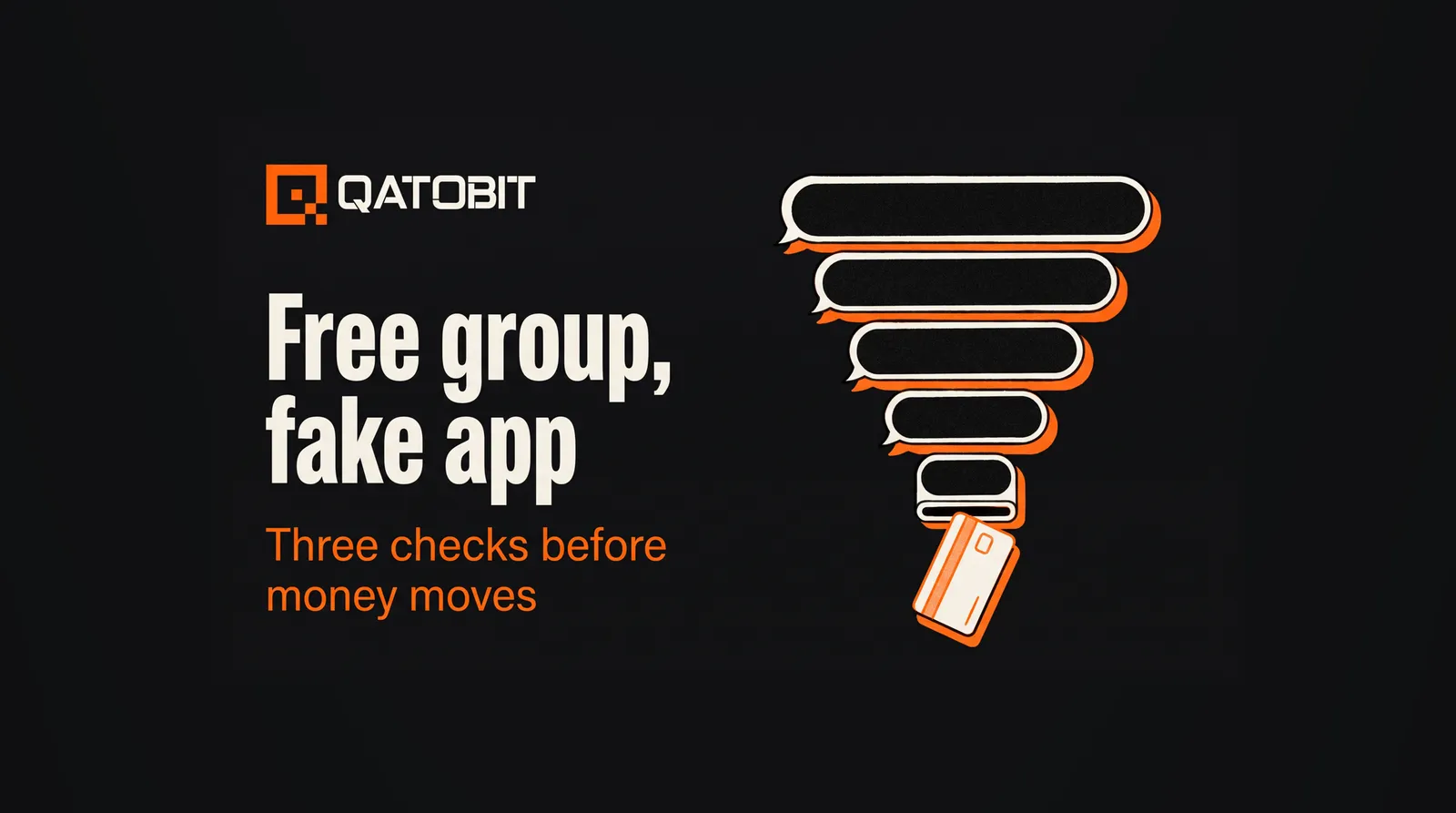
A scam group is a funnel, and every stage looks reasonable on its own. There is a free invitation, a crowd of satisfied members, a registered-looking name, a bank account and an app with a balance. SEBI's two releases name each stage. The three checks cut the funnel where testing costs nothing: the name, the destination account and the record of what is held.
The cheapest moment to run them is before the first transfer.
Frequently asked questions
What did SEBI warn about in its release of 23 November 2026?
SEBI warned about fraudsters impersonating registered intermediaries in closed WhatsApp and Telegram groups. Per Moneylife, they push investors to open accounts on unauthorised platforms and to transfer money to bank accounts held in the names of unregistered entities.
What is astroturfing in a WhatsApp stock group?
It is fabricated support. Per Business Today, SEBI describes members who work with the group's operators. They post false profit claims and praise the supposed experts, so the group looks full of real investor success.
How do I check whether a stock market intermediary is registered?
SEBI advises checking the intermediary's registration status on its official website directly, not through a screenshot. SEBI also says screenshots of its website are misused to show false registration, and that app details can be checked through its investor support portal.
Can I verify a bank account or UPI ID a group gives me?
Yes. Per Moneylife, SEBI says the authenticity of bank account details and UPI IDs provided by intermediaries can be verified through its verification facility. A transfer to a third-party account that does not belong to a registered entity is one of the red flags SEBI lists.
What should I do when a banned group sends a new invitation?
Treat it as a red flag and leave. SEBI warns that fraudsters may send fresh invitation links to a replacement group after a suspension. Business Today reports that the advice is to leave rather than follow the new invitation.
Crypto investments are subject to market risk. Not financial advice.
“A better allocation begins with a better explanation.”
Qatobit principle
Published construction. Fixed cadence. Versioned control.