The point
The Nifty IT index fell 3.24 percent on 9 September 2026, nearly four times the Nifty 50's 0.86 percent fall the same day (5paisa, 9 September 2026). A shared shock, higher US rates, a new US visa fee and one company's own bad news, hit every constituent at once. That is what a sector bet actually is: one exposure repeated across many names. A concentration cap changes what happens inside that exposure once a shock lands. It has no say over whether the shock arrives in the first place.
Why IT stocks fell harder than the market on 9 September 2026
The Nifty 50 closed at 23,431.50 on 9 September 2026, down 203.60 points or 0.86 percent, its lowest level in nearly 13 weeks. The Nifty IT index closed the same session down 3.24 percent, the sharpest fall among all 11 sectoral indices that day (5paisa, 9 September 2026).
Four things hit the sector together, as Business Today's market report from the same day laid them out. US markets had fallen overnight after a stronger than expected August jobs report. That report raised the odds of a US rate hike, from 47 percent to 58 percent on the CME FedWatch tool. Higher rates push large US corporations to cut discretionary technology spending, the software migrations and digital transformation projects that Indian IT firms bill for. The United States also suspended Cognizant's permanent labour certification filings that same week. That revived concerns about a wider crackdown on US work visas.
A new US rule added a third factor. The expanded 9-11 Response and Biometric Entry-Exit Fee took effect on 9 September 2026. It added a $4,000 charge on every H-1B extension and $4,500 on every L-1 extension. That is a recurring cost for firms staffed by Indian engineers on US visas (Business Today, 9 September 2026). Coforge supplied the fourth factor on its own: the stock fell 7 percent after chairman O.P. Bhatt resigned following an internal audit review disagreement.
Crude oil crossing $100 a barrel for the first time since July, amid escalating tension around the Strait of Hormuz, added to the broader market's fall that day. That factor spread across every sector alike (5paisa, 9 September 2026). What made IT the day's worst performer was the other three factors landing on the same narrow set of companies at once.
What Indian IT actually sells, and to whom
The United States is Indian software services' single largest customer. It accounted for roughly 53 percent of India's total software exports in the 2025 financial year (Business Today, 9 September 2026). That fact is the root the four factors above share. A rate hike that makes a US bank tighten its technology budget lands on that revenue line. So does a visa fee that raises the cost of the Indian engineers staffing that bank's project. Both trace back to the same client relationship.
Why a sector index moves as one thing
An index exists as three parts: the constituent list, the weighting rule, and the correlation between those constituents. The weighting rule says how much of the index each constituent is. Correlation decides whether a shock to one name stays contained or spreads to the rest.
Weighting decides how loud one company's move is inside the total. A market-cap-weighted sector index gives its largest constituents the biggest share of the move. A single large name falling hard can drag the whole index down even if smaller constituents barely move. Nifty IT's fall on 9 September 2026 came from Infosys, Tech Mahindra, HCL Technologies, Mphasis and Persistent Systems falling together on the same day. Several large names moved in the same direction at once (5paisa, 9 September 2026).
Correlation is the part a weighting rule cannot fix. It comes from what the companies actually do, rather than from how the index is built. Correlation between assets describes how closely two things move together, and a sector index is built from companies chosen precisely because they sell into the same market. Nearly every major Indian IT firm bills the same US corporate clients. Nearly all of them staff projects with the same category of visa-holding engineers, and report revenue in the same interest-rate environment. When something changes for that shared client base, a US rate view or a US visa rule, it does not wait for each company's individual reaction. It changes an input every one of them prices in, on the same day, in the same direction.
What this looks like next to a broad index
The Nifty 50 fell 0.86 percent the same day the Nifty IT index fell 3.24 percent. The Nifty 50 holds companies across banking, energy, consumer goods and autos, most of which carry little exposure to a US rate call or an H-1B fee. A shock to one client base moves one sector hard and leaves the rest of a broad index roughly where it started. That gap in how far each index moved is the correlation between IT's constituents, made visible on a single session.
What a concentration cap does, and where its job ends
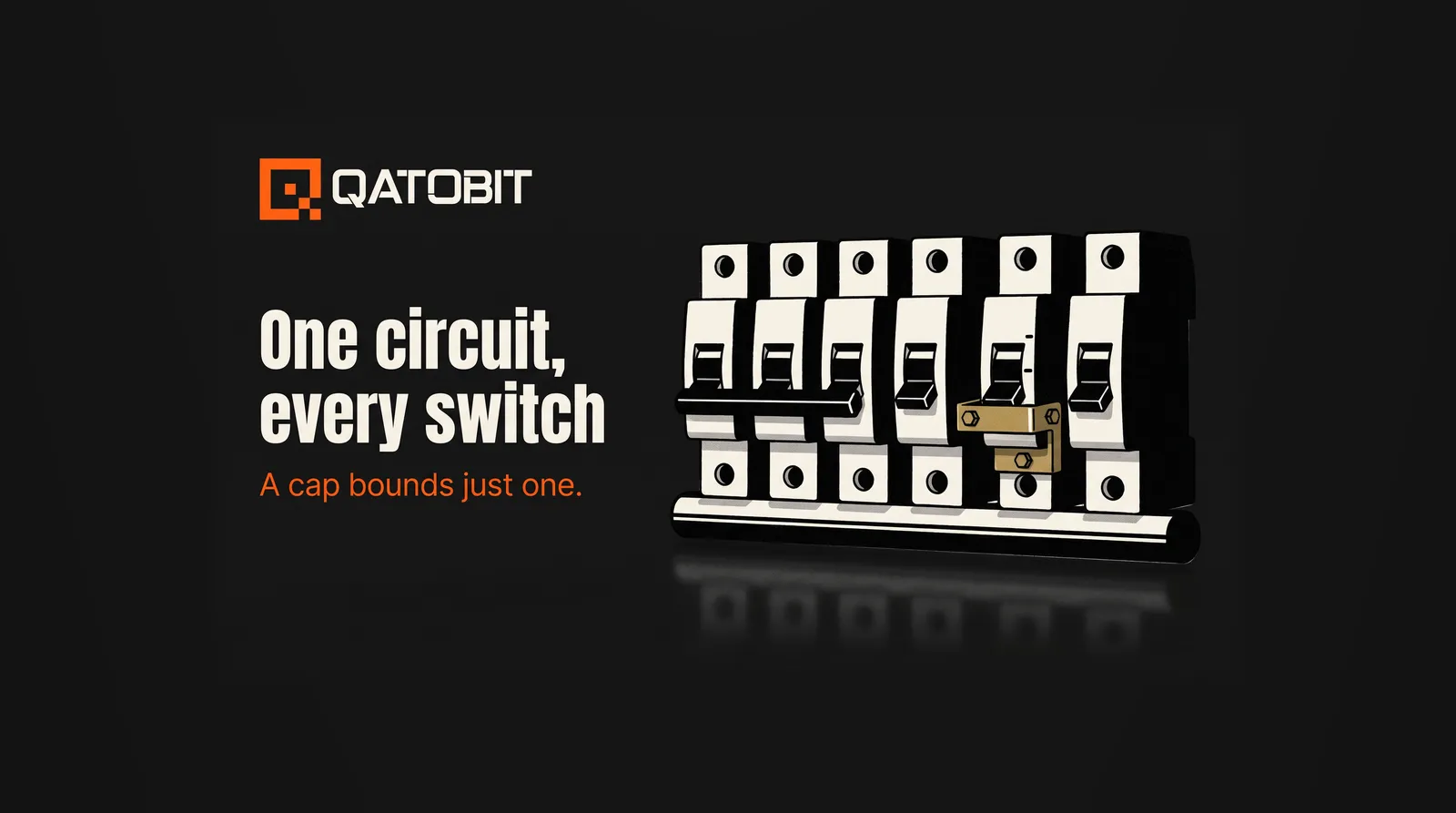
A concentration cap is a rule that stops any single holding from growing past a stated share of an index, however far that holding's own price runs. It answers exactly one question: how much can one company's rally or collapse move the whole basket. A second question sits outside its scope entirely: what happens when a shock reaches nearly every constituent in the group at once.
The Nifty IT session makes that boundary concrete. A concentration cap inside the index would have kept a single outsized winner, in a rally, from becoming most of the basket. The fall on 9 September 2026 came from a different source: several large constituents moving on the same news at the same time. A cap sets a ceiling on one company's weight inside an index. The shared exposure every constituent in a sector carries to the same client base is a separate fact, fixed at the point the sector itself is chosen.
What a monthly investor does with a rule like this
Qatobit's QSI GEQ8 index rests on the same boundary, stated by construction rather than by past performance. It holds eight companies across three sleeves: a platform sleeve of large technology firms, a digital finance sleeve, and a smaller innovation sleeve. A published rule caps any single holding at 15 percent of the index and floors it at 3 percent, reviewed quarterly and rebalanced monthly. What is QSI GEQ8 sets out the full composition this rests on.
The cap works the same way here as it does in an equity sector index: it bounds single-holding risk. Say one holding in a ₹20,000 GEQ8 position drifts from 12 percent to 18 percent of the basket during a rally, a 6 percentage point move worth about ₹1,200. The next monthly rebalance sells that excess back down to the 15 percent cap, at the standard 0.35 percent rebalancing fee, about ₹4.20 on that ₹1,200 transaction. The cap did its one job: it stopped that holding from becoming most of the basket.
A day when every holding in one sleeve moves together on shared news is a different event, the same kind Nifty IT lived through on 9 September 2026. A Crypto Index rebalances the rule inside it. The reason a sector or a sleeve moves together on a given day is a separate fact for an investor to know going in.
The rule and the reason, restated
A sector bet is a bet on one shared exposure repeated across many names. Four things hit Indian IT together on 9 September 2026: a US rate view, cooling discretionary tech spending, a new visa fee, and one chairman's resignation on top. A concentration cap decides how much one name inside that bet can dominate the outcome. It was never built to decide whether the bet itself gets called on a given day.
Frequently asked questions
Why did IT stocks fall more than the rest of the market on 9 September 2026?
The Nifty IT index fell 3.24 percent that day against the Nifty 50's 0.86 percent. IT firms share a narrow set of exposures: a US rate view, US client tech budgets and a new US visa fee. Most other sectors do not carry that same set (5paisa and Business Today, 9 September 2026).
What is a concentration cap in an index?
A concentration cap is a published rule that stops any single holding from exceeding a stated share of an index, whatever that holding's own price does. It is checked and enforced at each rebalance.
Does a concentration cap stop a whole sector from falling together?
No. A concentration cap manages how large one holding can grow inside an index. A shock that hits most or all of an index's constituents at once is a different kind of event, because it is not about any single holding's size.
Why do IT stocks move together as a group?
Most large Indian IT firms sell services to the same US corporate client base. They staff projects with visa-dependent engineers, too. A change to US interest rates, tech budgets or visa rules affects nearly all of them on the same day, in the same direction.
What is QSI GEQ8?
QSI GEQ8 is a Qatobit-designed Crypto Index of eight global companies across a platform, digital finance and innovation sleeve. No single holding is allowed above 15 percent or below 3 percent of the index. It is rebalanced monthly, at a 0.35 percent fee per rebalance, and sits outside SEBI regulation.
Crypto investments are subject to market risk. Not financial advice.
“A better allocation begins with a better explanation.”
Qatobit principle
Published construction. Fixed cadence. Versioned control.