The point
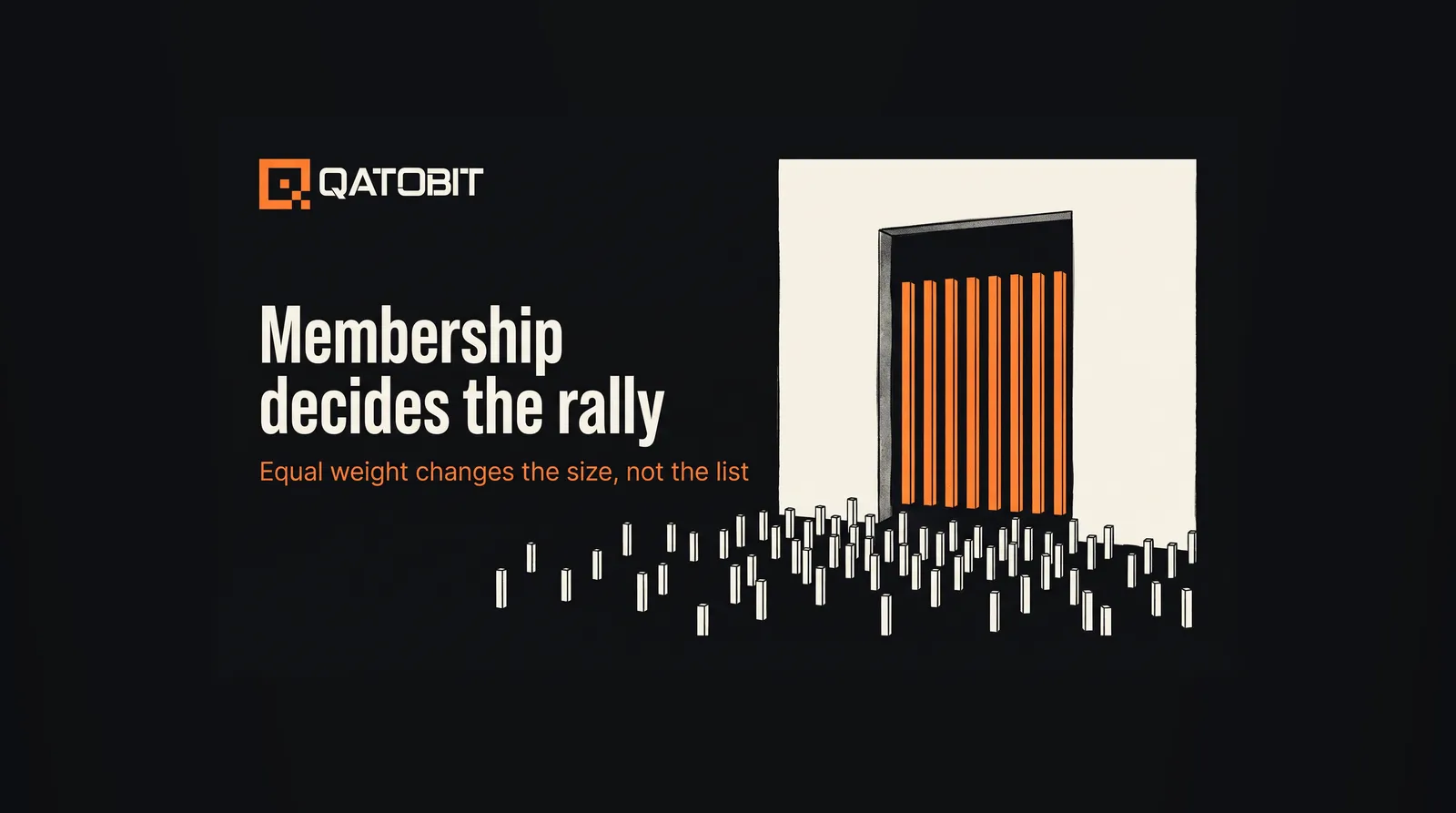
The Nifty rose 10.75% in the 10 sessions to 6 November 2026, and the Nifty Top 10 Equal Weight index rose 10.64%. The Nifty Midcap 150 and Smallcap 250 each fell 2.74%. An equal weight rule did not change who got the rally, because the ten names were already inside the door. Two rules decide an index: who is in, and how much each one counts.
What did the Nifty and the broader market do?
The Economic Times reported that the Nifty climbed 2,430 points, or 10.75%, from its 23 October 2026 close of 22,600 to 25,030 on 6 November 2026. It was the first close above 25,000 in more than eight months.
The same report quotes Apurva Sheth of SAMCO Securities with data on the month to 6 November 2026. The Nifty Top 10 Equal Weight index rose 10.64%. The Nifty Midcap 150 and the Nifty Smallcap 250 each fell 2.74%, and the Nifty Microcap 250 fell 5.32%.
The ten heavyweight stocks averaged a gain of 10.19% over that month, even though their average for 2026 stayed negative at 6.73%. The report names two causes. One is a recovery in valuations after the correction that began in January 2026. The other is foreign investors buying about ₹40,000 crore of Indian equities over eight sessions.
Source: The Economic Times, report last updated 6 November 2026 at 8:11 PM IST, https://economictimes.indiatimes.com/markets/stocks/news/nifty-soars-11-in-10-days-but-why-is-your-portfolio-not-moving-up/articleshow/135611525.cms, read 7 November 2026.
How does an index decide who counts for most?
An index is a list plus a rule for how much each name on the list counts. A portfolio that does not match the list, or does not match the rule, will not track the headline number.
The Nifty 50 white paper from NSE Indices describes the list. The eligible universe is drawn from the Nifty 100. Selection uses the 6-month average free float market capitalization, and the top 50 eligible companies are included and weighted on a free float basis. The index is reviewed semi-annually.
Free float market capitalization is the value of the shares that the public can actually trade, which is the share price times those shares. A company with a large public float counts for more.
The white paper also states that individual stock weights range from 0.49% to 11.83% under this framework. The largest name therefore counts about 24 times as much as the smallest, since 11.83 divided by 0.49 is 24.1.
Source: NSE Indices, Nifty 50 white paper, https://niftyindices.com/docs/default-source/indices/nifty-50/nifty-50-whitepaper_2026.pdf, read 7 November 2026.
Mechanism 1: market-value weighting hands the move to the biggest names
When each stock counts in proportion to its market value, a rise in the biggest names moves the index the most. Foreign buying tends to land on large, liquid stocks, because they can absorb large orders without moving the price much. The ET report says exactly that.
So a rally led by heavyweights lifts the headline number even when most listed companies are flat or falling. A reader who owns the other names gets none of that lift.
Mechanism 2: the list matters as much as the weights
The Nifty Top 10 Equal Weight index shows this. NSE Indices says it tracks the top 10 stocks, picked by 6-month average free-float market capitalization from the Nifty 50, and each stock is weighted equally.
Equal weighting changes how much each of the ten counts. It does not change which ten are inside. Midcap and smallcap names are outside by construction, so the index rose 10.64% with the large caps while the broader names fell.
Mechanism 3: a reset schedule means weights drift in between
NSE Indices published the Nifty Top 10 Equal Weight factsheet on 30 October 2026. Each of the ten should hold 10%, and the factsheet shows the actual weights.
- Infosys Ltd. at 11.46%
- Kotak Mahindra Bank Ltd. at 11.05%
- Bharti Airtel Ltd. at 10.69%
- ICICI Bank Ltd. at 10.19%
- Larsen & Toubro Ltd. at 9.66%
- Axis Bank Ltd. at 9.63%
- ITC Ltd. at 9.55%
- State Bank of India at 9.46%
- Reliance Industries Ltd. at 9.19%
- HDFC Bank Ltd. at 9.11%
Infosys carries 11.46% against HDFC Bank's 9.11%, a gap of 2.35 percentage points, or about 1.26 times the weight. An equal weight index is equal only on the day it is reset.
The factsheet's own wording on the reset differs between its two pages. Page one says the index rebalances semi-annually. The methodology box on page two says it is reconstituted semi-annually and rebalanced quarterly. The ET report says every six months. Read the methodology document before relying on any one description.
Source: NSE Indices, Nifty Top 10 Equal Weight factsheet dated 30 October 2026, https://www.niftyindices.com/Factsheet/Factsheet_NiftyTop10EqualWeight.pdf, read 7 November 2026.
What does that do to a ₹25 lakh portfolio, with the arithmetic?
Take the one-month moves ET reported and apply them to two mixes of a ₹25 lakh portfolio. This is arithmetic on one past month, and it says nothing about the next one.
For simplicity, treat the whole non-heavyweight part as moving by the 2.74% that the Midcap 150 and Smallcap 250 each recorded.
Mix A holds ₹20,00,000 in the ten heavyweights and ₹5,00,000 in midcap and smallcap names.
- Heavyweights: ₹20,00,000 times 10.19% is a gain of ₹2,03,800.
- Midcap and smallcap: ₹5,00,000 times 2.74% is a loss of ₹13,700.
- Net: ₹1,90,100, which is 7.60% of ₹25,00,000.
Mix B holds ₹5,00,000 in the ten heavyweights and ₹20,00,000 in midcap and smallcap names.
- Heavyweights: ₹5,00,000 times 10.19% is a gain of ₹50,950.
- Midcap and smallcap: ₹20,00,000 times 2.74% is a loss of ₹54,800.
- Net: a loss of ₹3,850, which is 0.15% of ₹25,00,000.
Both portfolios sat under the same Nifty headline. Mix B did not move with it because it did not own where the move happened. As Sheth put it in the ET report, "you don't own what is moving up."
How does the same question apply to a crypto index?
A crypto index answers the same two questions in its methodology: which assets are eligible, and how much each one counts. If it weights by market value, the largest asset sets the largest weight. If it holds a fixed list, anything outside that list gets none of a move.
Qatobit's crypto indexes are rebalanced monthly on a published methodology. QSI Core holds Bitcoin, Ethereum, Gold and a stable reserve. QSI Growth adds Solana. QSI VRION holds Bitcoin, Ethereum and Solana with no hedge layer. The list is the first decision, and the weights follow from it.
Index weights are published on the home and index pages, so anyone can work out how much of each asset a given amount buys. Before and after each rebalance, the investor can see what was sold and what was bought.
What should you check in an index before reading its headline?
Start with the list. Ask which names can get in, what the entry test is, and who is left out. A broad market headline says little about a portfolio that holds a narrow slice.
Then check the weighting rule: market value, equal, or capped. Check the schedule next, because weights drift between resets, as the Infosys and HDFC Bank gap above shows.
Last, compare your own holdings to the list. If most of your money sits outside it, the headline is about someone else's portfolio.
For related reading, what a crypto index is explains how a basket is built, and concentration risk covers how a few holdings can decide the outcome of a whole portfolio. Portfolio rebalancing after a holding falls is worked through step by step, and asset allocation sets how much of a portfolio any one index should be.
Frequently asked questions
Why did the Nifty rise 10.75% while midcaps and smallcaps fell?
The Economic Times reported that the Nifty rose 10.75% in the 10 sessions to 6 November 2026, led by heavyweight stocks. The Nifty Midcap 150 and Smallcap 250 each fell 2.74% over the month, because the gains went to large, liquid names.
What is the Nifty Top 10 Equal Weight index?
It tracks the top 10 stocks from the Nifty 50, picked by 6-month average free-float market capitalization, with each stock weighted equally. NSE Indices launched it on 24 June 2024, according to its factsheet.
Does an equal weight index capture a broad market rally?
Not by itself. Equal weight changes how much each holding counts, not which holdings are in. The Nifty Top 10 Equal Weight index rose 10.64% with the Nifty while the Midcap 150 fell 2.74%, as ET reported.
Why do the weights in an equal weight index differ from 10%?
Prices move between resets. In the 30 October 2026 factsheet the ten weights run from 9.11% for HDFC Bank to 11.46% for Infosys, which is a gap of 2.35 percentage points.
What should I check about a crypto index's weights?
Check which assets are eligible, how each is weighted and how often the weights reset. Qatobit's crypto indexes are rebalanced monthly on a published methodology, and the weights are published on the home and index pages.
Crypto investments are subject to market risk. Not financial advice.
“A better allocation begins with a better explanation.”
Qatobit principle
Published construction. Fixed cadence. Versioned control.