The point
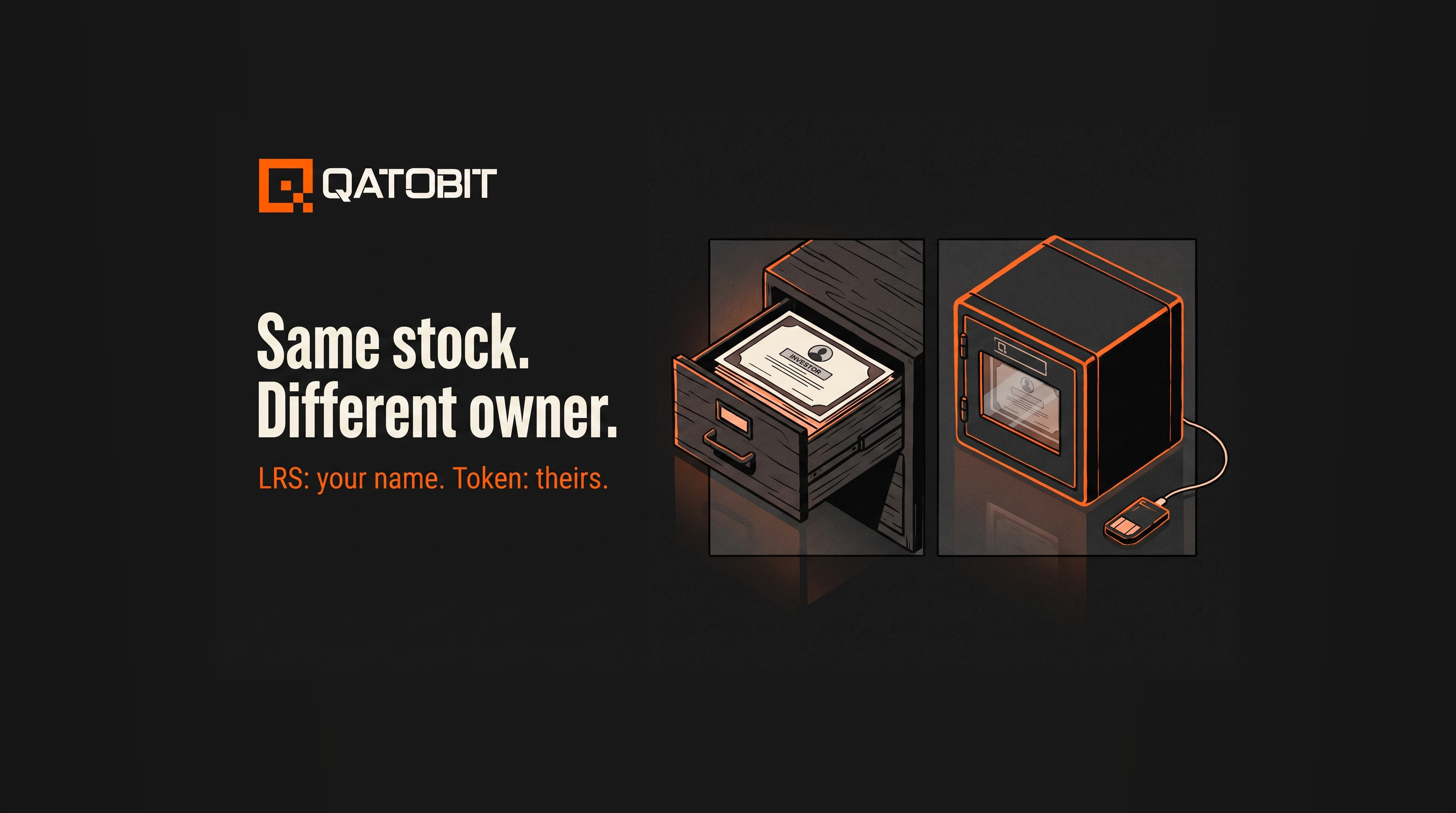
An Indian investor can send up to $250,000 a year abroad under the Liberalised Remittance Scheme and buy a US stock directly. The share sits in a brokerage account under the investor's own name, held by a US custodian. Buy the same stock as a token on a crypto app instead, and the wallet holds a token. The actual share sits with the platform's own custodian. Both routes reach the same company. Each puts the share in a different pair of hands.
"Which route is better" is the wrong first question
Every comparison of the two gets asked as which one wins. That framing assumes both are the same kind of object with different features attached. Buying a US stock through the Liberalised Remittance Scheme (LRS) makes the investor the shareholder of record, through a regulated broker. Buying a tokenized version on a crypto app makes the investor the holder of a token instead. The token's value tracks the share, but the platform's own custodian holds the share itself.
Those are two different legal positions wearing the same ticker symbol. The useful work is naming what each position actually gives an investor, before any rupee moves.
Five things that actually differ
Where the share sits
Route the purchase through LRS, and a US custodian holds the share. The investor's name sits on the brokerage account, the same way it would for a resident US investor buying the identical stock.
Route it through a tokenized product on a crypto app, and the share still exists, but the investor's name is not on it. It sits with the platform's own custodian, under an institutional custody arrangement, while the investor's wallet holds a token representing a claim against that arrangement.
For a portfolio built to survive a platform's own bad week, that difference matters most. LRS puts the investor's name on the record. Tokenization puts the platform's name there.
Dividends and votes
A share bought through LRS carries the standard rights of a shareholder. A dividend arrives when the company declares one. A vote arrives at the annual meeting. Both pass through the broker in the ordinary course.
A tokenized share carries neither by default. The US Securities and Exchange Commission's own investor guidance describes tokenized securities as coming in different structures. It states that the rights, obligations and benefits a token holder actually receives can differ significantly from a traditional owner of the same security, depending on the structure used. Whether a dividend or a vote reaches the token holder at all is a design choice the issuing platform makes. Read the platform's own documentation for that specific pass-through before assuming an answer.
How much can move, and what it costs to move it
LRS caps outward remittance at $250,000 per financial year per resident individual. That ceiling covers every purpose used that year combined: education, travel, gifts and investment together. A stock purchase carries no separate allowance on top of it.
Move money abroad under LRS for a purpose other than education or medical treatment, and tax is collected at source under Section 206C(1G) of the Income Tax Act. Nothing is collected on the first ₹10 lakh remitted in a financial year. Twenty percent applies to whatever crosses that threshold. Remit ₹13 lakh in a year to buy US stock, and TCS applies to the ₹3 lakh above the ₹10 lakh mark. That works out to ₹60,000, collected at the time of transfer and adjustable against the investor's tax bill at filing.
A tokenized purchase on a crypto app settles in rupees on an Indian platform. It never becomes an outward remittance. Neither the LRS ceiling nor Section 206C(1G) TCS applies to it.
When the price moves
A US-listed stock only prices during its own exchange's regular session, roughly 19:00 to 01:30 IST while daylight saving is in effect in the US. That window shifts an hour later in the winter months. Outside it, an LRS-bought share has no live price at all. The last quoted price stands until the exchange reopens.
A tokenized version can be bought or sold on the crypto platform's own market at any hour, on its own schedule. When the underlying exchange is shut, the price shown comes from that platform's own order book. It reflects the value of the share held in custody rather than a live quote from the exchange where the company actually lists.
What protects an investor if something goes wrong
An LRS holding sits inside a regulated US broker-dealer and custodian relationship, in the investor's own name. It carries the protections that relationship holds under US securities law.
A tokenized holding's protection is whatever the issuing platform's own custody and redemption terms actually promise. The six clauses in a crypto platform's terms decide who legally holds the underlying share, and what happens to a claim if the platform suspends withdrawals. A separate clause decides what recourse exists if the custody arrangement itself runs into trouble. None of that comes from the token itself. It comes from the same terms of service page most buyers never open, worth opening before the money moves rather than after.
Three ways this plays out
An investor who has already sent $180,000 abroad this financial year for a child's tuition has $70,000 of LRS headroom left. Every further remittance eats into that same ceiling first. For that investor, a tokenized product that settles in rupees never touches the LRS limit at all. It is the only route left this year that does not compete with money already committed elsewhere.
An investor who wants ₹5,000 of exposure to one company runs into the LRS route's own arithmetic before the custody question even comes up. Transfer fees, a currency conversion spread and a brokerage account minimum can consume a meaningful share of a ₹5,000 ticket before a single share gets bought. A tokenized product priced in rupees, with no cross-border transfer attached, fits that size of position. The compromise is holding a claim on the share rather than the share itself.
An investor who wants a dividend or a vote to show up under their own name is asking for something LRS delivers as a matter of course. A token delivers the same thing only if the specific platform has built the pass-through and documented it. For that investor, the better question before depositing is whether the platform's own terms name a dividend pass-through in writing. Assuming a token behaves like the share it tracks is not enough.
Choosing the position on purpose
Neither route is the automatic right choice for every investor. What matters is which position an investor meant to hold when they clicked buy: shareholder of record through a regulated broker, or token holder against a platform's custody arrangement.
The five questions worth asking before a first deposit runs the same underlying question this one does. So does the check on whether the crypto in a basket actually belongs to the investor. Both ask who legally holds what an investor thinks they own. Run that same check against any tokenized stock product before assuming an answer.
Frequently asked questions
Does a tokenized US stock pay dividends?
Only if the platform issuing it has specifically built a pass-through for that dividend and states so in its own terms. The token carries no dividend right by default, since the underlying share is held by the platform's custodian rather than by the token holder directly.
Do I get a shareholder vote on a tokenized stock?
Not automatically. The US Securities and Exchange Commission's own investor guidance notes that a tokenized security's structure decides which rights the token holder actually receives. Those rights can differ significantly from a traditional shareholder's. Check the specific platform's terms rather than assuming a vote comes with the token.
What is the LRS limit for buying US stock directly?
$250,000 per financial year per resident individual, covering every purpose that person uses the Liberalised Remittance Scheme for that year. It is not $250,000 reserved for stock purchases alone.
Is tax collected when I remit money to buy a US stock?
Yes, for most investors. Section 206C(1G) of the Income Tax Act collects nothing on the first ₹10 lakh remitted for investment in a financial year. Twenty percent tax at source applies to whatever crosses that threshold.
Can I buy or sell a tokenized US stock while the US market is shut?
Yes. The token changes hands on the crypto platform's own market rather than the exchange where the underlying share lists, so a price is available around the clock. Outside the underlying exchange's own hours, that price reflects the platform's own market rather than a live quote from the exchange itself.
Crypto investments are subject to market risk. Not financial advice.
“A better allocation begins with a better explanation.”
Qatobit principle
Published construction. Fixed cadence. Versioned control.