The point
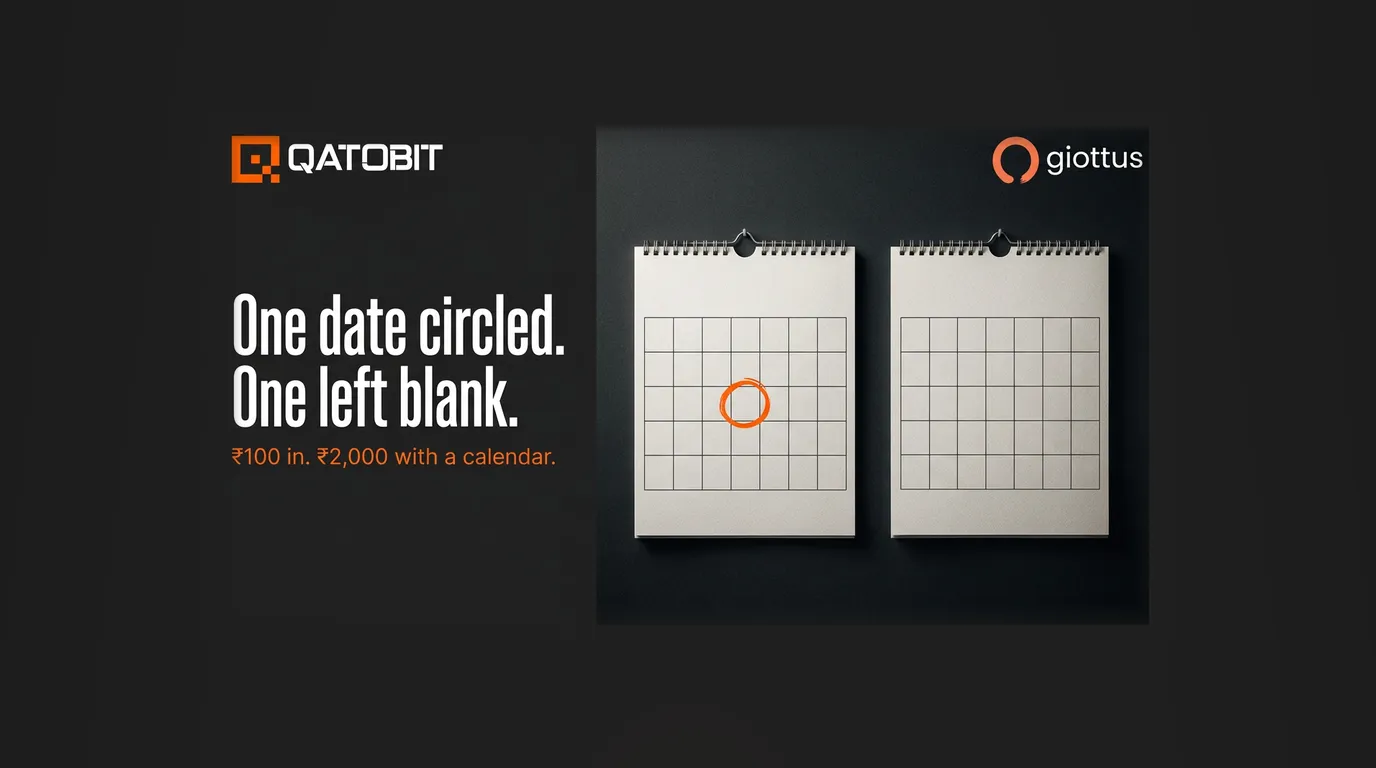
Giottus opens its crypto baskets at ₹100 with zero fee to buy and no published rebalancing calendar. Qatobit's QSI indices open at ₹2,000, rebalance on a documented monthly calendar across all four, and publish a live proof-of-reserves page. A reader testing a themed basket with pocket change is better served by Giottus. A reader who wants a fixed monthly rule into a published index is better served by Qatobit QSI.
Last verified: 10 September 2026
What each product is
Giottus, on its own site, describes its baskets as a selection of cryptocurrencies grouped by theme, "such as large caps, DeFi, metaverse or memecoins," curated by its own team. Each coin carries a pre-allocated share, and Giottus states that "all basket buys are zero-fee trades" (Giottus, 13 January 2022, updated 24 November 2025).
Qatobit is a crypto index investing platform in India: investors hold a curated basket of digital assets, rebalanced on a published methodology, rather than picking coins.
Giottus at a glance against Qatobit
- Minimum to start: Giottus opens a basket or SIP position from ₹100. Qatobit opens each QSI index from ₹2,000.
- Fee to buy a basket: Giottus charges zero fee on a basket buy. Qatobit charges 0.35 percent of the transaction amount on a basket buy, sell or rebalance.
- Fee per rebalance or exit: Giottus publishes no rebalance fee and no rebalance calendar for its baskets. Qatobit charges 0.35 percent each time a QSI index rebalances, on a fixed monthly calendar, and nothing to exit at any holding period.
- Annual or management fee: Giottus states none on the pages read for this comparison. Qatobit states none across all four QSI indices.
- Basket composition published: Giottus's basket page and proof-of-reserves page returned no readable text to an automated read on 10 September 2026. Qatobit names every holding on every index's own product page.
- Weighting rule: Giottus states its baskets are "curated by experts", with each coin given a pre-allocated share. It publishes no rule for how that share is set or changed. Qatobit documents a methodology per index, published before launch, with hard caps on QSI GEQ8: no holding above 15 percent or below 3 percent.
- Rebalance cadence: Giottus publishes no rebalance calendar for its baskets. Qatobit rebalances all four QSI indices monthly.
- SIP: Giottus runs an automated SIP from ₹100 into individual coins such as Bitcoin or Ethereum, at zero fee. Qatobit runs a SIP into an index from ₹2,000 per cadence, or into a single asset from ₹500 weekly or biweekly.
- Custody, as published: Giottus's fee page, basket page and proof-of-reserves page carried no custody or fund-segregation statement as of 10 September 2026. Qatobit states institutional custody.
- Proof of reserves: Giottus's live proof-of-reserves page returned no readable content to an automated read on 10 September 2026. The company's most recent public statement on the subject is a 29 November 2022 post announcing an intention to publish Merkle-tree-based reserves. Qatobit's proof of reserves is live and available at any time.
- Scale: Giottus's Google Play listing shows 22,400 reviews at 4.4 stars, over 10 lakh downloads and access to 450-plus cryptocurrencies, read 10 September 2026. Qatobit does not publish a comparable download count.
Sources, all read 10 September 2026. giottus.com/blog/giottus-introduces-baskets-sip-and-a-new-tradeview-interface, dated 13 January 2022 and updated 24 November 2025. giottus.com/blog/how-to-diversify-your-crypto-portfolio-with-giottus-tools, dated 1 August 2025. giottus.com/docs/fees.html. giottus.com/blog/what-is-proof-of-reserves-why-is-it-important, dated 29 November 2022. The Google Play listing for the Giottus app. giottus.com, giottus.com/basket and giottus.com/proof-of-reserves returned no visible text to the same automated read. Qatobit figures come from Qatobit's own product documentation.
What ₹2,000 a month costs on each platform
A basket buy on Giottus costs nothing in fees. The company's 2022 launch post states "all basket buys are zero-fee trades," and its 2025 portfolio guide repeats "zero trading fees" for its SIP feature. Twelve monthly ₹2,000 contributions into a Giottus basket, at that stated zero fee, add up to zero rupees in basket-buy fees for the year, on the figures Giottus itself publishes.
A Qatobit QSI index charges 0.35 percent of the transaction amount on every buy, sell or rebalance. A ₹2,000 monthly contribution costs ₹7 in fee, which is 0.35 percent of ₹2,000. Twelve such contributions across a year add up to ₹84 in fees. There is no annual management fee, and nothing charged to leave at any holding period.
What each fee buys differs more than what it costs. Giottus states no rebalance rule for what happens to a basket after the buy. The 0.35 percent on a Qatobit QSI index pays for a rebalance the index runs on a fixed date every month, a rule published before the index launched.
Where Giottus is genuinely stronger
Giottus's ₹100 entry is real. The 2025 portfolio guide and the SIP feature both confirm a position can start at "just ₹100". Every basket buy and every SIP buy is priced at zero fee, per the company's own 2022 and 2025 posts.
Giottus also runs a full exchange around its basket product. Its fee schedule lists spot fees down to 0.05 percent for its highest-volume tier, and its Google Play listing states access to 450-plus cryptocurrencies. The 22,400 reviews and 10-lakh-plus downloads on that listing, read 10 September 2026, mark an install base built since the company's 2017 founding in Chennai.
Where Qatobit is stronger
Qatobit names every QSI index's holdings. All four rebalance on the same fixed monthly calendar, a rule set and published before the index launched, rather than a rebalance frequency left unstated. Giottus's most recent public statement on reserves is a 2022 announcement of an intention to publish them. Qatobit's proof of reserves is live and available at any time. QSI GEQ8 carries a hard cap on every holding: no position above 15 percent or below 3 percent. Giottus's "curated by experts" description states no equivalent rule for its own baskets.
The QSI indices, in full
Qatobit runs four QSI Crypto Indices.
- QSI Core holds Bitcoin, Ethereum, Gold and a stable reserve (USDT Earn).
- QSI Growth holds Bitcoin, Ethereum, Solana, Gold and a stable reserve (USDT Earn).
- QSI VRION holds Bitcoin, Ethereum and Solana, with no hedge layer.
- QSI GEQ8 holds eight global companies across three sleeves. The platform sleeve holds Apple, Amazon, Alphabet, Meta Platforms and NVIDIA. The digital finance sleeve holds Coinbase and Robinhood Markets. The innovation sleeve holds Tesla. No holding sits above 15 percent or below 3 percent, and the composition gets a quarterly review.
Every holding on every index is named on Qatobit's own product pages, and each index's methodology is documented and published before launch. Every index rebalances monthly. The minimum per index is ₹2,000, and a Crypto SIP into an index also starts at ₹2,000 per cadence. Buying, selling or rebalancing any index costs 0.35 percent of the transaction amount, shown before the investor confirms. No index carries an annual management fee, an exit load, a lock-in or a minimum holding period, at any holding period. INR deposits and withdrawals run through NEFT, RTGS or IMPS, with a ₹200 minimum on either side and no fee. Custody is institutional, and proof of reserves is live.
Who should choose which
A first-time investor who wants to try a themed basket with a small amount is served by Giottus's ₹100 entry. That investor also has to be comfortable choosing which coins sit inside the basket, since Giottus publishes no rebalance rule.
An investor who wants to actively buy and sell, use leverage or hold futures is served by Giottus's wider exchange, which Qatobit does not offer. An investor who wants a fixed monthly rule applied to a published set of holdings is served by Qatobit QSI. That comes at a ₹2,000 minimum, with a live proof-of-reserves page and no charge to leave at any time.
How this page was checked
This page was built by reading Giottus's own pages on 10 September 2026. Giottus's homepage, basket page and proof-of-reserves page returned no visible text to an automated read. Giottus's fee schedule rendered in full, as did its 2022 basket and SIP launch post, its 2025 portfolio guide and its Google Play listing. The exact dates are given in the sources line above. Qatobit's figures are drawn from Qatobit's own product documentation. This page is rechecked against the same sources roughly once a month, and the Last verified line above changes in place.
A reader who wants a working method for judging any index's rulebook, Giottus's or anyone else's, can use a five-point framework for reading a crypto index methodology. A proof-of-reserves page, including the kind that never went live, can only prove so much. That question is covered in does proof of reserves prove your crypto basket is backed. The construction and monthly rebalance behind the four indices used on this page is laid out in four crypto indexes, one methodology. The same comparison, run against a different basket product, is in Qatobit QSI vs Mudrex Coin Sets.
Frequently asked questions
Is Giottus's ₹100 basket minimum real?
Yes. Giottus's own 2025 portfolio guide states an investor can start with "just ₹100" through its SIP and basket features. Every basket buy is priced at zero fee under the company's 2022 launch post, still live as of 10 September 2026.
Does Giottus publish a rebalancing rule for its baskets?
Giottus's own posts describe its baskets as "curated by experts," with a pre-allocated share for each coin. They give no published schedule or rule for when that share changes. Qatobit's four QSI indices rebalance on a fixed monthly calendar, published before each index launched.
Is Giottus's proof of reserves live?
Not as far as an automated read on 10 September 2026 could confirm. Giottus's proof-of-reserves page returned no visible text. The company's most recent public statement on the subject is a November 2022 post announcing an intention to publish Merkle-tree-based reserves. Qatobit's proof of reserves is live and available at any time.
What does a Qatobit QSI index cost to buy and to leave?
0.35 percent of the transaction amount on every buy, sell or rebalance. No index carries an annual management fee, and nothing is charged to leave, at any holding period, on any of the four indices.
Can I buy a themed basket on Qatobit the way I can on Giottus?
Qatobit sells four permanent-allocation indices, QSI Core, QSI Growth, QSI VRION and QSI GEQ8, each with its own published composition and monthly rebalance. None is a rotating catalogue of theme baskets. An investor who specifically wants a rotating set of themed baskets, such as Giottus's DeFi or memecoin baskets, is better served by Giottus.
Crypto investments are subject to market risk. Not financial advice.
“A better allocation begins with a better explanation.”
Qatobit principle
Published construction. Fixed cadence. Versioned control.