The point
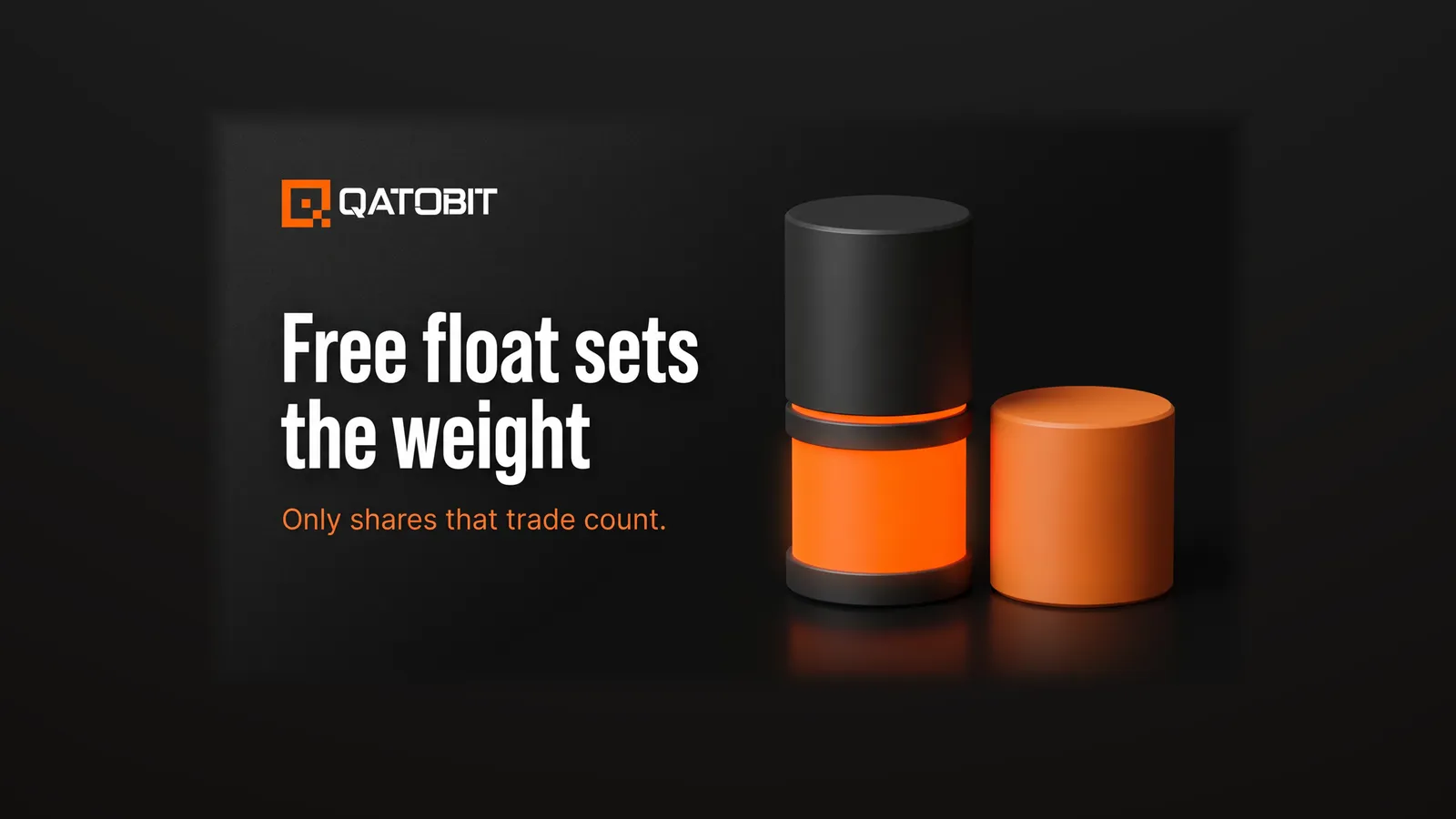
Free float is the share of a company's stock that outside investors can actually buy and sell. An index weights each stock by its free float market cap, which is full market cap times that share. A company with 38 percent of its shares in public hands counts at 38 percent of its headline size.
What is free float, in plain words?
Free float is the part of a company's shares that is available to trade. Shares held by the founding family, by the government or by any other long-term holder that is not expected to sell are outside it.
The headline number every news page quotes is market cap, which is the share price times every share that exists. Free float market cap is the share price times only the shares that can change hands.
NSE's index rulebook puts the idea in its own terms. It calls the adjustment the Investible Weight Factor, or IWF. The document describes it as a unit of floating stock "expected to be available for trading in the market" (Nifty Indices Methodology Document, September 2026, read 20 October 2026).
Why does an index use free float and not market cap?
An index exists so that a fund can copy it. A fund copying an index has to buy the shares, and it can only buy shares that someone is willing to sell.
If an index weighted a company by its full market cap, it would tell funds to hold a bigger slice of that company than the market could ever supply. The weight would look right on paper and fail the first time a fund placed an order.
Free float fixes that by making the index weight match what is buyable. NSE's methodology picks the Nifty 50's 50 companies on free-float market capitalisation, and describes the Nifty Next 100 as "free-float market capitalization weighted" (Nifty Indices Methodology Document, September 2026).
My view is that headline market cap is the wrong number for anyone comparing companies inside an index. It measures what a company is worth. The index measures what an investor can own, and the two differ most for the companies that look biggest.
How does an index turn free float into a weight?
The arithmetic has three steps, and each one is checkable against the rulebook.
Step 1: find the shares that can trade
The index provider starts from total shares and removes the holdings that are not expected to trade. NSE's list runs to 22 categories. Among them are promoter shares, cross-holdings between group companies, employee benefit trusts, directors and government holdings. Private equity, sovereign wealth funds and shares under lock-in are on it too (Nifty Indices Methodology Document, September 2026).
The remainder is divided by total shares to give the IWF.
Step 2: multiply market cap by that factor
Free float market cap is market cap multiplied by the IWF. A company worth ₹20,000 crore with an IWF of 0.38 enters the index at ₹20,000 crore × 0.38, which is ₹7,600 crore.
Step 3: divide by the index total
Each stock's weight is its free float market cap divided by the sum across all constituents. The factors themselves come from the public shareholding that each company files with the exchanges every quarter. NSE reviews the Nifty 50 semi-annually, and any replacement takes effect on the last trading day of March and September.
What does a worked example in crore look like?
Take two illustrative companies in a two-stock index. These are made-up figures to show the mechanism, not real companies.
Illustrative Ltd has 100 crore shares at ₹200, so its market cap is ₹20,000 crore. Promoters and lock-ins hold 62 percent, so its IWF is 1 − 0.62 = 0.38. Its free float market cap is ₹20,000 crore × 0.38 = ₹7,600 crore.
Peer Ltd has 60 crore shares at ₹200, so its market cap is ₹12,000 crore. Almost all of it trades, with an IWF of 0.90. Its free float market cap is ₹12,000 crore × 0.90 = ₹10,800 crore.
Weighted by full market cap, Illustrative Ltd is ₹20,000 crore of ₹32,000 crore, which is 62.5 percent of the index. Weighted by free float, the total is ₹7,600 crore + ₹10,800 crore = ₹18,400 crore, and Illustrative Ltd is 7,600 ÷ 18,400, which is 41.3 percent. Peer Ltd moves from 37.5 percent to 58.7 percent.
The company that looked 67 percent larger on the headline ends up with the smaller seat. Neither business changed between the two calculations. The first answers what each company is worth, and the second answers what a fund can buy.
NSE publishes its own worked case with real share counts. Its example company has 1,00,00,000 shares. NSE removes 19,75,000 promoter shares, 50,000 foreign direct investment shares, 2,50,000 shares held through depository receipts, 12,575 cross-holding shares, 1,45,987 employee trust shares and 14,78,500 lock-in shares. The IWF works out to 60,87,938 ÷ 1,00,00,000, or 0.608794, rounded to six decimals.
Why is a minimum free float also an entry rule?
Free float sets the weight, and it also decides whether a stock gets in at all. NSE's eligibility rules for its broad indices ask for an IWF of at least 0.10, which is 10 percent free float. A stock can also qualify if its six-month average free float market cap is at least 25 percent of the smallest existing constituent's (Nifty Indices Methodology Document, September 2026).
That floor is why a company with a tiny public slice can be large by headline and still be missing from the index funds hold.
What does Indonesia show when the free float rule moves?
When a market changes its free float rule, index weights change with it. Indonesia gives a dated example.
IDNFinancials, citing Reuters, reported on 25 June 2026 that MSCI had pushed its decision on Indonesia's market status to November 2026. One of the reforms Jakarta put in place was raising the minimum free float requirement for listed companies from 7.5 percent to 15 percent. The same article reports a calculation by the Indonesia Stock Exchange at the end of 2025. If no company delisted, around IDR 187 trillion of additional shares would be needed for every listed company to reach 15 percent.
Run the same arithmetic as above on a company that moves from 7.5 percent to 15 percent free float with its price unchanged. Its free float market cap doubles, because 15 ÷ 7.5 is 2. A passive fund that tracks the index has to buy that extra slice, and every other stock's weight shrinks by the same step.
The article also reports regulators gave companies between one and three years to comply, so the effect arrives in stages. A rule that is easy to state takes years to land because a company has to sell shares to the public before its factor can change.
How does this connect to how Qatobit builds an index?
One QSI index, QSI GEQ8, holds eight global companies across three sleeves: platform, digital finance and innovation. Its weights are set by the methodology as free float market cap adjusted by a quarterly score. Hard caps hold any one stock to 15 percent at most and 3 percent at least. It is rebalanced monthly, with a quarterly composition review.
GEQ8 holds global equities. Three of the four QSI indices hold crypto, and each of those is built on its own published methodology. The common idea is the one on this page: a rule written before the market moves decides the weight, and the holder does not decide it in the moment.
Two neighbouring rules are worth reading next. One is how the Nifty 50 is calculated. The other is the rule smart beta uses in place of market cap. To see a rule at work when prices fall, read how a crypto index rebalances during a market crash.
What should an allocator take from this?
When a headline says a company is one of the biggest in a country, ask what share of it trades. The answer decides how much of it an index fund can own, and how much of your own index exposure rests on shares that were never for sale.
The same question applies to any index you hold, whatever the asset. Read the rulebook for what is counted, how often the counts are refreshed and who decides when a count changes. Then decide whether you want to hold the rule or the headline. To hold a rule-based basket, you can invest in QSI Growth on Qatobit.
Frequently asked questions
What is free float market capitalization?
It is a company's share price multiplied by the number of its shares that can be traded freely. It leaves out shares held by promoters, governments, cross-holdings and other holders not expected to sell. NSE selects the Nifty 50 on this basis.
What is an Investible Weight Factor?
It is NSE's name for the free float factor. It is the fraction of a company's shares that are counted as tradable, between 0 and 1. In NSE's worked example, a company with 1,00,00,000 shares and 39,12,062 excluded shares has an IWF of 0.608794.
Is free float the same as market cap?
No. Market cap counts every share, and free float market cap counts only the shares that can trade. In the worked example above, a company with a ₹20,000 crore market cap and an IWF of 0.38 has a free float market cap of ₹7,600 crore.
Why did Indonesia raise its minimum free float?
IDNFinancials, citing Reuters, reports that the minimum rose from 7.5 percent to 15 percent as part of reforms aimed at MSCI's transparency concerns. The article says more shares in public hands narrows the room for artificial price moves.
Does a lower free float mean a worse company?
No. A low free float describes who holds the shares, not how the business performs. It only means an index will count less of the company than its headline size suggests.
Crypto investments are subject to market risk. Not financial advice.
“A better allocation begins with a better explanation.”
Qatobit principle
Published construction. Fixed cadence. Versioned control.