The point
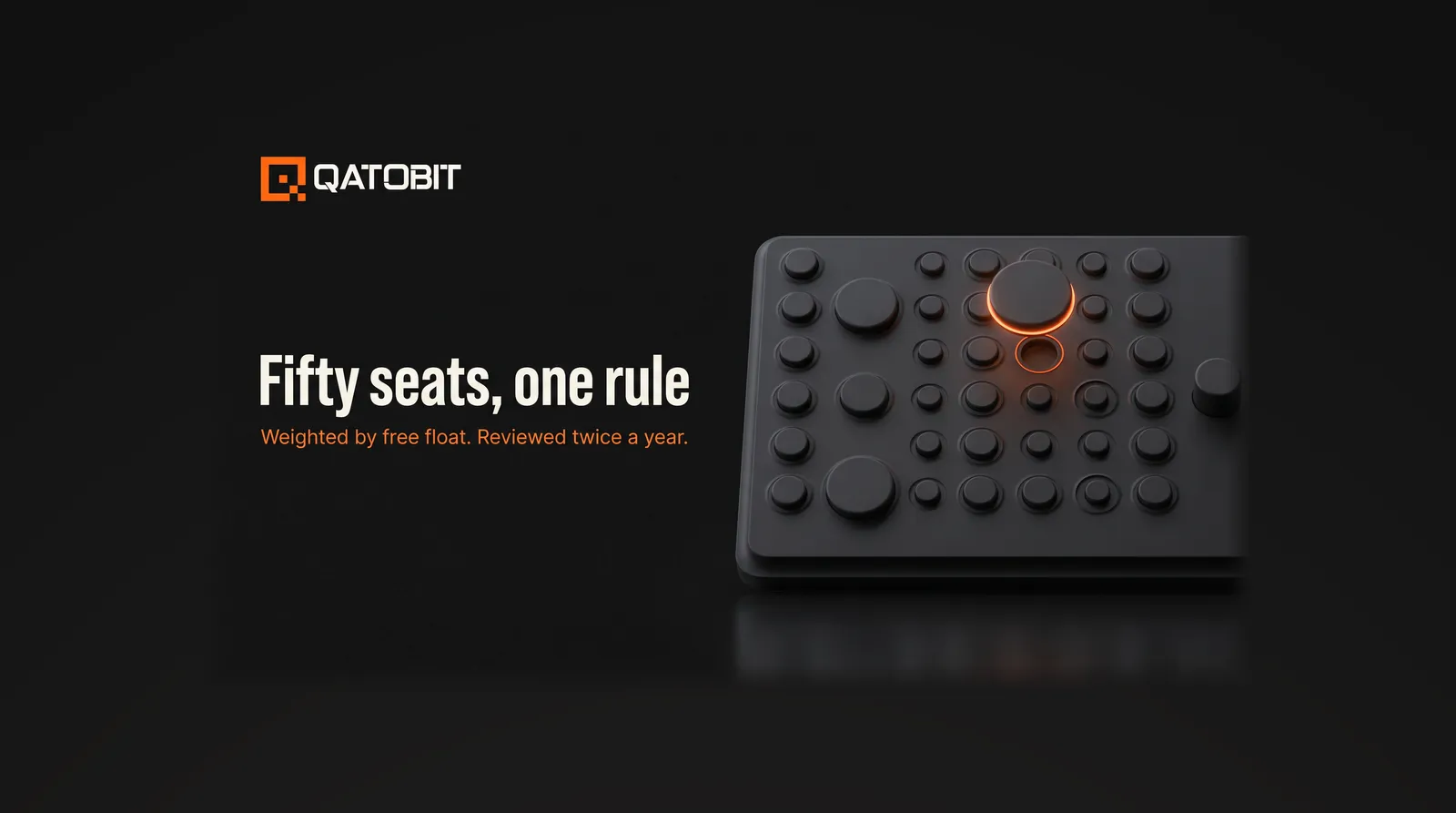
The Nifty 50 is a list of 50 companies listed on the NSE, each weighted by the value of its shares that are actually free to trade. NSE Indices reviews the list twice a year, and on 30 September 2026 BSE Ltd replaced Wipro. In the NSE Indices factsheet dated that day, HDFC Bank carries 10.38 percent of the index and the ten largest names carry 52.27 percent between them.
How is the Nifty 50 calculated?
The Nifty 50 is calculated on free-float market capitalisation. Market capitalisation is the price of a company's shares times the number of shares outstanding. Free-float market capitalisation counts only the shares freely available for trading, which leaves out promoter holdings and other locked-in shares (source: 5paisa).
NSE Indices has computed the index on this basis since 26 June 2009. The base date is 3 November 1995 and the base value is 1,000. The index launched on 22 April 1996 (source: NSE Indices factsheet). The base capital was ₹2.06 trillion, per the Wikipedia entry that cites NSE Indices.
Put in words, the index takes the current free-float market capitalisation of the 50 companies, divides it by the base capital, and multiplies by 1,000. An illustration, not a live figure: if the 50 companies' free-float value were exactly double the base capital, ₹2.06 trillion × 2 = ₹4.12 trillion, the index would read 1,000 × 2 = 2,000.
Free float matters because it moves the weights. Take two hypothetical companies, each worth ₹10 lakh crore in total. Company A has 75 percent of its shares free to trade, so its free-float value is ₹7.5 lakh crore. Company B has 25 percent free, so its free-float value is ₹2.5 lakh crore. In a two-company index A carries 7.5 ÷ 10 = 75 percent and B carries 25 percent, although the companies are the same size. The index weights what the market can buy.
What weights does the Nifty 50 carry?
Weights follow free-float value, so a few companies carry a lot. The factsheet dated 30 September 2026 lists these as the ten largest:
- HDFC Bank Ltd., 10.38 percent
- ICICI Bank Ltd., 9.05 percent
- Reliance Industries Ltd., 7.58 percent
- Bharti Airtel Ltd., 5.10 percent
- Larsen & Toubro Ltd., 4.20 percent
- State Bank of India, 3.79 percent
- Axis Bank Ltd., 3.37 percent
- Infosys Ltd., 3.35 percent
- Kotak Mahindra Bank Ltd., 2.93 percent
- Mahindra & Mahindra Ltd., 2.52 percent
Source: NSE Indices factsheet dated 30 September 2026, read on 1 October 2026.
Add them: 10.38 + 9.05 + 7.58 + 5.10 + 4.20 + 3.79 + 3.37 + 3.35 + 2.93 + 2.52 = 52.27 percent. The other 40 companies share the remaining 47.73 percent. By sector, Financial Services is 37.45 percent and Oil, Gas & Consumable Fuels is 9.39 percent in the same factsheet.
For a ₹1 crore allocation that tracks the index exactly, the weights translate to ₹10,38,000 in HDFC Bank, ₹52,27,000 across the top ten and ₹37,45,000 across Financial Services. A holder of the index owns that shape, which is narrower than a count of 50 companies suggests.
What does a stock need to join the Nifty 50?
A stock must clear three tests, all from the factsheet's methodology page.
First, liquidity. Over the last six months the stock must have traded at an average impact cost of 0.50 percent or less. That must hold for 90 percent of the observations, for a basket of ₹10 crore (the factsheet writes ₹100 million). Impact cost is the extra a buyer pays, or a seller gives up, when trading a basket of that size.
Second, the stock must be allowed to trade in the NSE futures and options segment.
Third, it must have a listing history of at least one month on the cut-off date.
Passing the tests makes a stock eligible. Ranking decides the rest. In the September 2026 review, NSE Indices compared six-month average free-float market capitalisation. An entrant needed at least 1.5 times the figure of the constituent it replaced (source: Bajaj Broking, reproducing a DSIJ report on the NSE Indices notice).
BSE Ltd's six-month average free-float market capitalisation was ₹1,40,879 crore and Wipro's was ₹55,930 crore. Divide: 1,40,879 ÷ 55,930 = 2.52, so BSE Ltd cleared the 1.5 times bar with room. TVS Motor Company at ₹84,566 crore and Divi's Laboratories at ₹82,930 crore were next in line by size. They were not taken. NSE Indices said they did not meet the required multiple against the lowest constituents left after Wipro's exit: HDFC Life at ₹65,666 crore and Tata Consumer Products at ₹73,054 crore.
Who decides what is in the Nifty 50?
NSE Indices Limited, a subsidiary of the NSE, owns and manages the index. A professional team runs all of its indices. Governance has three tiers: the Board of Directors of NSE Indices Limited, the Index Advisory Committee (Equity) and the Index Maintenance Sub-Committee (source: NSE Indices factsheet).
The review is semi-annual. The cut-off dates are 31 January and 31 July, and the data used is the average for the six months ending on the cut-off date. NSE Indices gives the market at least four weeks' notice before a change. The change effective 30 September 2026 was announced on 10 August 2026. It applied after the close of trading on 29 September (source: 5paisa and Bajaj Broking, both citing the NSE Indices notice).
My reading is that a constituent change is a rule applied to a ranking, and the ranking is all it measures. Wipro moved to the Nifty Next 50, the index of the next 50 companies by size, and stays in the index family.
What does a change do to everything that tracks the Nifty 50?
Index funds and exchange-traded funds that follow the index have to hold what it holds. When the constituents change, they buy the entrant and sell the exit. 5paisa reported expected passive inflows of about $741 million into BSE Ltd and passive outflows of about $246 million from Wipro for this review. Those are estimates reported by 5paisa, not figures from NSE Indices.
The index sets the rule, and every product built on it carries out that rule on the effective date. The swap decision never reaches the holder of such a product.
What can the Nifty 50 tell a holder, and what can it not?
It describes a slice of the market. NSE says the index represented about 53.73 percent of the free-float market capitalisation of NSE-listed stocks as on 30 March 2026. It puts the index's impact cost for a ₹50 lakh portfolio at 0.02 percent for March 2026 (source: NSE India).
It does not tell a holder what prices will do, whether a constituent is cheap, or whether the weights suit a particular portfolio. Those questions sit with the holder. What it does give is a published way to answer four questions about any basket. What is it weighted by? Who decides? When does the list change? Can a holder read the rule before relying on it?
How does a published index methodology read at Qatobit?
The same four questions apply to the QSI Crypto Indices. Qatobit designs and rebalances them monthly on a published methodology, and the methodology pages for each index sit at /methodology.
Index weights are published on the home and index pages, so anyone can work out how much of each asset a given amount buys. Around every rebalance, before it and after it, the investor can see what changed: what was sold and what was bought, and the basket can be looked into.
Where to read next
The weights above rest on market value, and what market cap is and why a crash erases no money covers the definition they rest on. For the other number people watch beside the index level, what India VIX is and what the fear number measures explains how it is built.
Frequently asked questions
How is the Nifty 50 calculated?
The Nifty 50 is calculated on free-float market capitalisation: the value of each company's freely tradable shares, divided by a base capital and multiplied by the base value of 1,000. NSE Indices set the base date at 3 November 1995.
Who decides which companies are in the Nifty 50?
NSE Indices Limited decides, through its three-tier governance structure of the Board, the Index Advisory Committee (Equity) and the Index Maintenance Sub-Committee. The list is reviewed twice a year against a published methodology.
How often does the Nifty 50 change?
The Nifty 50 is reviewed semi-annually, with cut-off dates of 31 January and 31 July and a six-month average of data. NSE Indices gives the market four weeks' notice before a change takes effect.
What does a stock need to be in the Nifty 50?
It needs an average impact cost of 0.50 percent or less for a ₹10 crore basket on 90 percent of observations. It must trade in the NSE futures and options segment and have at least one month of listing history at the cut-off date. In the September 2026 review an entrant also needed 1.5 times the free-float market capitalisation of the stock it replaced.
Is the Nifty 50 an equal-weight index?
No. It is weighted by free-float market capitalisation, so HDFC Bank at 10.38 percent weighs far more than Mahindra & Mahindra at 2.52 percent in the factsheet dated 30 September 2026.
Crypto investments are subject to market risk. Not financial advice.
“A better allocation begins with a better explanation.”
Qatobit principle
Published construction. Fixed cadence. Versioned control.