The point
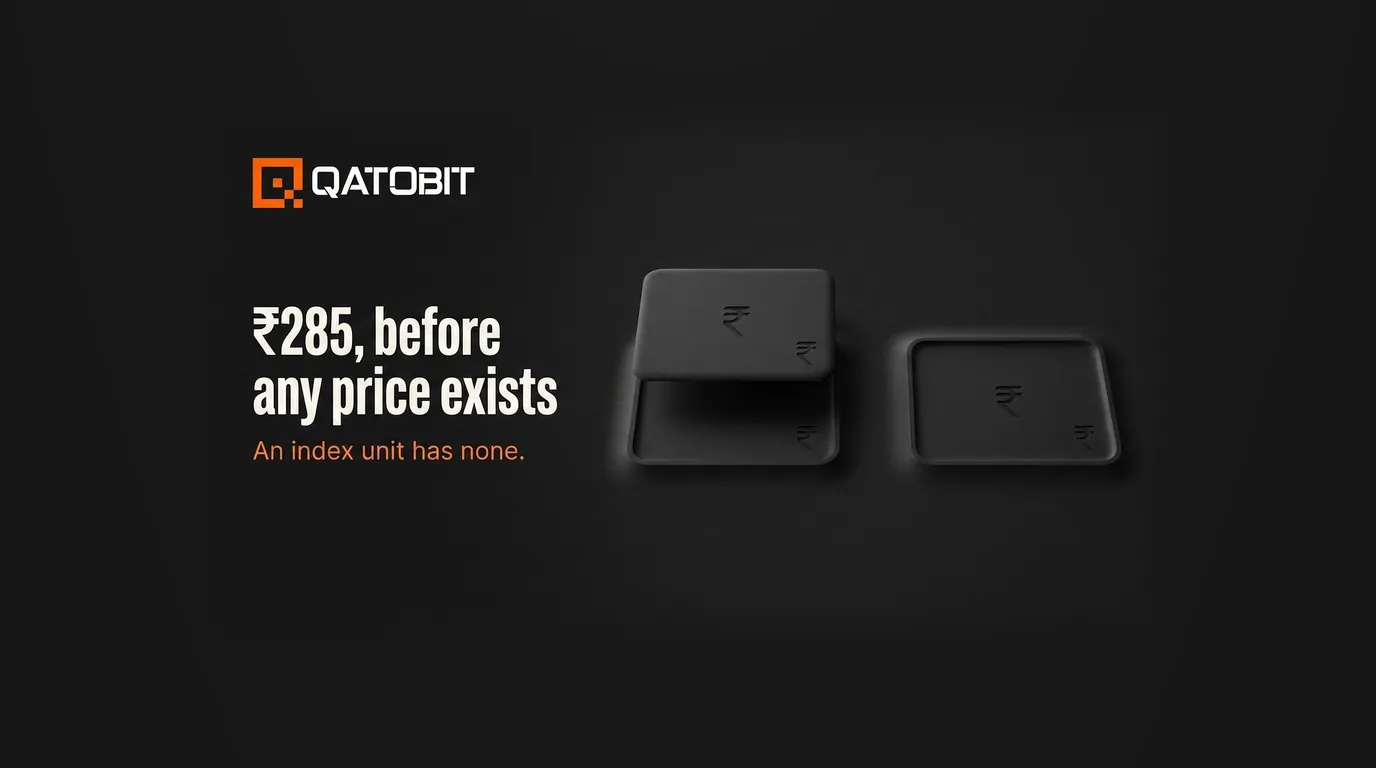
A grey market premium is the extra amount buyers say they will pay for a share before it lists, set informally and guaranteed by nobody. NSE's own shares carried one of Rs 273 to Rs 285 as of 7 September 2026, with no price band yet announced. A Qatobit index unit has none: its price is what its holdings are worth divided by the units that exist, set the moment you buy.
What a grey market premium actually measures
A share that has filed for an IPO has no public price yet. There is no exchange listing, no order book and no price band until the regulator clears one. In that gap, an informal network of dealers and platforms quotes a number anyway. It is the amount somebody will currently pay above the expected issue price, or above the share's last known private trade.
NSE itself is the example running right now. As of 7 September 2026, its premium stood at Rs 273 to Rs 285. That is up from around Rs 250 before the exchange's IPO cleared SEBI's approval. It is up further still from the Rs 150 to Rs 200 range quoted earlier, according to Shivani Nyati, head of wealth at Swastika Investmart, reported by Business Standard. Separately, NSE's own unlisted shares have been changing hands at Rs 1,940 to Rs 2,035, per Unlisted Arena data in the same report. That is still 13 to 14 percent below the stock's June 2025 peak of Rs 2,360. Analysts quoted in the piece expect a price band somewhere between Rs 1,800 and Rs 2,200 a share.
Every one of those numbers describes the same thing: what somebody was willing to pay, informally, on a specific day, before any of it was official. None is a price NSE has confirmed. None is a number any exchange has matched or settled.
Where that number comes from, and why SEBI keeps warning about it
A recognised exchange discovers a listed stock's price through a matching engine and a public order book. A grey market quote skips all of that. It is collected informally, through dealers and platforms that sit outside the exchange system, and nobody stands behind the trade if the other side does not pay up.
SEBI has flagged this gap before. In a press release dated 17 June 2026, the regulator warned investors against buying or selling shares of unlisted public companies through platforms it does not recognise. Business Today reported the advisory the same day. Such transactions, SEBI said, fall entirely outside its oversight. There is no access to the grievance redressal mechanism exchanges run, and no online dispute resolution through the depositories' own system. There is no investor protection framework either, of the kind a listed trade carries by default. Recognised stock exchanges, SEBI added, are the only entities authorised to run a platform for fundraising and trading in securities. This was already its third such advisory, after warnings in 2016 and December 2024.
That does not make a grey market premium fake as a sentiment signal. The number is exactly what it looks like: an unregulated, informal read on demand, carrying no legal weight and no protection if the deal goes wrong.
What changes once a share actually lists
Once NSE's shares are actually admitted to trading, the grey market number stops mattering. The stock gets one official price on listing day. The exchange's own opening process discovers it, inside whatever band SEBI has approved by then, and whoever is actually buying and selling that day sets it. A premium that ran hot for weeks can vanish on listing morning. A flat one can pop just as easily. The grey market was pricing sentiment about the stock, ahead of the stock ever having a price of its own.
Why an index unit has no premium, no discount and no listing day
A Qatobit Crypto Index unit is built differently, and the difference is structural.
There is no pre-listing window, because there is no listing
An index unit is priced continuously. Its value is what the basket's holdings are worth right now, divided among however many units exist right now. There is no single day the unit "goes public," and no gap beforehand for an informal market to fill.
The live value is the only value
Say a basket's holdings are worth Rs 10 lakh at a given moment, and 5,000 units exist. Each unit is worth Rs 200 at that instant, arithmetic and nothing else. Buy in through a lump sum or a Crypto SIP, and Qatobit values you in at that same Rs 200, whatever it happens to be that day. There is no separate number floating around that a dealer network is quoting on the side. Nothing sits ahead of the transaction for anyone to quote in the first place. The price you get is simply the price.
A calendar decides the day
A Qatobit Crypto SIP invests on a cadence you set, weekly, biweekly or monthly, starting at Rs 2,000 a month into an index. That calendar rule, agreed in advance, decides the day you buy. No crowd of other buyers is bidding a name up before it becomes available to you, which is the entire mechanism a grey market premium exists to describe. A monthly rebalance runs on the same logic: a fixed date resets the basket's weights, on schedule, whatever the market happens to be doing that hour.
What this means when you are the one buying
An IPO's grey market premium is a number nobody guarantees, collected outside SEBI's oversight, with no recourse if it turns out to mean nothing on listing day. A Qatobit index unit carries a different kind of number entirely. It is priced off what the basket actually holds, at the moment you transact, under a documented methodology you can read before you buy. Read more on how a Crypto Index is actually built and on the difference between a basket and an index in practice.
Frequently asked questions
What is a grey market premium in an IPO?
It is the extra amount buyers are informally willing to pay for a share before it lists, over its expected issue price or last known private trade. NSE's own shares carried a premium of Rs 273 to Rs 285 as of 7 September 2026, before any price band was announced.
Is a grey market premium a guaranteed listing price?
No. It is an informal sentiment reading with no regulator behind it and no exchange matching it. A share's actual listing price is set on the day itself, through the exchange's own process, and can land above or below whatever the grey market was quoting beforehand.
Is it legal to buy or sell shares in the grey market?
SEBI's 17 June 2026 press release warned investors specifically against transacting in unlisted public company shares through electronic platforms not recognised by the regulator. It noted that such trades carry no access to exchange-backed grievance redressal or investor protection, its third such warning after 2016 and December 2024.
Does a Qatobit Crypto Index have anything like a grey market premium?
No. An index unit is priced continuously off what its holdings are worth divided by the units that exist. There is no pre-listing period, no informal quote and no gap for one to appear in.
What actually decides the price I pay for an index unit?
The value of the basket's holdings at the moment you transact, divided by the units outstanding at that same moment. A Crypto SIP's calendar decides the day you buy, on schedule, regardless of any premium anyone else might quote.
Crypto investments are subject to market risk. Not financial advice.
“A better allocation begins with a better explanation.”
Qatobit principle
Published construction. Fixed cadence. Versioned control.