The point
The difference between a crypto basket and a Crypto Index is discipline: an Index is a basket that commits to documented rules the investor can hold against.
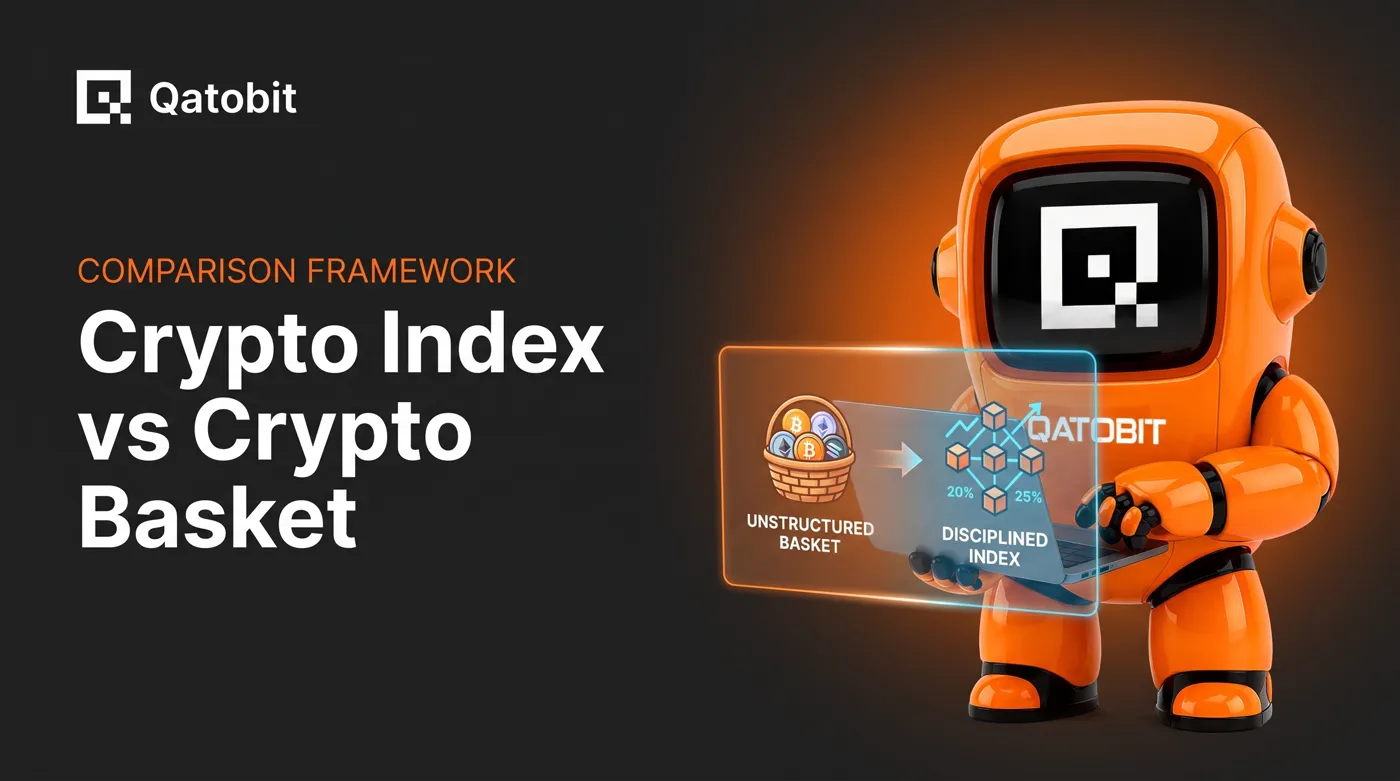
Crypto basket and Crypto Index are often used as synonyms. They are not. A basket is the inclusive category: any structured grouping of assets sold as a single buy. An Index is the disciplined subset: a basket with documented methodology, defined constituents, mechanical rebalancing, transparent fees, and accountable design. This piece walks the five-feature framework that distinguishes the two, why the distinction matters for the investor, and where Qatobit's QSI Crypto Indices sit on the framework.
A crypto basket is a structured grouping of crypto assets. A Crypto Index is a basket with five additional features: documented methodology, defined constituents, mechanical rebalancing, transparent fees, and accountable design. The distinction matters because an index commits to a holding pattern the investor can understand and hold against, while a generic basket may shift without documented rules.
The inclusive category and the disciplined subset
The term "basket" is inclusive. Any structured grouping of crypto assets that an investor can buy in a single transaction qualifies as a basket. A platform that bundles five tokens into a single buy is selling a basket. A user-created list of crypto holdings is a basket in a loose sense. The category does not constrain how the grouping was constructed, whether the constituents are fixed, how the basket is rebalanced, or who is accountable for the design.
The term "index" is narrower. An Index is a basket plus a discipline. The discipline is what allows the investor to understand what they are buying, hold against the construction's logic across cycles, and evaluate the product against alternatives. Without the discipline, a basket is a curated grouping that the investor cannot evaluate structurally.
The distinction is functional, not pedantic. An investor who treats a generic basket as if it were an index will hold against assumptions that the basket does not commit to. An investor who treats an index as if it were a generic basket will miss the structural advantages the index discipline provides. The five-feature framework below makes the distinction operational.
The five features
A Crypto Index is a basket that carries all five of the following features. A grouping that has some but not all of them is somewhere between a basket and an index, and the investor should understand which features are present and which are missing.
Feature 1. Documented methodology
A Crypto Index publishes a methodology document. The methodology describes:
- The asset universe from which constituents are selected
- The selection criteria (market capitalisation thresholds, liquidity requirements, fundamental quality screens, thematic fit)
- The weighting logic (equal-weight, market-cap-weighted, methodology-defined target weights)
- The rebalancing cadence and the rules that trigger or govern rebalances
- The conditions under which a constituent is rotated out and another rotated in
- The fee structure and the operational mechanics of fee application
A generic crypto basket may have an asset list and not much more. The asset list may have been chosen by a platform's marketing team, a curator's discretion, or a snapshot of the top market-cap rankings on a given date. Without a methodology, the basket cannot be evaluated against alternatives, and the investor cannot predict how the basket will respond to market regime changes.
Feature 2. Defined constituents
A Crypto Index has a specific list of assets, governed by the methodology. The list is stable in the sense that changes happen through the methodology's documented rotation rules, not through discretionary updates. When a rotation occurs (an asset is removed and another added), the change is traceable to a methodology rule that triggered it.
A generic basket may have a constituent list that shifts based on platform discretion or market-cap rankings without a documented trigger. Investors who held the basket at one point may find that the basket holds different assets six months later, with no methodology-level explanation. The basket is functionally a moving target, which makes it difficult to hold against a long-horizon thesis.
Feature 3. Mechanical rebalancing
A Crypto Index rebalances on a documented cadence (typically monthly, sometimes quarterly), with the rebalance executed by methodology rule rather than discretionary decision. On the rebalance date, constituents that have drifted above their target weights are trimmed; those that have drifted below are increased; the operation runs whether the market is rallying, in drawdown, or flat. The mechanical character of the rebalance is what produces the counter-cyclical effect that adds discipline over time.
A generic basket may rebalance, or it may not. When it does, the rebalance may be discretionary (the basket's curator decides when and how) or driven by external rankings (market cap rotations). The investor cannot anticipate the rebalance behaviour and cannot model how the basket will behave through a cycle.
Feature 4. Transparent fees
A Crypto Index has a clear, disclosed fee structure: a transaction fee on buys and rebalances, an annual fee deducted from the holding, or both, with the rate and the mechanic explicitly published. The investor knows what they are paying, when the fee is applied, and how it affects the holding's return.
A generic basket may have the platform's standard transaction fees, additional curator fees, hidden costs in the form of bid-ask spreads on the constituent purchases, or all of the above. Without a transparent fee structure documented at the basket level, the investor cannot calculate the true cost of holding.
Feature 5. Accountable design
A Crypto Index has a named methodology owner (a firm, a research team, or a documented design committee) responsible for the construction. The accountability layer means that the methodology has been argued through, defended publicly, and is open to scrutiny. The methodology owner can be asked to explain the design choices and to update the methodology when the asset universe or market structure changes.
A generic basket may have no named designer. The basket is on a platform; the platform offers it; the construction logic may not be defended in any document. The accountability layer is absent, which makes the investor's evaluation difficult.
Why the distinction matters for the investor
The five-feature framework converts the basket-versus-index question into a concrete evaluation. Two implications for the investor follow.
Holdability. A position is holdable through difficult periods only if the investor can articulate why they are holding it. An index's documented methodology gives the investor that articulation: "I am holding QSI Core because the methodology selects Bitcoin and Ethereum as institutional-grade crypto core, Gold as a structural buffer, and a stable reserve as rebalancing capital. The construction is designed to be held through a full crypto cycle, with monthly rebalancing capturing counter-cyclical buying." The articulation gives the investor an internal anchor when the position is in drawdown.
A generic basket does not provide that articulation. When the basket is in drawdown, the investor has no methodology-level reason to hold; they have only the basket's name and current price. Capitulation is more likely because the anchor is missing.
Evaluability. A product can be compared to alternatives only if its structure is documented. An index can be evaluated against another index on the five features and on the specific choices each makes (different asset universes, different weighting logic, different rebalancing cadences). A generic basket cannot be evaluated structurally; it can only be ranked against other baskets by recent price performance, which is a weak basis for a long-horizon allocation decision.
For the framework that walks the methodology evaluation specifically, see how to evaluate any Crypto Index methodology. For the rebalancing mechanic that the framework's third feature describes, see how a Crypto Index rebalances. For the hub on what a Crypto Index is in detail, see what is a Crypto Index.
Where Qatobit's QSI suite sits on the framework
Qatobit's QSI Crypto Indices are built to all five features. The QSI suite (QSI Core, QSI Growth, QSI VRION, and QSI GEQ8) each publishes a methodology document, has defined constituents governed by the methodology, rebalances on a documented cadence (monthly across all four, with a quarterly composition review on QSI GEQ8), discloses the fee structure transparently (0.35 percent per rebalance transaction across all four indices, with no annual management fee on any of them), and operates under Qatobit's accountable design.
For the conservative entry point, QSI Core is the four-asset Crypto Index. The other three QSI pieces walk the rest of the suite. Each QSI piece demonstrates the five-feature framework in operation, which the investor can compare against any other Crypto Index they encounter using the same framework.
The QSI Crypto Indices operate under Qatobit's documented index methodology. The methodology documents for each QSI index are published on the product pages.
The framework is the discipline
The reason the distinction between a basket and an index matters is that the discipline is the value. An investor who chooses an index is choosing a documented construction they can hold against and a designer they can hold accountable. An investor who chooses a generic basket is choosing a curated grouping they cannot evaluate structurally. The choice is structural, and the framework converts the choice from a label-based confusion into a five-feature decision.
Frequently asked questions
What is the difference between a crypto index and a crypto basket?
A crypto basket is a structured grouping of crypto assets: any platform-bundled collection that can be bought in a single transaction. A Crypto Index is a basket with five additional features: documented methodology, defined constituents, mechanical rebalancing, transparent fees, and accountable design. The five features together produce a disciplined construction that the investor can understand, hold against, and evaluate. A basket without those features is a curated grouping that may shift without documented rules.
Is a crypto basket the same as a crypto index?
Not exactly. Every Crypto Index is a basket (because an index is a structured grouping of assets), but not every basket is a Crypto Index. The terms are often used interchangeably in casual conversation and in some marketing copy, but the structural distinction matters. An index commits to a documented construction; a generic basket may not. The investor should look at the five features to determine which category a product falls into.
What makes a crypto index a "real" index?
A "real" Crypto Index has all five features: documented methodology (the rules are written down and published), defined constituents (the asset list is governed by the methodology), mechanical rebalancing (the rebalances run by rule, not discretion), transparent fees (the fee structure is clearly disclosed), and accountable design (a named methodology owner is responsible for the construction and updates). A product missing one or more of these features is somewhere between a basket and an index; the investor should know which features are present.
Should I invest in a crypto basket or a crypto index?
A Crypto Index is structurally easier to evaluate and hold against than a generic crypto basket. For most investors with a long-horizon allocation thesis, an index is the more defensible choice because the documented construction gives the investor the articulation they need to hold through difficult periods. A generic basket may be acceptable for a small, tactical allocation, but is structurally weaker as a long-horizon holding because the investor cannot evaluate the construction or anticipate its behaviour through market regime changes.
How are crypto baskets different from mutual funds?
A SEBI-registered mutual fund operates under SEBI's regulatory framework, with the fund's holdings, fee structure, and management governed by mutual fund regulations. A crypto basket or Crypto Index operates within the VDA framework under Indian tax law, with gains taxed at 30 percent flat under Section 115BBH at transfer time. The two products serve different portfolio roles and operate under different regulatory frameworks; an investor whose portfolio requires SEBI-registered mutual fund holdings should hold those products separately. Crypto baskets and Crypto Indices are complementary to mutual funds, not substitutes.
Disclaimer
Crypto investments are subject to market risk and volatility. Past performance is not indicative of future returns. This is not investment advice. Please consult a qualified financial advisor before investing.
*Written by Sneha, Content Strategist, Qatobit Research Team.*
“A better allocation begins with a better explanation.”
Qatobit principle
Published construction. Fixed cadence. Versioned control.