The point
Open interest counts the futures contracts that are still open, meaning not yet closed or settled. Every one of them has a buyer on one side and a seller on the other. CoinDesk reported on 2 October 2026 that bitcoin open interest had risen by 27,000 BTC, or $2.3 billion, to about 653,000 BTC. The number measures how much exposure is outstanding, and which side turns out right is a separate question.
What does open interest count?
Open interest counts contracts that are still open. Wikipedia defines it as the total number of outstanding derivative contracts that have not been settled. It adds the point this piece leans on. For each buyer of a futures contract there must be a seller (source: Wikipedia, read 2026-10-03).
CoinDesk phrases it for bitcoin as the total value of outstanding futures and perpetual contracts that have yet to be closed or settled. A perpetual contract is a futures contract with no expiry date, so it can be held indefinitely. Per Wikipedia, perpetual futures are cash-settled, which means no coin changes hands when they close (source: Wikipedia, read 2026-10-03).
Three things follow from the definition:
- It counts open contracts, so it is a stock, measured at a single moment. Volume is the flow: how many contracts changed hands in a period. Open interest counts how many are still standing at the end of it.
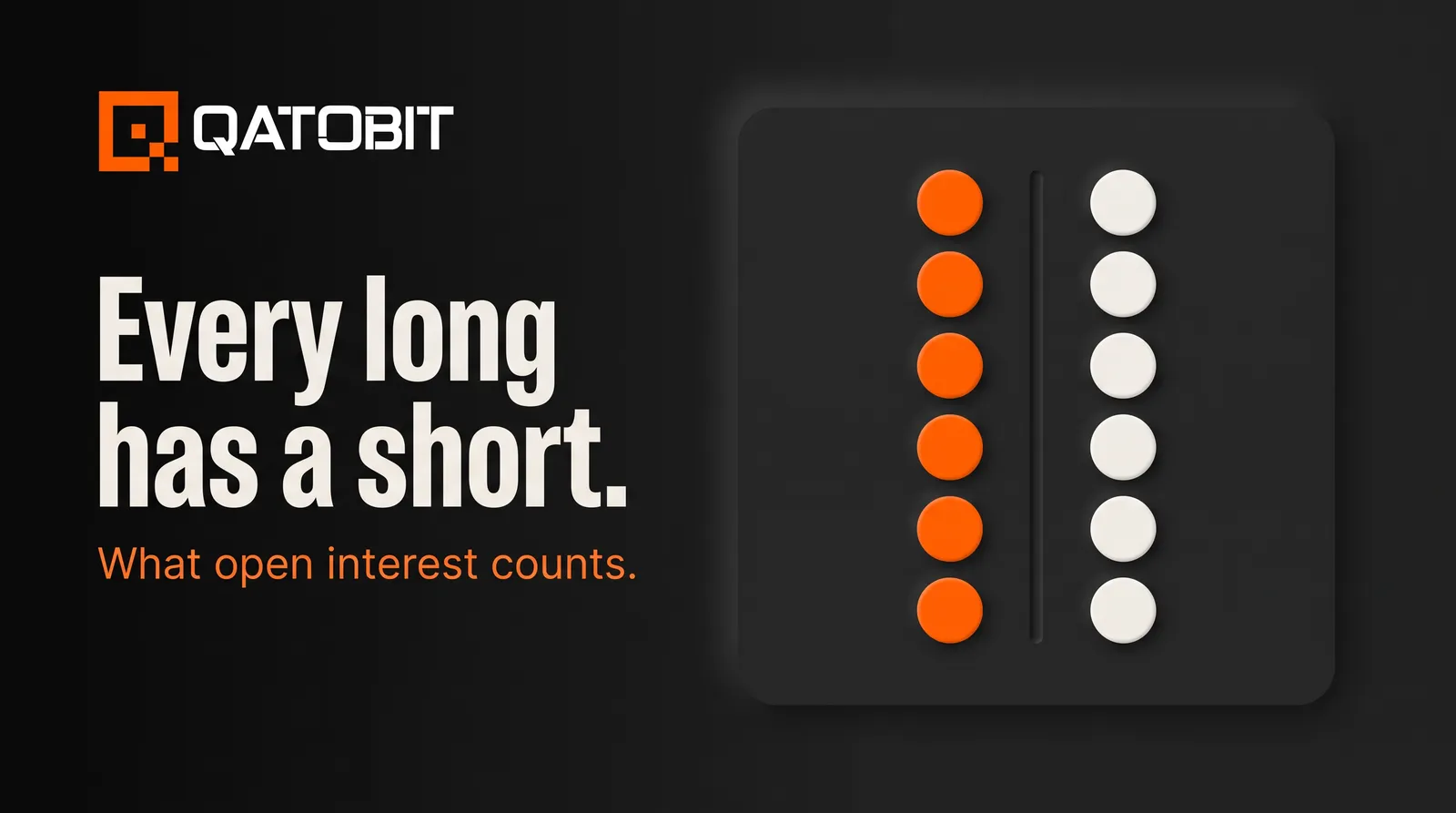
- It is two-sided. Every long position is matched by a short position of the same size, so the total cannot lean one way.
- It is derivatives only. Coins held in a wallet or an account do not appear in it.
What did the latest rise look like in numbers?
As of 2 October 2026, CoinDesk reported bitcoin open interest at approximately 653,000 BTC ($56.2 billion). On 30 September it was 626,000 BTC, so the rise is 27,000 BTC or $2.3 billion (source: CoinDesk, 2 October 2026).
The arithmetic is short. 653,000 − 626,000 = 27,000 BTC. 27,000 ÷ 626,000 = 0.043, or 4.3 percent, which matches CoinDesk's "roughly 4.3%".
The same article reports that bitcoin moved from about $83,500 to $86,500 over those days, and that the perpetual funding rate rose from around 3 percent to 10 percent. CoinDesk adds a fact that changes how the headline reads. Open interest of about 625,000 BTC at the end of September was near its lowest level in 12 months, so the rise came from a low base.
A $2.3 billion jump sounds large. Against a base that had just been near a one-year low, CoinDesk reads it as speculative activity beginning to recover.
What does funding add to the picture?
Funding is the payment that keeps a perpetual contract tied to the coin's price. CoinDesk describes it as a periodic payment exchanged between traders holding long and short positions, designed to keep perpetual futures prices close to the spot price. When funding is positive, traders betting on higher prices pay those betting on lower prices.
That makes funding a price tag on one side of the crowd. When it rises from around 3 percent to 10 percent, as CoinDesk reports for the period, the long side is paying more to stay long. CoinDesk's reading is that this suggests stronger demand for bullish exposure.
Open interest tells you how many contracts are open. Funding tells you what it costs to hold one side of them. Together they describe how crowded one side has become and how expensive that crowding is, and neither says where the price goes next.
What happens when leveraged positions unwind?
Leverage means a position is bigger than the money posted behind it, and the gap is where open interest becomes a risk. Per Wikipedia, cryptocurrency perpetuals are characterised by the availability of high leverage, sometimes over 100 times the margin.
Take a worked example with round numbers. A trader posts ₹3,00,000 as margin and opens a position worth ₹30,00,000, which is 10 times leverage. A 10 percent move against the position is 10% × ₹30,00,000 = ₹3,00,000, which is the whole margin. In practice the position closes earlier than that, because an account must keep collateral above a maintenance requirement. Wikipedia's margin entry describes the maintenance requirement as the minimum collateral needed to keep a position open (source: Wikipedia), read 2026-10-03).
When collateral falls below that line, the position is closed for the trader. That closing is a forced sale or a forced buy, and it lands in the same market as everyone else's orders. CoinDesk says higher funding "raises the cost of holding long positions and can leave leveraged traders more vulnerable to a sudden price reversal."
So the sequence in a crowded market is mechanical: leverage builds, a price move goes against it, forced closes add to the move, and more positions cross their own lines. Open interest falls as those contracts close. A sharp drop in open interest is usually that process showing up in the count.
What can open interest not tell you?
Open interest cannot tell you direction, timing or who is right. CoinDesk says so directly: rising open interest indicates that traders are adding exposure, although it does not reveal whether they are betting on prices rising or falling.
Wikipedia records a rule of thumb used in technical analysis: a rise in open interest alongside a rising price is said to confirm an upward trend. The same entry attributes that to proponents of technical analysis. It is a pattern some analysts read, with no guarantee behind it. The 2 October figures fit it only in the sense CoinDesk gives: new positions are helping support the rally.
Three readings are common and all three overreach:
- That a rise means conviction. A rise means more contracts are open, and some of them are hedges against coins held elsewhere.
- That a high number means a top, or a low number a bottom. The count has no memory of the price level it was opened at.
- That it predicts a move. It describes the positions already taken, which were taken before the price you see.
What should a spot holder do with the number?
A holder of coins should read open interest as a measure of how crowded the derivatives side is, and then leave their own plan where it is. The count is a fact about other people's borrowed exposure, and your thesis and horizon sit outside it.
Here is the scale that matters to a holder. Put ₹25,000 a month into a basket and the year brings 12 × ₹25,000 = ₹3,00,000 across twelve instalment dates. Open interest will rise and fall many times in those twelve months, and none of the moves changes an instalment. A position sized at three percent of a ₹1 crore portfolio is ₹3,00,000 as well. A derivatives count that moved 4.3 percent in two days is a thin basis for resizing it.
My view is that the useful reading is narrow. A fast rise in open interest with rising funding says the market is leaning on borrowed money, and borrowed money gets sold on a schedule set by the lender. That is a reason to expect a rougher path for a while, with no direction attached. It is also a reason to look at how your own holding is sized for a rougher path, while the weights stay where they were.
What does a rule-based index do when leverage builds?
A rule-based index does what its rules say, on its own schedule. A Crypto Index is a curated basket of digital assets, weighted on a methodology and rebalanced on a schedule. An investor in one holds the basket, not a set of coins to store. Qatobit offers four QSI Crypto Indices (QSI Core, QSI Growth, QSI VRION and QSI GEQ8), three of which hold crypto, each rebalanced monthly. The rebalance date does not move because a derivatives count did.
Where to go next
Open interest is one reading of crowd behaviour among several. Crypto fear and greed index: what it measures about crowd behaviour covers a sentiment gauge built from other inputs. First Friday jobs report and bitcoin covers a scheduled data release that often draws positioning ahead of it. For the rules side, four crypto indexes, one methodology sets out what each QSI index holds.
Frequently asked questions
What is open interest?
Open interest is the total number of futures or perpetual contracts that are still open, meaning not yet closed or settled. For bitcoin, CoinDesk put it at about 653,000 BTC ($56.2 billion) as of 2 October 2026.
Does rising open interest mean prices will rise?
No. CoinDesk notes that rising open interest shows traders adding exposure and does not reveal whether they are betting on rising or falling prices. Every long position has a short position matched against it.
What is the difference between open interest and volume?
Volume counts contracts that changed hands in a period, and open interest counts contracts still open at the end of it. A contract opened and closed within the day adds to volume and leaves open interest unchanged.
What is a funding rate?
A funding rate is a periodic payment between holders of long and short perpetual contracts that keeps the contract price close to the spot price. When it is positive, longs pay shorts. CoinDesk reported it rising from around 3 percent to 10 percent between 30 September and 2 October 2026.
Should open interest change how I invest in crypto?
It describes how crowded the derivatives side is and says nothing about your plan. A holder putting ₹25,000 a month into a basket invests ₹3,00,000 a year across twelve instalments, and no single reading of a derivatives count is part of that rule.
Crypto investments are subject to market risk. Not financial advice.
“A better allocation begins with a better explanation.”
Qatobit principle
Published construction. Fixed cadence. Versioned control.