The point
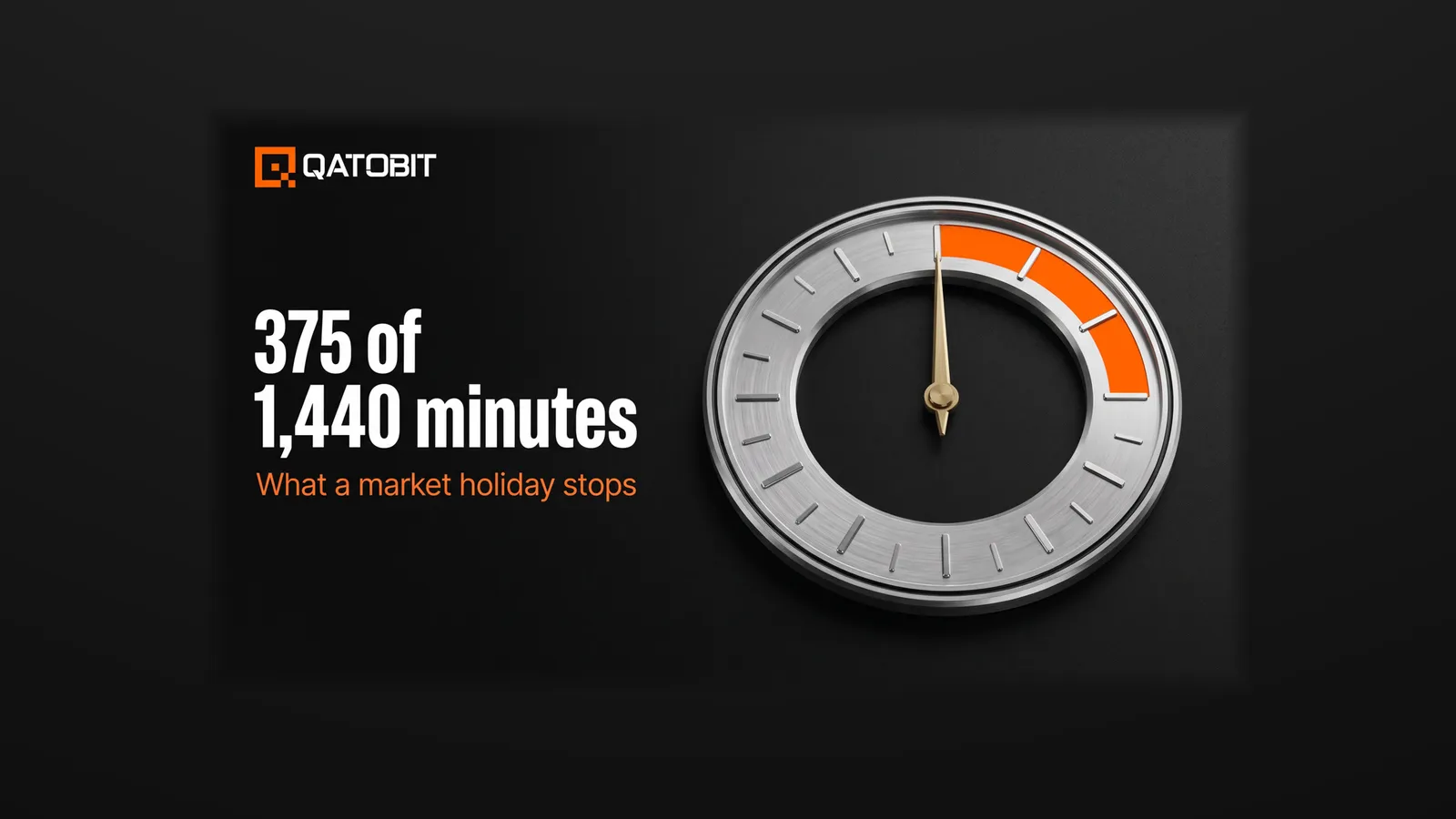
A market holiday freezes the price of an Indian share and leaves everything else running. The NSE equity session runs 9:15 AM to 3:30 PM, which is 375 minutes, or about 26 percent of a weekday. A crypto position has a live price for all 1,440. A holder gets more information from neither schedule, only more or fewer moments to react to it.
What actually stops when the exchange is shut?
Only price discovery stops. On a closed day nobody can buy or sell your shares at an exchange price, so the last close stays on your screen.
Everything else keeps arriving. Earnings, policy announcements, overseas sessions and rumours all pile up behind the closed door. When the exchange reopens, the whole queue is priced in at once, which is why a share can open well away from where it closed.
Dussehra on 20 October 2026 is one example. Upstox's list of NSE holidays shows the equity segment closed that Tuesday. It also counts 15 weekday closures in 2026 and 19 holidays in total once weekends are included (Upstox, NSE holidays 2026, read 20 October 2026).
Upstox also lists clearing holidays separately. On those days NSE is open, but the clearing corporation and the depositories are shut, so settlement moves to the next business day.
How different is the crypto side?
The difference is large. Coin Bureau's guide, updated August 2026, says crypto spot markets trade 24 hours a day, seven days a week. Major exchanges normally stay open through nights, weekends and public holidays, though maintenance and outages can still interrupt a particular exchange (Coin Bureau, crypto trading hours, read 20 October 2026).
The same guide notes that CME Group has expanded its crypto futures and options to 24/7. Even the regulated derivatives world has moved toward continuous access.
Put the two schedules side by side. NSE equity gives a holder 375 minutes of price a day and 1,875 minutes across a five-day week, out of 10,080 minutes in the week. That is 1,875 ÷ 10,080, or 18.6 percent. Crypto spot gives all 10,080.
Does a 24-hour market give a holder more information?
No. The common claim is that an always-open market is the more transparent one, because you can always act. Being able to act tells you nothing new about the asset.
News arrives at the same speed in both markets. What differs is how many times in a week a price can interrupt you. A closed day compresses a pile of news into one opening print. An open market spreads the same news across many small prints, each one an invitation to decide.
My view is that for anyone holding a position on a thesis, the closed day is the better design. It removes the decision. Nobody can sell a share on a holiday out of fright, because nobody can sell it at all.
What does that cost a holder in practice?
Take a ₹5 lakh position and an illustrative 4 percent swing. The arithmetic is 5,00,000 × 0.04 = ₹20,000. This is a made-up figure to show the mechanism, not a forecast of any move.
In a market that closes, that ₹20,000 can only show up at the next open, once, and the holder meets it once. In a market that never closes, it can arrive at 2 AM on a Sunday in pieces, with the holder's phone lighting up several times on the way.
The swing is the same size in both markets, but the open one forces more decisions. Every one of those decisions is a chance to sell on a mood rather than a rule, and the rule is what the allocation was supposed to be about.
What replaces the closing bell for a holder who wants one?
A schedule written before the move. With Qatobit's Crypto SIP, an investor sets an amount, picks a weekly, biweekly or monthly cadence and links a bank account. The platform then invests on that schedule from the INR balance, and how a crypto SIP works walks through the cadence step by step. ₹25,000 a month is ₹3,00,000 over twelve instalments, and none of them depends on how the holder feels that morning.
The QSI indices work the same way at the basket level. Each is rebalanced monthly on a published methodology, so the rule decides the weights and the holder does not. A rebalance happens on a calendar and not because a price crossed a number someone was watching.
A schedule removes the moment of choosing and leaves market risk where it was, so the position still rises and falls.
Are exchange hours as fixed as they look?
Less than they seem. NSE's own holiday page notes that Muhurat trading will be conducted on Sunday, 8 November 2026, for Diwali Laxmi Pujan. Timings are to follow by circular (NSE India, Market Timings & Holidays, read 20 October 2026).
So the exchange chooses when the door is open, and it sometimes opens it on a day the calendar says is shut. A holder who built a plan around the closing bell has handed the schedule to somebody else.
Count the looks instead. A holder who checks a ₹1 crore portfolio once a week looks 52 times a year, and one who checks monthly looks 12 times. If each look tempts a change of 3 percent of the portfolio, that is 3,00,000 × 52, or ₹1.56 crore of decisions in one case and ₹36 lakh in the other. The figures are illustrative, but the ratio is not: it is 52 to 12.
What should a holder do with a market that never closes?
Decide the hours. Pick when you will look at the position, weekly or monthly, and write it down. Treat any look outside that window as a cost, because each one is a chance to act on a mood.
A related piece is how a crypto index rebalances during a market crash, which shows the same rule-over-mood idea under stress. If you want a position that runs on a calendar instead of a screen, you can start a Bitcoin SIP or invest in QSI Growth on Qatobit.
Frequently asked questions
What happens to my shares when the stock market is closed?
Nothing is bought or sold at an exchange price, so the last close stays as the reference. News keeps arriving and is priced in when the exchange reopens. The NSE equity session runs 9:15 AM to 3:30 PM on trading days.
How many stock market holidays does NSE have in 2026?
Upstox lists 19 NSE holidays in 2026, of which 15 fall on weekdays and 4 on weekends. Dussehra on 20 October 2026 is one of the weekday closures.
Is the crypto market open on holidays?
Crypto spot markets trade 24 hours a day, seven days a week, including public holidays. An individual exchange can still pause for maintenance, according to Coin Bureau's August 2026 guide.
Does a market holiday change a SIP schedule?
A Crypto SIP on Qatobit is set by cadence, weekly, biweekly or monthly, and invests on that schedule from the INR balance. The cadence is what the investor chose, not what the exchange calendar shows.
Is a market that never closes riskier?
It is not riskier in itself. It offers more moments to react, and a reaction made on a mood is where most of the damage to a plan is done.
Crypto investments are subject to market risk. Not financial advice.
“A better allocation begins with a better explanation.”
Qatobit principle
Published construction. Fixed cadence. Versioned control.