The point
A CoinSwitch crypto SIP buys one crypto you choose, on a repeat date, from a list of 400 plus. A Qatobit SIP into a QSI index buys the whole basket on every cycle, split by a published methodology. CoinSwitch suits an investor who wants to pick each coin from a long list. Qatobit suits one who wants the split and the monthly rebalance decided by a rulebook.
Last verified: 9 November 2026
What each product is
CoinSwitch describes its SIP as "recurring investment of a fixed amount into a selected crypto at chosen intervals". The investor opens the Buy page, selects the SIP option, picks a crypto, enters the amount and sets a repeat date. The page says the investor can pause, resume or stop the plan at any time. Source: CoinSwitch Crypto SIP page.
Qatobit is a crypto index investing platform in India. An investor holds a curated basket of digital assets, rebalanced monthly on a published methodology, rather than picking coins. A Qatobit SIP into an index spreads every cycle across the whole basket. Qatobit sells four QSI indices: QSI Core, QSI Growth, QSI VRION and QSI GEQ8.
A CoinSwitch SIP against a Qatobit QSI SIP at a glance
- What one SIP buys: a CoinSwitch SIP buys one selected crypto. A Qatobit index SIP buys every holding of the index in one order.
- What is on offer: CoinSwitch's SIP page says "400+ cryptos". Qatobit offers four QSI indices, plus a SIP into a single asset.
- Basket or index product: on the pages read on 9 November 2026 we could not find a CoinSwitch basket or index product. Its homepage lists SmartInvest, described as "a wide range of strategies". Qatobit sells four indices with every holding named.
- Minimum: a CoinSwitch SIP starts from ₹100 per transaction. A Qatobit SIP into an index starts at ₹2,000 per cadence, and a Qatobit SIP into a single asset starts at ₹500 weekly or biweekly, or ₹2,000 monthly.
- Cadence: the CoinSwitch page names a monthly SIP option and a repeat date. Qatobit SIPs run weekly, biweekly or monthly.
- Fee: the CoinSwitch SIP page states no fee rate, so this page compares none. Qatobit charges 0.35 percent of the transaction amount on a basket buy, sell or rebalance, shown before confirmation.
- Rebalancing: CoinSwitch's SIP page describes none, because each SIP holds one crypto. Qatobit rebalances all four indices monthly.
- Exit charge and annual fee: the CoinSwitch SIP page states neither. Qatobit has no exit load and no annual management fee.
- INR deposit and withdrawal: Qatobit takes UPI, IMPS, NEFT or RTGS deposits and pays withdrawals to the linked bank, with a ₹200 minimum each way and no fee. We did not read CoinSwitch's rails for this page.
- Custody as each company states it: Qatobit states institutional custody. CoinSwitch's pages read for this page carry no custody statement that we quote.
- Proof of reserves as each company publishes it: CoinSwitch published a sixth edition on 25 May 2026. Qatobit publishes live proof of reserves, available at any time.
Sources, all read on 9 November 2026:
- coinswitch.co Crypto SIP page
- coinswitch.co sixth Proof of Reserves post
- coinswitch.co About page
- coinswitch.co Building Blocks listing
- coinswitch.co homepage
Qatobit figures are from Qatobit's own product documentation.
What does the same monthly amount buy in each?
A SIP is a fixed amount invested on a schedule. The product around it decides what the amount buys. On CoinSwitch the SIP buys the one crypto you picked. On Qatobit an index SIP buys the whole basket.
Take ₹25,000 a month for twelve months, ₹3,00,000 in all, and a holding of five assets.
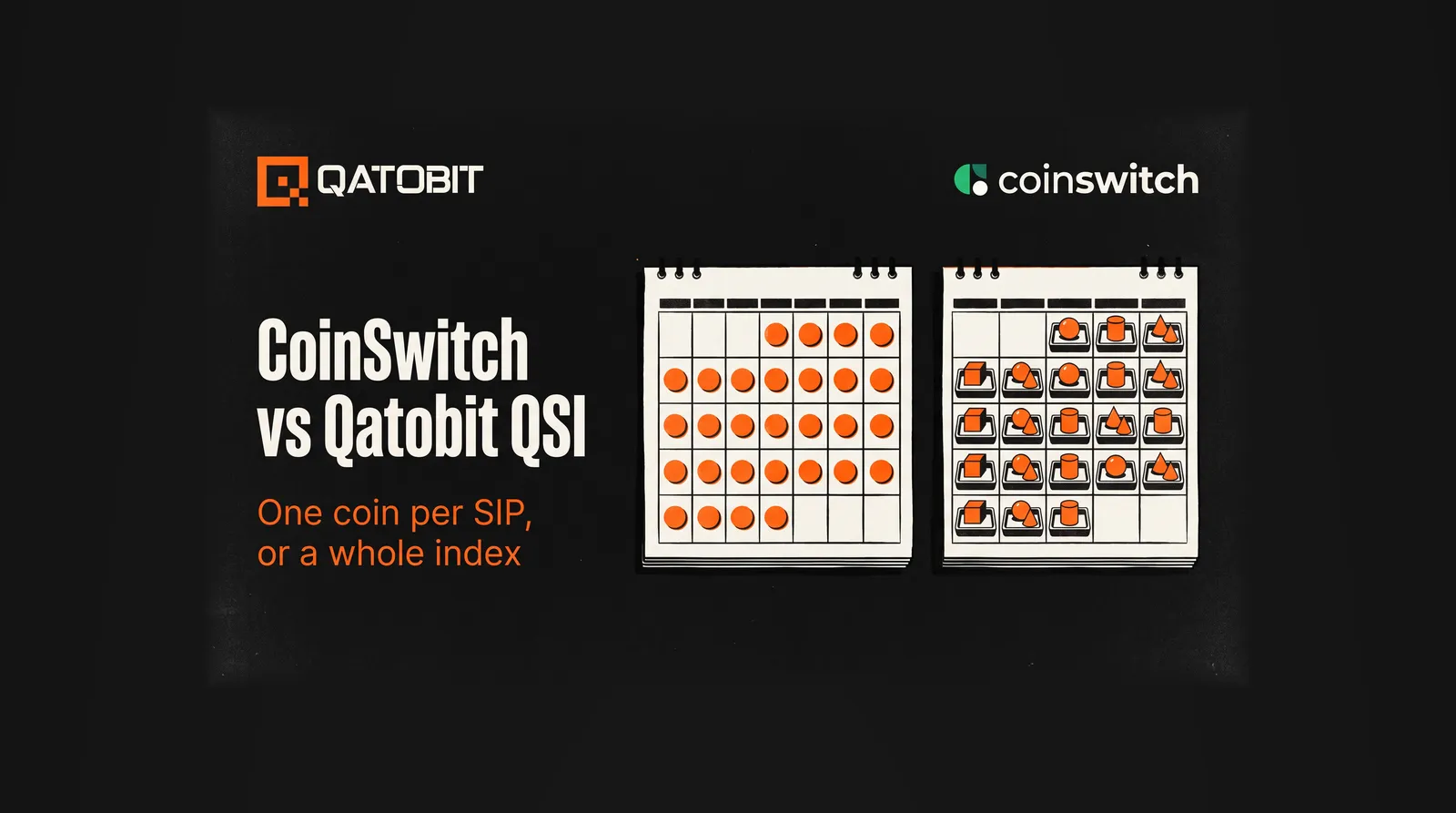
- On CoinSwitch, a five-asset spread takes five SIPs, one per crypto. The investor sets each amount. Five SIPs of ₹5,000 make ₹25,000 a month. That is 5 orders a month and 60 orders in twelve months, each sized by the investor.
- On Qatobit, QSI Growth holds Bitcoin, Ethereum, Solana, Gold and a stable reserve (USDT Earn). One SIP of ₹25,000 is 1 order a month and 12 orders in twelve months. The methodology sets the split.
The CoinSwitch page makes the same point about spreading. It says "multiple SIPs operate across different cryptocurrencies" and lists "concentrating investments in a single cryptocurrency" among common mistakes. The spread is the investor's to build there. In an index it is the product.
The count shows who holds the decision. With five SIPs the investor decides five amounts and notices when one asset has grown past the others. With an index SIP the rulebook decides, and the rebalance runs monthly without the investor.
What does a monthly rebalance change?
A rebalance is a reset of the basket to its target split after prices have moved. Say the basket has drifted, so one holding now takes more of the total than the rule allows. The rebalance sells a little of that holding and buys the ones that fell behind.
Qatobit runs this monthly on all four indices and charges 0.35 percent of the transaction amount. Take a rebalance that moves ₹10,000 of a ₹3,00,000 holding. The fee is 0.35 percent of ₹10,000, which is ₹35.
A holder of five separate CoinSwitch SIPs gets no rebalance unless they place the orders themselves. Our reading of the SIP page is that it describes none. The investor can do it by hand: sell part of the grown holding and buy the others, and pay whatever fee applies. That fee is not stated on the SIP page, which is why we show no rupee figure for it.
The arithmetic assumes a flat price and compares mechanics only.
How do the two publish proof of reserves?
Proof of reserves is a record that a platform holds at least as much as its customers are owed. The useful questions are how recent the record is, who reviewed it and whether anyone can check it.
CoinSwitch published a sixth edition on 25 May 2026. As of 31 March 2026, it reports total reserves of ₹2,360.33 crore against customer holdings of ₹1,747.25 crore, a surplus of ₹613.08 crore. It reports crypto coverage of 1.28 times and INR coverage of 2.97 times. It says the review followed the Institute of Chartered Accountants of India standard SRS 4400. It also shares wallet addresses so holdings can be checked on blockchain explorers. The listing on its Building Blocks page shows earlier editions back to the third.
Qatobit publishes live proof of reserves, available at any time, so a reader checks it today rather than against a past date. For what such a record proves, see what Qatobit's proof of reserves is. A dated edition from a reviewer and a live record answer different questions: the first is checked once and published, the second can be checked on any day.
Where CoinSwitch is genuinely stronger
CoinSwitch's SIP page says it "supports 400+ cryptos and serves more than 2.5 crore registered users". Qatobit does not list 400 plus coins and does not state a user count. An investor who wants one specific coin, such as Dogecoin or Shiba Inu, which the page names, can set up a SIP for it on CoinSwitch and cannot on Qatobit.
The entry point is lower. The page says SIPs start "from ₹100 per transaction", against ₹2,000 for a Qatobit index SIP.
CoinSwitch has the longer public record. Its About page dates the company to 2017 and lists a16z, Tiger Global and Sequoia Capital India among its backers. Its Building Blocks posts record a ₹600-crore recovery program for users affected by a 2024 exchange cyberattack.
Its Building Blocks listing shows rupee-powered crypto futures launched on 29 April 2025. It also publishes a recurring proof-of-reserves report, now in its sixth edition, reviewed under an accountancy standard. A dated disclosure reviewed by a third party is a strength, and a live record does not replace that habit.
Where Qatobit is stronger
A Qatobit index SIP buys several assets in one order, and the split comes from a methodology documented per index and published before the index launches. Every holding is named on the product pages.
The basket resets monthly on its own. Qatobit prices every basket action at one rate, 0.35 percent, shown before the investor confirms. There is no annual management fee, and no exit load, lock-in or minimum holding period on any index.
Qatobit states institutional custody, and publishes live proof of reserves, available at any time. Deposits arrive by UPI, IMPS, NEFT or RTGS, and withdrawals go directly to the linked bank account at no fee.
The QSI indices, in full
Qatobit sells four QSI indices. Three hold crypto and one holds global equities.
QSI Core holds Bitcoin, Ethereum, Gold and a stable reserve (USDT Earn). QSI Growth holds Bitcoin, Ethereum, Solana, Gold and a stable reserve (USDT Earn). QSI VRION holds Bitcoin, Ethereum and Solana with no hedge layer. QSI GEQ8 holds eight global companies in three sleeves: Apple, Amazon, Alphabet, Meta Platforms and NVIDIA (platform), Coinbase and Robinhood Markets (digital finance), and Tesla (innovation). No holding in QSI GEQ8 sits above 15 percent or below 3 percent, and its composition is reviewed quarterly. QSI GEQ8 sits outside SEBI regulation and is an index, not a fund.
All four rebalance monthly on a methodology documented per index. The minimum per index is ₹2,000, and a SIP into an index starts at ₹2,000 per cadence. A basket buy, sell or rebalance costs 0.35 percent of the transaction amount, displayed before confirmation. There is no annual management fee, and no exit load, lock-in or minimum holding period on any index. A single-asset buy or sell costs 0.4 percent and a crypto-to-crypto convert costs 0.1 percent. A crypto SIP into a single asset starts at ₹500 weekly or biweekly, or ₹2,000 monthly. Deposits arrive by UPI, IMPS, NEFT or RTGS and withdrawals go directly to the linked Indian bank account, with a ₹200 minimum each way and no fee.
Who should choose which
CoinSwitch suits an investor who wants to choose each coin, start with a small amount, and use a platform with a long record and a periodic reserve report. That investor accepts that the spread, the weights and any resets are theirs to set and keep.
Qatobit suits an investor who wants the allocation and the rebalance rule written down before the first investment, and prefers one order to five.
Someone who wants one particular coin, or futures, is better served by CoinSwitch, because Qatobit's indices are built to be held as baskets.
How this page was checked
Every CoinSwitch figure on this page was read from CoinSwitch's own pages on 9 November 2026. Those pages are the Crypto SIP page, the About page, the Building Blocks listing, the sixth Proof of Reserves post and the homepage. A figure that did not appear in the text read was dropped. The CoinSwitch pages are re-read once a month and the Last verified line is changed in place. Qatobit figures come from Qatobit's product documentation. This page compares no return and no performance.
For the question before the product question, what asset allocation is and what it decides before any pick sets out the framework. Portfolio rebalancing when one holding falls 10 percent walks through a reset. How a crypto SIP works covers the schedule itself, and what a crypto index is defines the product.
Frequently asked questions
What does a CoinSwitch crypto SIP buy?
A CoinSwitch crypto SIP buys one selected crypto at chosen intervals. Its SIP page, read on 9 November 2026, lists 400 plus cryptos to choose from. A Qatobit SIP into an index buys every holding of the index in one order.
Does CoinSwitch sell a crypto index or basket?
On the pages read on 9 November 2026 we could not find a CoinSwitch basket or index product. Its homepage lists SmartInvest as a wide range of strategies. Qatobit sells four QSI indices with every holding named.
How many orders does a five-asset SIP take?
On CoinSwitch, five assets take five SIPs, so 60 orders in twelve months at one SIP per asset a month. On Qatobit, a QSI Growth SIP is one order a month, 12 in twelve months.
Does CoinSwitch publish proof of reserves?
Yes. CoinSwitch published a sixth edition on 25 May 2026, reviewed under the accountancy standard SRS 4400. As of 31 March 2026 it reports total reserves of ₹2,360.33 crore against customer holdings of ₹1,747.25 crore. Qatobit publishes live proof of reserves, available at any time.
What does Qatobit charge on an index SIP?
Qatobit charges 0.35 percent of the transaction amount on a basket buy, sell or rebalance, shown before confirmation. There is no annual management fee and no exit load on any index.
Crypto investments are subject to market risk. Not financial advice.
“A better allocation begins with a better explanation.”
Qatobit principle
Published construction. Fixed cadence. Versioned control.