The point
No. A proof-of-reserves check shows only that a platform holds the crypto it claims to hold, on one specific day. It says nothing about what the platform owes, whether those coins are pledged somewhere else, or whether a basket that rebalances every month stayed backed through the move. The PCAOB, the US audit regulator, told investors in March 2023 to treat these reports with "extreme caution."
What "reserves" actually means
A platform's reserves are the crypto it holds on behalf of its users, sitting in wallets the platform controls rather than a wallet the user holds personally. That is the same reason custody comes up at all: your name is on the account, not on the wallet holding the coins. Proof of reserves is the practice of showing, through a cryptographic check or an outside reviewer, that those wallets hold what the platform says they hold.
The word doing the real work here is "reserves," not "proof." A reserve is a balance sheet line, a pile of coins sitting somewhere. Proving the pile exists is a smaller claim than proving the business behind it is healthy. That gap is where trust usually gets misplaced.
What a reserves check actually shows
Done properly, a reserves check adds up a defined set of wallets. It confirms the total holds at least as much crypto as the platform told its users it holds, on the day the check ran. Most reserves pages stop at that single combined total. Some methods go further with a Merkle tree. That technique lets one user confirm their own balance sits inside the total, without the platform revealing anyone else's balance.
That is a real, useful check. It rules out one specific lie: a platform simply not having the coins it claims to have.
What a reserves check cannot show
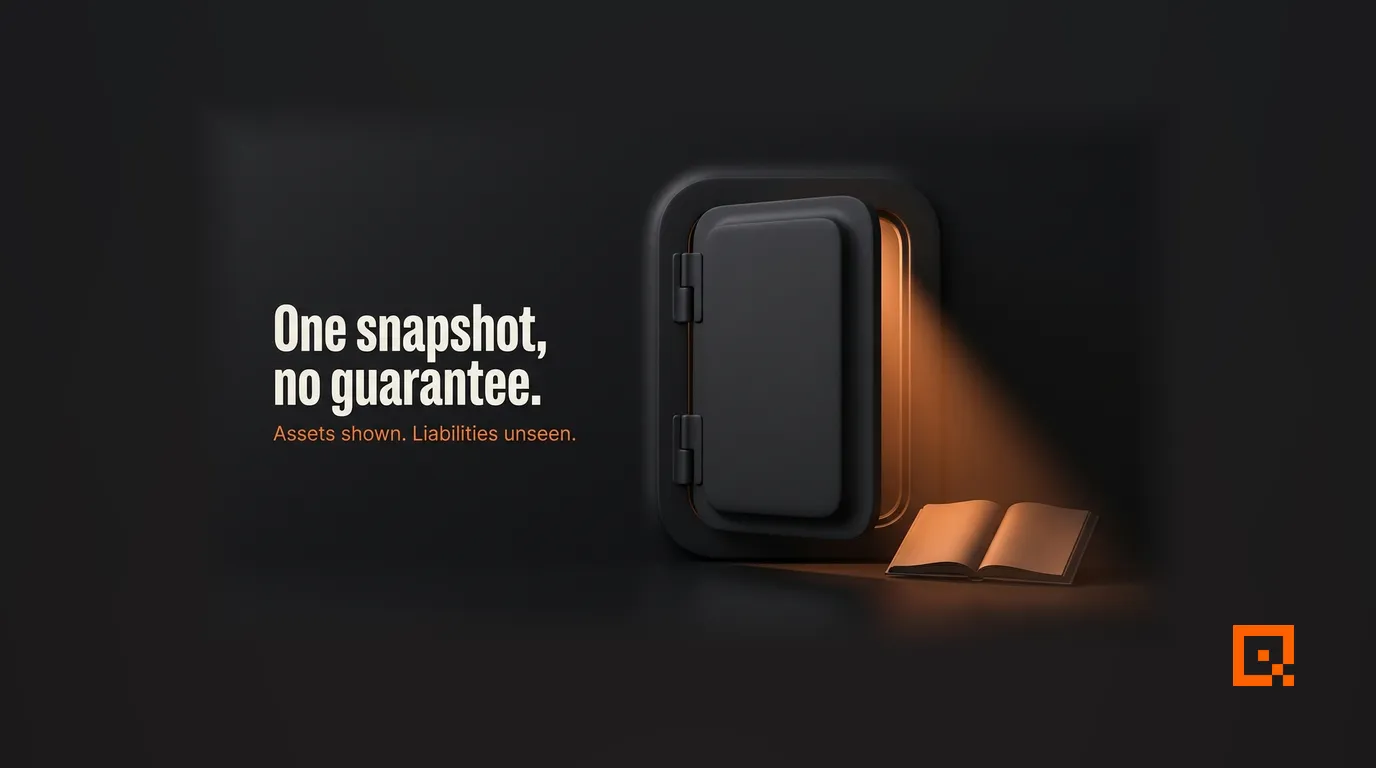
It stops there. The PCAOB's March 2023 advisory was direct about the rest. These procedures, it said, likely do not address the crypto entity's liabilities, the rights and obligations of the asset holders, or whether the assets have been borrowed. A platform can hold every coin shown in a snapshot and still owe more than it holds. Counting assets while leaving out debts is exactly the difference between proof of reserves and proof of liabilities. The same advisory called these reports not equivalent to an audit, and said they offer no meaningful assurance that customer assets will stay protected.
There is a specific way a snapshot gets gamed, and the PCAOB named it directly. Say a platform borrowed against its coins earlier in the cycle and returned them just before the check ran. Investors, the advisory says, "would not know based on the PoR Report" in that case. A page that looks clean on the day of the check may have run on borrowed coins for weeks before it.
The firm that ran these checks for the biggest names in the industry learned the same lesson from the inside. Mazars produced proof-of-reserves reports for Binance, Crypto.com, and KuCoin. It paused all crypto work in December 2022, weeks after FTX collapsed. Its own reports, the firm said, do not constitute an assurance or an audit opinion. They reflect limited findings, based on agreed procedures, at a historical point in time. Mazars gave its own reason for stopping: the gap between what these reports actually checked and what the public assumed they proved. That caution applies to every platform's reserves page, including the ones that never failed.
What actually narrows the gap for a rebalancing basket
A QSI Crypto Index does not hold a single coin sitting still. Read the difference between a crypto index and a crypto basket if the two terms still blur together for you. What follows applies to either name for the same thing. Take QSI Growth, a five-asset construction of Bitcoin, Ethereum, Solana, gold, and a stable reserve, rebalanced monthly on a fixed, calendar-defined date. Say Solana runs hard between two rebalance dates. Its share of the basket grows past target while the platform's total reserves figure for that week reports the same aggregate number regardless. Concentration limits keep any single holding from quietly taking over the index between two rebalance dates. Rebalances are not always on that fixed date either. A security failure, a break in an asset's liquidity, or a change that fails one of the index's screens can trigger an off-cycle rebalance. Each one gets the same versioned, dated documentation as a scheduled rebalance. A company-wide reserves total, checked at one moment, says nothing about whether your own basket's mix matched what you were told at that same moment. That is the honest problem. What follows is what actually answers part of it, and what still does not.
A continuously live figure blocks one specific trick
The PCAOB named the exact way a snapshot gets gamed. A platform borrows against its coins, then returns them just before the check runs. Investors, the advisory says, "would not know based on the PoR Report" in that case. That trick works only when there is one scheduled date to aim for. Qatobit's live Proof of Reserves is checkable on the holder's own schedule, rather than on a quarterly date announced in advance. Pick a random day and check the figure. There is no separate number sitting behind it for the day the platform knew someone would look. That closes off the specific trick the PCAOB described, though it does not prove your basket's mix matched target that day.
Fund segregation answers the borrowing question a snapshot cannot
The PCAOB's real worry sits between checks, in what a platform does with the coins: whether they get pledged, lent, or borrowed against for its own purposes. Qatobit's design keeps user funds separate from operational funds, with the accounting open to check whenever a holder wants to look. That structure governs what the platform's own operating rules allow it to do with your coins, independent of any single check date.
What still sits outside any reserves page
None of that is an audit. Qatobit's operating standard also names a CERT-In audit, verifiable at launch. It sits alongside the live reserves figure rather than replacing it, because an audit examines more than whether a defined set of wallets adds up on one day. The methodology behind the basket is held to the same discipline. It is versioned and dated, and a changed version stays readable in its earlier form, so nothing about how the basket is built moves quietly. Built, Not Open, and the Methodology Is Already Published explains why that standard, and every index's construction, went public before Qatobit opened to a single investor. Even together, a continuously live figure, a documented fund separation, and a named audit do not add up to a formal proof of solvency. Nothing here claims they do.
What this means for reading any platform's reserves page, including ours
Qatobit's operating standard sits on three legs: a documented security and custody architecture, a CERT-In audit named and verifiable at launch, and live Proof of Reserves. That record updates continuously instead of once a quarter. User funds are kept separate from operational funds. The accounting is open to check whenever a holder wants to look, rather than gated behind a request form or a once-a-quarter release.
None of that closes the liabilities gap the PCAOB describes. A continuously live figure, checked on your own schedule, is a stronger position than a single quarterly snapshot. So is a documented separation between user and operational funds. Neither is proof of solvency.
Everything above assumes a calm month, where the biggest source of drift is ordinary price movement between two scheduled dates. The next honest question is what happens to that same rebalance when the market itself is falling apart. Does the calendar-defined cadence described above still hold when every asset in the basket is moving at once? How a crypto index rebalances during a market crash walks through exactly that. It is worth reading before assuming a calm month's snapshot tells you anything about a volatile one.
Frequently asked questions
Does proof of reserves mean a crypto platform is solvent?
No. It shows that specified assets exist in specified wallets at one point in time. Solvency requires proving liabilities too, and the PCAOB has said these reports likely do not address liabilities at all.
What is the biggest limitation of a proof-of-reserves report?
It is a point-in-time snapshot. A platform can hold the coins it shows on the day of the check and still have borrowed, pledged, or lost them the following week.
Did an accounting firm ever stop doing proof-of-reserves work?
Yes. Mazars produced these reports for Binance, Crypto.com, and KuCoin, then paused all crypto work in December 2022. It said the reports were not audits and only reflected a historical point in time.
Does a rebalancing crypto basket make proof of reserves harder to read?
Yes. A basket that rebalances monthly changes its own composition between checks. A snapshot taken mid-cycle says less about that basket than it would about a holding that never moves.
What can I actually check on Qatobit's Proof of Reserves page?
The live reserves figure, checked at a moment you pick rather than a date announced in advance, and whether the platform documents keeping user funds separate from operational funds. Together those answer more of the PCAOB's core concern than a single snapshot, though neither is a formal proof of solvency.
Crypto investments are subject to market risk. Not financial advice.
“A better allocation begins with a better explanation.”
Qatobit principle
Published construction. Fixed cadence. Versioned control.