The point
Futures and options (F&O), contracts that take their value from a share or an index, trade for 385 minutes a session on the National Stock Exchange. SEBI's study of FY26 found 87.7 percent of individual traders in the segment lost money. A salaried day covers most of those minutes. The job needs a screen, a rulebook and a loss budget, and a day job leaves room for none of them.
How many hours does F&O trading take?
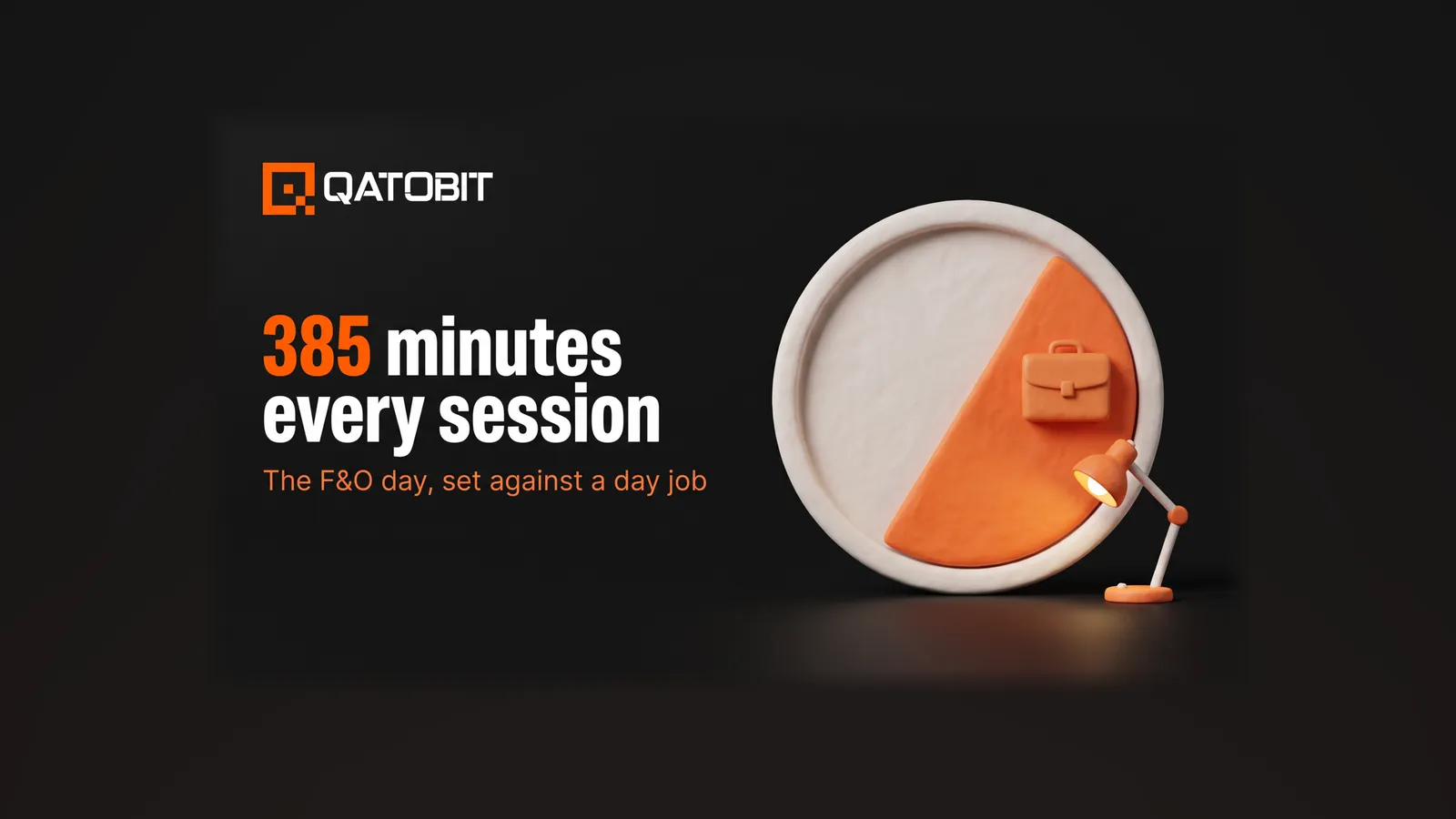
The equity derivatives segment on the National Stock Exchange opens at 09:15 and closes at 15:40, as of 28 October 2026 on the exchange's own market timings page. That is 6 hours 25 minutes, or 385 minutes, in which the price can move and a position can need a decision.
Set that against a salaried day. Suppose your desk runs from 10:00 to 18:00. The overlap with the session is 10:00 to 15:40, which is 340 minutes, or 88 percent of the F&O day. The part you keep is 09:15 to 10:00, which is 45 minutes, and the market is still settling in those minutes.
The session is only part of the job. Add the hours around it, as an assumption you can reset to your own. Say 45 minutes before the open to read the overnight news and set levels. Say 45 minutes after the close to log what you did and why. That is 385 plus 45 plus 45, which is 475 minutes, or 7 hours 55 minutes. It is a second full-time job, and the first one does not pause for it.
Why can the position not wait until the evening?
An option has a last day. On that day the contract stops existing, and whatever it was worth is settled. The SEBI study, as reported by Outlook Business, found that about 59 percent of index options turnover by individuals came from contracts expiring that same day. About 75 percent came from contracts expiring within one day, and about 97 percent from contracts expiring within one week.
Read that as a statement about how long a position lasts. Most of the money in the segment sits in contracts that live for hours. The decision to hold, cut or add is due while the market is open. A trade placed before a 10:00 meeting and checked at lunch is a trade nobody was managing for the hours in between.
A longer horizon would give you evenings, and the contracts people trade most give you none.
Who is on the other side of the trade?
The same Outlook Business report, citing the SEBI study, carries a line worth reading twice. About 99 percent of the profits made by foreign portfolio investors and proprietary traders came from algorithmic entities. These are firms whose orders are placed by software, at a speed and cost a person cannot match from a phone.
That figure describes a job. The counterparty to a part-time trader is a firm whose staff watch the same 385 minutes and have written rules for every one of them.
The loss data follows the same shape. The study counted 78.6 lakh active individual traders in FY26, down from 98.1 lakh in FY25. The share who lost money moved from 90.9 percent to 87.7 percent, so a fall of 3.2 percentage points while a fifth of the traders left. Among those who lost in two consecutive years and kept trading, about 90 percent lost again the next year.
What does the average loss look like against a real portfolio?
In August 2026 the government told the Rajya Sabha what SEBI's analysis of the top 15 brokers found. Individual traders' net losses were ₹91,685 crore in FY26, and the average loss was ₹1.16 lakh per trader, as reported by Business Today.
The sums reconcile. ₹91,685 crore is ₹9,16,85,00,00,000. Divided across 78.6 lakh traders, which is 78,60,000, it comes to about ₹1,16,600 each.
Now size it to a portfolio. Say you hold ₹1 crore and set three percent of it aside for F&O. That sleeve is ₹3 lakh. An average loss of ₹1.16 lakh is 116 divided by 300, which is 38.7 percent of the sleeve, gone in one year by the average individual trader. An average is not your outcome, but it sizes the loss the sleeve would have to survive.
One more figure from the study changes how the numbers read for a person who already holds a portfolio. Loss rates fell as equity holdings rose. About 93 percent of traders with no equity holdings made losses, against about 58 percent of those holding more than ₹10 crore in equities. A larger portfolio helped, and a majority of even that group still lost.
Where do the losses come from?
Options accounted for about 92 percent of individual traders' losses, and about 97 percent of traders were mainly option buyers. A buyer pays a premium up front, which is the price of the contract. If the contract expires without being worth more than that premium, the whole premium is lost, and with contracts expiring in hours that is the common ending.
The study also looked at traders with both profitable and losing quarters. For nearly 79 percent of them, the average gain in a good quarter was smaller than the average loss in a bad one. A trader can win more often than they lose and still go backwards, because the wins are small and the losses are large.
Some individuals do make money: about one in eight traders, the 12.3 percent outside the 87.7 percent, did not lose. A person with other commitments still starts behind desks that have none.
What is the job description, written honestly?
A part-time F&O trader needs five things. A screen for 385 minutes a day. A written rulebook for entries and exits. A loss limit per trade and per day, obeyed. Capital they can lose without changing their life. A way to act on an expiring contract in the hour it matters. If any one is missing, the trade is a guess with a ticker on it.
The investor's job description is short. Decide how much of the portfolio the thesis deserves and over what horizon, then let a rule do the monthly work. Qatobit's QSI indices are built for that job. A QSI index is a basket of assets, designed and rebalanced monthly by Qatobit on a published methodology. The investor makes one decision, and the methodology runs everything downstream. QSI Growth holds Bitcoin, Ethereum, Solana, Gold and a stable reserve. The fee is 0.35 percent per rebalance, with no annual management fee and no exit load.
Qatobit's founders have run both jobs. Kumar Sonu co-founded a commodities and algorithmic trading firm in Trichy in 2013 and later invested his own book in crypto. Two crashes, the Trichy firm's over-risky trading and 2022 in crypto, are why Qatobit is rules-based and built for investing rather than trading.
The view here is plain. If you hold a portfolio and have a day job, the F&O desk is the wrong second job, and a monthly rule is the right second sleeve. To invest instead, you can invest in QSI Growth or start a Bitcoin SIP, an Ethereum SIP or a Solana SIP.
Source lines. Exchange hours: NSE market timings page, https://www.nseindia.com/market-data/market-timings, read 28 October 2026. FY26 trader count, net loss and average loss: Business Today, https://www.businesstoday.in/markets/story/unique-individual-investors-in-fo-trading-declines-in-fy26-but-average-per-person-loss-widens-548559-2026-08-11, read 28 October 2026. Loss rates, expiry concentration and algorithmic profit share: Outlook Business reporting of the SEBI study, https://www.outlookbusiness.com/markets/nearly-90-retail-fo-traders-lost-money-in-fy26-why-do-they-keep-coming-back, read 28 October 2026.
Other pieces in this series work the same argument from the other side. The two job descriptions set the trader's spec beside the investor's. The part-time arithmetic prices a round trip in full. The intraday piece asks the same question of a person with a job.
Frequently asked questions
Can a salaried person make money in F&O trading?
Some do. In FY26, 87.7 percent of individual F&O traders lost money, so about one in eight did not. The segment runs 385 minutes a day, which overlaps most of a salaried day. A part-time trader has less time on the screen than the desks on the other side.
What are the F&O trading hours in India?
The equity derivatives segment on the National Stock Exchange opens at 09:15 and closes at 15:40, as of 28 October 2026. That is 385 minutes a day, on days the exchange is open.
How many F&O traders lose money?
SEBI's study found 87.7 percent of individual equity derivatives traders lost money in FY26, down from 90.9 percent in FY25. The aggregate net loss was ₹91,685 crore across 78.6 lakh traders, about ₹1.16 lakh each.
Why do so many F&O positions need attention during market hours?
Most are in contracts that end within a day. About 59 percent of individual index options turnover came from contracts expiring the same day, and about 75 percent from contracts expiring within one day. The position has to be managed while the market is open.
What can I do instead if I cannot watch a screen?
Hold a basket on a monthly rule. A Qatobit Crypto SIP into a QSI index starts at ₹500 weekly or biweekly or ₹2,000 monthly, and the per-index minimum is ₹2,000. The index rebalances monthly on a published methodology, so no part of it needs you at 09:15.
Crypto investments are subject to market risk. Not financial advice.
“A better allocation begins with a better explanation.”
Qatobit principle
Published construction. Fixed cadence. Versioned control.