The point
A financial plan earns its keep in the weeks it tells you to do nothing. The plan exists so that a falling day, a rising day or a loud headline has no vote on your allocation. If your plan needs rewriting every time the market moves, it was a forecast, and a forecast is the one thing a plan is built to avoid.
What is a financial plan actually for?
A financial plan is a set of decisions written down before the market gives you a reason to make them badly. It names how much sits in each asset, what the money is for, how far each holding may drift, and which events permit a change. The writing happens in a calm week so the acting can happen in a loud one.
Dhirendra Kumar, Founder and CEO of Value Research, made the same point at the fourth Global Financial Planners Summit 2026 hosted by 1 Finance in Mumbai. The Economic Times report, carried by inkl, quotes him saying financial advice is "equally about preventing costly financial mistakes". Its headline is that the best financial advice is often to do nothing.
That headline does not make plans optional. Doing nothing works only when something was decided earlier, and without a plan inaction is just drifting.
Why is doing nothing so hard to do?
Doing nothing is hard because every screen invites a reaction. A price moves, a feed fills with opinions, and an idle portfolio starts to feel like negligence. Action feels like responsibility even when it is only motion.
Kumar describes the same pull in Why I wrote Money, Markets and Mistakes on Value Research. He points readers back to "diversification, asset allocation, compounding, and the discipline to do nothing when the world insists you do something". He also writes that he has watched "the same old drama play out in new costumes".
My view: the market tests one thing, whether you will break a decision you made in a calm week. Most people know the right behaviour and still fail, because a plan that lives in your head has no authority over you. A plan on paper does.
A plan that revises itself every few days is a forecast
Count the times a plan changed in the last quarter, and ask what changed each time. If the answer is "the market moved", the plan was a prediction about the market, with a spreadsheet around it.
A real plan changes for reasons that belong to you: the goal moved, the income moved, the liability moved. It does not change because a number on a screen went up or down by 1.5 percent. Prices are an input to a plan, and the plan decides what an input is allowed to change.
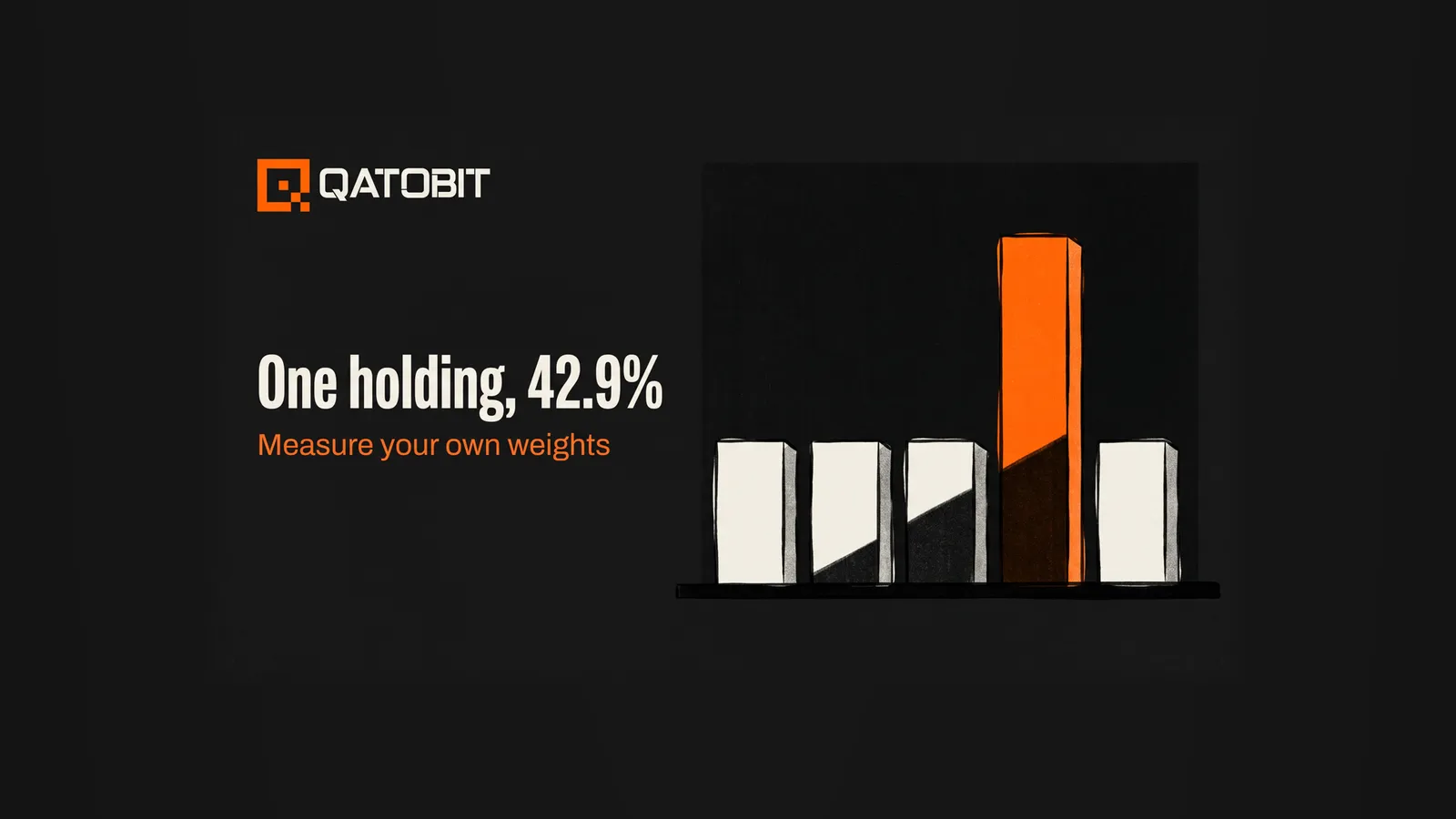
Think of a ₹1 crore portfolio with a 3 percent sleeve, meaning a defined slice, set aside for crypto. Three percent of ₹1 crore is ₹3 lakh. The plan says the sleeve may drift between 2 percent and 4 percent, which is ₹2 lakh to ₹4 lakh, before anything is done. A day that moves the sleeve from ₹3 lakh to ₹2.9 lakh asks for nothing. The plan has already answered, and the answer is no.
What does a plan actually license you to do?
A plan licenses three actions, and only three.
1. A scheduled rebalance
A rebalance is moving a portfolio back to its target weights, selling what has grown past its share and buying what has shrunk. A plan fixes the date or the band in advance. In the example above, the sleeve crossing ₹4 lakh, or falling below ₹2 lakh, is the signal. The action is mechanical: bring it back toward ₹3 lakh. Nobody has to feel brave.
At Qatobit this is how an index works. A QSI Crypto Index is a curated basket of digital assets that Qatobit designs and rebalances monthly on a published methodology. The schedule sets the date, so the investor never has to pick one. The only index fee is 0.35 percent per rebalance, with no annual management fee. For how a rebalance behaves in a drawdown, see how a crypto index rebalances during a market crash.
2. A change in your own circumstances
A plan may be rewritten when the person it serves changes. A new liability, a new income, a goal that moved closer or further away. The test is whether the reason would still be true if the market had stood still.
3. A breach of your own limits
If the sleeve is at 5 percent when the plan said no more than 4, the plan was broken, and the repair is part of the plan. That repair is the plan doing its job.
Everything else is a headline, a forecast from someone with no stake in your outcome, a friend's gain or your own boredom.
What does doing nothing look like in rupees?
Take ₹25,000 a month. Over twelve months that is 12 × ₹25,000 = ₹3 lakh going in on a fixed date. The plan has already decided the amount, the date and the asset. A SIP, short for systematic investment plan, is a standing instruction that moves a fixed amount into an investment on a schedule. That is doing nothing, automated, with no decision due in any of the twelve months.
Now give the same person a plan with no schedule and ask what the twelve decisions cost. Each month brings a choice about whether this is the right time. Twelve choices, each made under whatever mood the week supplied. The amount invested is identical on paper. The number of times the plan can be broken went from zero to twelve.
For a lump sum the arithmetic is the same shape. A ₹5 lakh allocation made once, on a schedule of review and rebalance, leaves two or three dates a year on which anything needs deciding. The rest of the year has no agenda.
How does this fit a portfolio that includes crypto?
Crypto moves faster than most assets a portfolio holds, so the pull to react is stronger. That is the case for sizing the sleeve small enough to leave alone and writing the band down. The framework for sizing a sleeve is in crypto allocation for an Indian portfolio. Whether the asset class belongs at all over a long horizon gets its own answer in does crypto belong in a long-term portfolio.
The mistakes that grow with the portfolio are traced in why every mistake costs more as you grow. The short version: a reaction that costs ₹10,000 on a small holding costs ₹1 lakh on a ten times larger one, and the plan is the cheapest insurance against it.
An index with a published monthly rebalance is a plan that acts on schedule rather than on mood. If the allocation fits your plan, you can invest in QSI Growth and let the schedule carry it.
What to take from this
Write the plan while the week is quiet. Put numbers on it: the weights, the band, the dates, the three events that permit a change. Then let it say no, often, and let the no stand. Building the plan is the easy part of financial planning; leaving it alone on the day it tells you to is the hard one.
Frequently asked questions
What is financial planning in simple terms?
Financial planning is deciding in advance how much goes into each asset, what the money is for and which events allow a change. The decisions are written down so a market move cannot rewrite them on a bad day.
Does a financial plan mean never acting on the market?
No. A plan licenses three actions: a scheduled rebalance, a change in your own circumstances and a repair when a limit is breached. Price moves alone are not on that list.
How often should a financial plan change?
Only when your circumstances change or when a written band is crossed. A plan that changes every time the market moves by a small percentage is a forecast, not a plan.
What is a rebalance band?
A rebalance band is the range a holding may drift within before it is brought back to target. On a 3 percent sleeve of a ₹1 crore portfolio, a band of 2 to 4 percent means ₹2 lakh to ₹4 lakh.
How does a QSI Crypto Index handle rebalancing?
A QSI Crypto Index is rebalanced monthly by Qatobit on a published methodology, so the investor does not choose the date. The fee is 0.35 percent per rebalance, with no annual management fee.
Crypto investments are subject to market risk. Not financial advice.
“A better allocation begins with a better explanation.”
Qatobit principle
Published construction. Fixed cadence. Versioned control.