The point
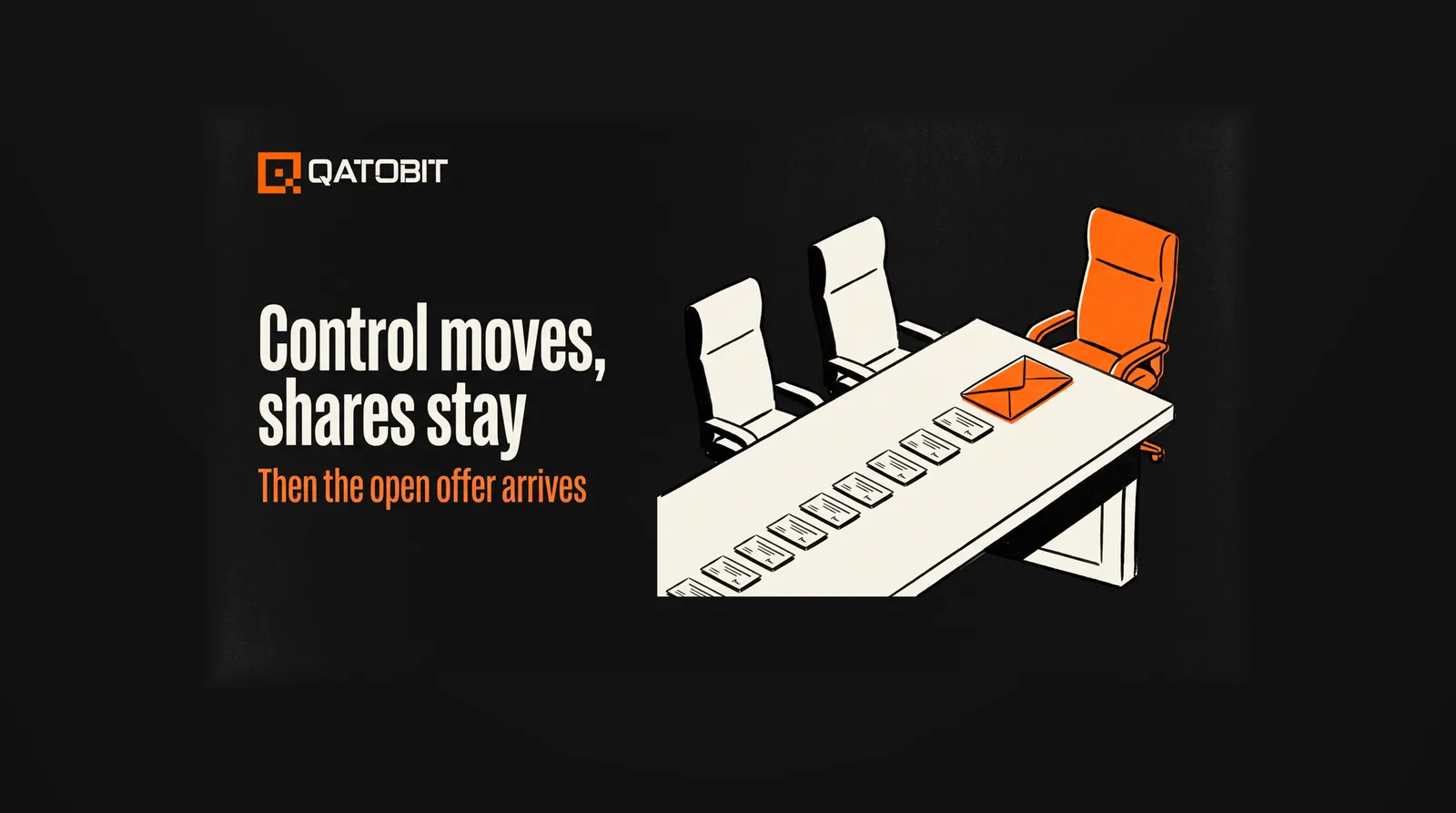
The Cabinet committee approved the sale of 60.72% of IDBI Bank to a Fairfax-backed buyer at ₹81 a share, about ₹52,878 crore in all. The sale is not complete. A holder's real decisions come later, when the open offer to minority shareholders is announced with its own price and timetable.
What has been approved, and what has not?
The approval is real and the completion is not. On 14 October 2026 the Cabinet Committee on Economic Affairs cleared the sale of 60.72% of IDBI Bank to 10955230 Canada Inc, a Fairfax Financial Holdings vehicle. The government sells 30.48% and Life Insurance Corporation of India (LIC) sells 30.24%.
The price is ₹81 a share, ₹52,878.08 crore in all. Kotak Neo reports that this is above the ₹75.99 benchmark, which is the average of two independent valuations. Outlook Business adds that earlier offers stayed below a reserve price of ₹94.42 a share and were turned down.
Three steps remain, in this order, per Kotak Neo's report of 23 October 2026. The Reserve Bank of India (RBI) must clear Fairfax. The share purchase agreement is then signed. Fairfax then makes an open offer to minority shareholders. The government expects the sale to complete by the end of FY27.
Sources, each read on 25 November 2026: Kotak Neo, published 23 October 2026. Outlook Business, published 14 October 2026. The latest report read for this piece lists RBI clearance as pending, so check the exchange filings for anything newer.
What changes for a minority holder when control passes?
A minority holder is somebody who owns shares without control of the company. For that holder, four things move at once: control, the board, the supply of shares and the exit route.
Control and the board
Management control passes to Fairfax. Outlook Business reports that the government will keep 15% and LIC 19% after the sale, a joint 34%. Kotak Neo reports that both will withdraw their nominees from the bank's board.
For a holder, that means the two largest shareholders of the past decade stop sitting at the table. Responsibility for managing the bank and providing capital when it is needed moves to the buyer, per Kotak Neo.
Moneylife adds a limit. Under the Banking Regulation Act, 1949, it reports, Fairfax's voting rights will be capped at 26% however much equity it owns. Ownership and votes are therefore two different numbers for this bank.
The supply of shares
Two sellers are still in the register after the deal. LIC must bring its stake down from 19% to 15% within two years, per the DIPAM Secretary quoted by Outlook Business. Kotak Neo adds that the government has been authorised to sell its residual stake through the open market.
That is more shares that can reach the market over time. Neither source says what this does to the price. The fact a holder can use is narrower: the number of shares in public hands is not fixed at today's level.
The reference price
The deal sets one number everyone now quotes, ₹81. Moneylife notes that the share closed at ₹93.62 on 14 October 2026, well above it. A deal price and a market price are two separate facts, and a holder needs both.
How does the open offer work for a holder?
An open offer is the buyer's invitation to the remaining shareholders to sell to it, and nobody is obliged to accept. Under SEBI's takeover regulations, Moneylife reports, Fairfax must make an open offer to public shareholders for up to 26% of the bank.
Moneylife works through the likely price. A 2022 amendment to the takeover rules, it explains, removed the market-average test where the government sells control of a public sector company. So the offer price will most likely stay at the negotiated ₹81. The caveat it gives is IDBI's classification as a private-sector bank since 2019, which SEBI could read differently. That is an analyst's expectation, and no offer price has been announced.
The size of the offer decides whether everyone who wants to sell can. Moneylife puts the shares in public hands at barely 5%, since the government and LIC held nearly 95%, while the offer can absorb up to 26%. It concludes that every holder who wants to tender can be accommodated in full, and that Fairfax would reach at most about 66% if every public share were tendered. The offer is about five times the size of the float, since 26 ÷ 5 = 5.2.
Moneylife's own reading of the choice is plain: tendering makes sense only if the market price falls below the final offer price. The offer price, size and timetable are not yet announced, so none of this is a decision a holder can take today.
What does the arithmetic look like on a ₹3 lakh position?
Take three percent of a ₹1 crore portfolio held in IDBI Bank, which is ₹3,00,000. This is an illustration with named assumptions, not a forecast. It uses the ₹93.62 close on 14 October 2026 as the market price and ₹81 as the offer price, though the offer price is not yet announced.
At ₹93.62 a share, ₹3,00,000 buys 3,204 shares, since ₹3,00,000 ÷ ₹93.62 = 3,204.6 and a share cannot be split. Their market value is 3,204 × ₹93.62 = ₹2,99,958.
Tendered at ₹81, the same 3,204 shares bring in 3,204 × ₹81 = ₹2,59,524. The gap is ₹2,99,958 − ₹2,59,524 = ₹40,434, which is 13.5% of the market value.
So in that picture ₹81 is a reference point to hold in mind, not a reason to move. If the market price sat below ₹81 instead, the same arithmetic would run the other way. The number that decides is the one printed in the final offer document, set against the market price on the day the offer closes.
What should a holder wait for?
Four documents or events, in the order they arrive, tell a holder what is actually on the table. Each one replaces an assumption in this piece with a fact.
First is RBI clearance for Fairfax, which Kotak Neo lists as the next major step. Second is the signed share purchase agreement. Third is the public announcement of the open offer, which carries the price and the size. Fourth is the letter of offer, which carries the tendering procedure and the dates.
LIC's 2018 open offer for the same bank also ran through a public announcement and a letter of offer, both filed on the exchange. Read each one the day it appears.
Two terms from the deal are worth knowing even though they do not touch a holder's decision directly. Outlook Business quotes the DIPAM Secretary that the buyer's invested capital is locked in for three years and that the IDBI name will stay. Moneylife reports that Fairfax must merge CSB Bank into IDBI Bank or exit it within two years of signing. RBI norms do not allow one promoter to run two banks.
Where does this leave a holder?
Where a minority holder stands depends on facts that do not exist yet. The approval is settled, the price paid to the sellers is ₹81, and the rest depends on an RBI decision and an offer document.
A single listed company is a position inside a larger allocation, and a change of control is the moment to ask how big that position is. Our piece on concentration risk works through what happens when one holding decides the result. Sizing it is the same discipline as sizing any holding. Two longer reads cover it: a framework for sizing an allocation and what happens to your basket if the platform shuts down.
Frequently asked questions
Has the IDBI Bank sale to Fairfax been completed?
No. The Cabinet committee approved it on 14 October 2026 for ₹52,878.08 crore. Kotak Neo reports that RBI clearance, the share purchase agreement and the open offer are still to come. The government expects completion by the end of FY27.
How much of IDBI Bank is being sold?
60.72%, of which the government sells 30.48% and LIC 30.24%. After the sale, Outlook Business reports, the government keeps 15% and LIC 19%.
Will there be an open offer for IDBI Bank shareholders?
Yes. Fairfax must make an open offer for up to 26% of the bank under SEBI's takeover regulations, per Moneylife, after the share purchase agreement is signed. The price, size and dates will come with the public announcement.
Do IDBI Bank shareholders have to sell in the open offer?
No. An open offer is an invitation, not an obligation. Moneylife's reading is that tendering makes sense only if the market price falls below the final offer price.
What is the ₹81 price?
It is the price Fairfax pays the government and LIC per share for the 60.72% stake. Kotak Neo reports it is above the ₹75.99 benchmark derived from two independent valuations. It is not the open offer price, which has not been announced.
Crypto investments are subject to market risk. Not financial advice.
“A better allocation begins with a better explanation.”
Qatobit principle
Published construction. Fixed cadence. Versioned control.