The point
The Nifty rose 2,812 points, or 12.65 percent, between 8 October and 8 November 2026. Over the same month 769 stocks fell (ACE Equity data, reported by the Economic Times). Market breadth is the measure of how many stocks share in a move. When breadth is narrow, an index can climb on a handful of names while most of a portfolio goes nowhere.
What does market breadth measure?
Market breadth counts how many stocks take part in a move, where the index level counts only how far the weighted average travelled. Three readings are in common use.
The first is advances against declines: on a given day or over a month, how many stocks rose and how many fell. The second is the share of stocks trading above their own 200-day moving average, which is the average closing price over the last 200 sessions. The third is the gap between a cap-weighted index and the same stocks weighted equally.
Cap-weighted means each company counts in proportion to its market value. A large company moves the index more than a small one, whatever the number of stocks behind it.
How narrow was the rally to 8 November 2026?
The numbers from the month to 8 November 2026 describe a market moving on very few names. ACE Equity data, reported by the Economic Times on 11 November 2026, shows 769 stocks lower while the Nifty gained 12.65 percent.
SAMCO Securities' Apurva Sheth gave the index figures for the same month. The Nifty Top 10 Equal Weight index gained 10.64 percent. The Nifty Midcap 150 and the Nifty Smallcap 250 each fell 2.74 percent. The Nifty Microcap 250 fell 5.32 percent.
Individual stocks sat at both ends. In Sheth's review period ICICI Bank and Infosys each gained 16 percent, and Bharti Airtel gained 14.61 percent. In the ACE Equity data, eMudhra fell 33.73 percent and Genesys International fell 31.58 percent.
Source: Economic Times, "Hidden pain! Why did investors lose money in 750 smallcaps when Nifty rallied 2500 points?", published 11 November 2026, read 12 November 2026.
Why does the Nifty hide how few stocks led?
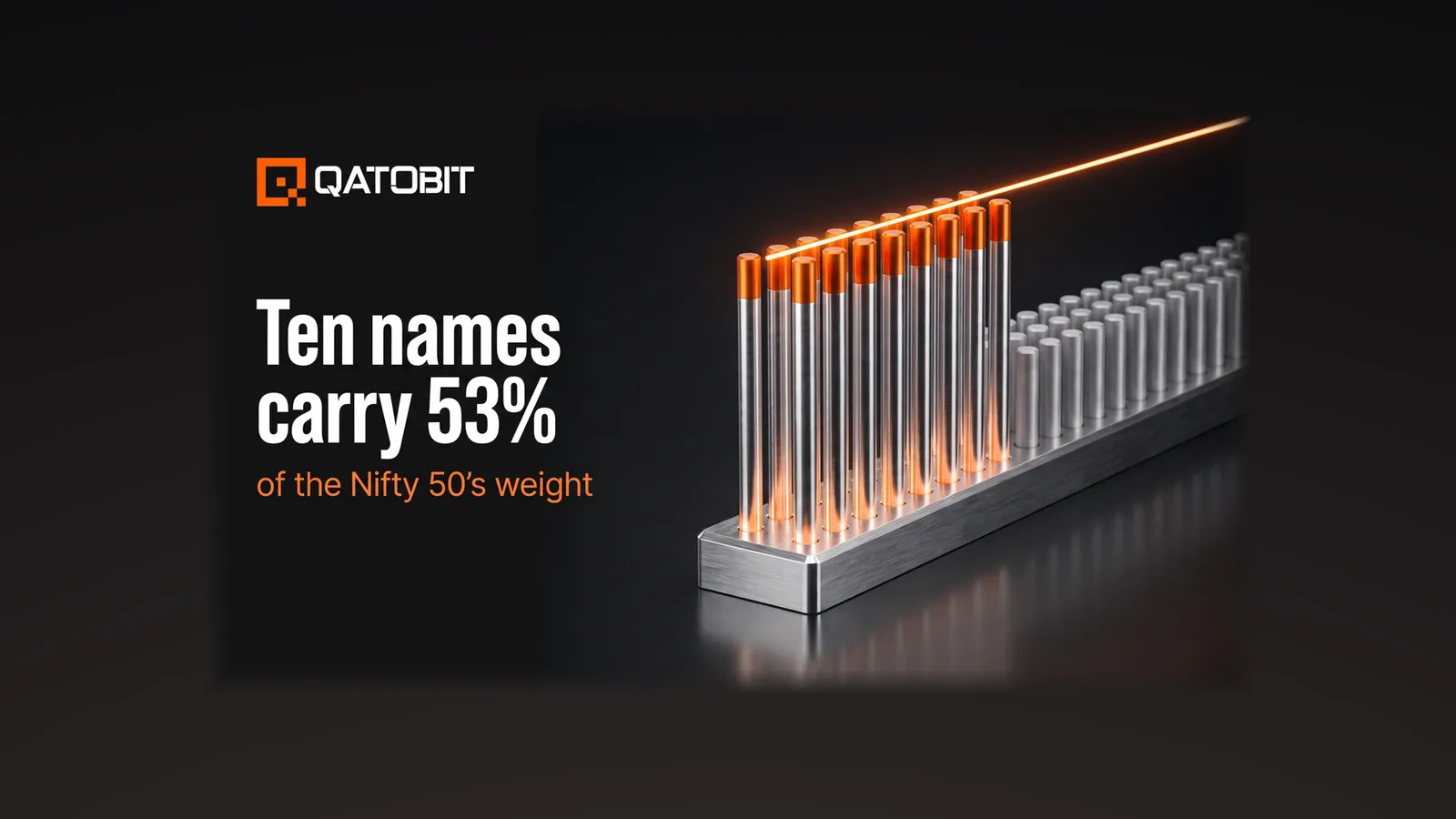
The Nifty 50 is weighted by free float market capitalisation, so the largest companies decide most of what the index does. NSE Indices' factsheet dated 30 October 2026 lists the ten largest weights. They are HDFC Bank 9.95 percent, ICICI Bank 9.39 percent, Reliance Industries 7.30 percent and Bharti Airtel 5.63 percent. Then Larsen & Toubro 4.25 percent, Infosys 3.92 percent, State Bank of India 3.73 percent and Axis Bank 3.28 percent. Kotak Mahindra Bank carries 3.19 percent and Bajaj Finance 2.40 percent.
Those ten add up to 53.04 percent of the index. Financial services alone is 37.13 percent of it. The other forty names share the remaining 46.96 percent.
The Economic Times reports, citing Reuters, that foreign investors bought more than USD 4.1 billion of Indian equities in November. Large, liquid companies suit that kind of buying because a big order does not move their share price much. Money arriving in that shape lands at the top of the weight list, and the index registers it in full.
Source: NSE Indices, Nifty 50 factsheet, niftyindices.com, dated 30 October 2026, read 12 November 2026.
What does it look like for a portfolio?
A portfolio is a set of weights too, and the weights decide which half of the market it sat in. Take a ₹1 crore portfolio held as ₹50 lakh in a Nifty 50 exposure and ₹50 lakh in a Smallcap 250 exposure. Use the index moves above for the month to 8 November 2026.
The Nifty half moved by 12.65 percent: ₹50,00,000 × 12.65 / 100 = ₹6,32,500 gained.
The Smallcap 250 half moved by minus 2.74 percent: ₹50,00,000 × 2.74 / 100 = ₹1,37,000 lost.
The net is ₹6,32,500 minus ₹1,37,000, which is ₹4,95,500, or 4.955 percent of the ₹1 crore. The Nifty printed 12.65 percent and the portfolio held 4.955 percent, over one month of history.
Sheth's explanation of the gap is short: "you don't own what is moving up."
A portfolio can look diversified by number of holdings and still sit almost entirely outside the stocks the index leaned on.
Why does knowing breadth not fix it?
Breadth is easy to read and hard to act on. A reader can see in a minute that 769 stocks fell. What the number cannot say is when the move turns, or which of the other 750 stocks would have joined the heavyweights.
The Economic Times piece names two causes. One is valuations that had reset in the larger stocks during the correction that began in January 2026. The other is foreign buying that favours liquid companies. It says the next test is whether that buying and earnings reach beyond the largest names, and it gives no date for that.
Breadth tells a holder what they owned after the month has ended, which makes it a poor signal to trade on. A part-time holder who rotates into whatever is leading needs to have known the leaders before the month began. By the time breadth is visible, the lead sits in a few names that have already moved.
The alternative is to decide ownership by a written rule and keep the rule fixed. The rule sets what is held and in what proportion without knowing which names will lead, so the holder is not the one guessing.
How does an index own what it owns?
An index is a rule that turns a list of assets into weights, and the rule is the whole product. It states what qualifies, how much each holding gets and when the weights are reset. The holder's decision is made once, on the rule, and the rule then does the work month after month.
Qatobit's QSI indices follow that pattern. There are four, QSI Core, QSI Growth, QSI VRION and QSI GEQ8, each with a documented methodology, and three of the four hold crypto (GEQ8 holds global equities). Each one rebalances monthly, which means the weights are reset to the rule's targets once a month. The investor holds proportional exposure to every asset in the index, and the weights are published on the index pages.
QSI Growth, for example, holds Bitcoin, Ethereum, Solana, Gold and a stable reserve (USDT Earn), so no single month's leader is the only thing in the portfolio. A basket buy, sell or rebalance carries a fee of 0.35 percent, and there is no annual management fee. The rebalance reports show what was sold and what was bought around each reset.
What that describes is who decides what is held: a rule the investor read in advance, rather than a view formed after a month like the one above. It predicts nothing about what any index will do.
What breadth reading is worth checking on a portfolio?
Two checks take a few minutes. List each holding's weight and add up the ten largest, which is the same sum done on the Nifty 50 above. Then ask how many of those holdings would have to move together for the portfolio to follow an index.
If ten holdings carry more than half the weight, the portfolio is as narrow as the Nifty is. Whether that is intended is the allocation question, and it is worth settling before a month like the one above settles it.
For the rule-based side of the question, the explainer on what a crypto index is sets out how weights get decided. Concentration risk when a few holdings decide everything covers the ten-names check in more detail. Portfolio rebalancing when one holding falls 10 percent shows what a reset does to the weights. What asset allocation is and what it decides before any pick explains why the weights come first.
Frequently asked questions
What is market breadth?
Market breadth measures how many stocks take part in a market move. It is read through advances against declines, the share of stocks above their 200-day moving average, and the gap between a cap-weighted index and an equal-weighted one. In the month to 8 November 2026, 769 stocks fell while the Nifty gained 12.65 percent, which is a narrow market.
Why did the Nifty rise while 769 stocks fell?
The Nifty 50 is weighted by free float market capitalisation, and its ten largest names hold 53.04 percent of it (NSE Indices factsheet, 30 October 2026). The Economic Times reports foreign buying of more than USD 4.1 billion in November, concentrated in large, liquid companies. Money in a few heavyweights lifts the index while smaller stocks stay flat or fall.
Does a rising Nifty mean my portfolio is rising?
No. The Nifty reflects its own weights, and a portfolio has different ones. In the worked example above, the ₹1 crore portfolio split evenly between a Nifty 50 exposure and a Smallcap 250 exposure moved 4.955 percent. The Nifty moved 12.65 percent in the month to 8 November 2026.
Is market breadth a signal to trade on?
Breadth reports what has already happened across the market, and it does not say when it will change. A holder who rotates after a narrow month is acting on a lead that sits in a few names that have already moved. Breadth is better used as a check on how concentrated a portfolio is.
How does a rule-based index handle a narrow market?
A rule-based index sets what is held and in what proportion in advance, and resets those weights on a schedule. Qatobit's QSI indices rebalance monthly, hold proportional exposure to every asset in the index and publish their weights. The rule does not forecast which holding will lead, so the investor is not asked to.
Crypto investments are subject to market risk. Not financial advice.
“A better allocation begins with a better explanation.”
Qatobit principle
Published construction. Fixed cadence. Versioned control.