The point
Nvidia added $952 billion to its market value in a single session on 23 November 2026, after its board reinstated Jensen Huang as chief executive. The Nation reports the gain at 31.48 percent, the stock's largest one-day percentage rise since May 2003. It recovered only part of what had been lost, and a cap-weighted index passes every bit of that swing to the person who holds it.
What happened to Nvidia's market cap?
Nvidia's market cap is the share price multiplied by the number of shares. The Nation reports it lost roughly $1.5 trillion after concerns about Huang's conduct became public on 8 November 2026, then regained $952 billion on 23 November. The stock closed at $165.05 on 23 November, up from $125.53 on 20 November.
The Nation reports he resigned on 11 November. Euronews reports that the company announced the resignation on a Thursday and that the shares closed at $166.19 that day, down 4.3 percent. It also reports that Nvidia had lost about $1.8 trillion in market value since its record close of $239.24 on 6 October 2026.
On 23 November, Nvidia's own release said the board voted unanimously to reinstate Huang as President, Chief Executive Officer and board member, effective immediately. The board said it had received input from senior levels of the United States government and that a committee of independent directors would complete its investigation.
Source: The Nation Thailand, "Nvidia shares rise 31.48% on 23 Nov as Huang returns as CEO", https://www.nationthailand.com/news/world/40073843, read 24 November 2026.
Source: Euronews, "Nvidia has lost nearly $2tn in value. What could it be worth without Jensen Huang?", https://www.euronews.com/2026/11/13/nvidia-has-lost-nearly-2tn-in-value-what-could-it-be-worth-without-jensen-huang, read 24 November 2026.
Source: NVIDIA Newsroom, "NVIDIA Board Reinstates Jensen Huang as President, CEO and Board Director", https://nvidianews.nvidia.com/news/nvidia-board-reinstates-jensen-huang-as-president-ceo-and-board-director, read 24 November 2026.
How big was the round trip, in plain arithmetic?
A 47.5 percent fall followed by a 31.5 percent rise leaves the shares well short of the start. Take the record close of $239.24 on 6 October 2026 as the start. The close of $125.53 on 20 November is 47.5 percent below it, because (125.53 minus 239.24) divided by 239.24 is minus 0.475.
The rise to $165.05 on 23 November is 31.48 percent, because 165.05 divided by 125.53 is 1.3148. Yet $165.05 still sits 31.0 percent below the record close, because (239.24 minus 165.05) divided by 239.24 is 0.310. To get back to $239.24 from $165.05, the shares need a further 44.9 percent.
A loss is measured against a bigger base than the gain that follows it, so the gain has to be larger in percentage terms just to break even. The same arithmetic holds for any drawdown, including Bitcoin's fall alongside US tech stocks. Nobody can say from this arithmetic where the price goes next, and this piece makes no forecast. It only shows how the same move reads differently going down and coming back.
Prices above are share prices in US dollars as of the closes named. Exchange-rate moves against the rupee are left out.
Why does one person move a trillion dollars of value?
Investors price a company on what it will earn, and they pay a premium when they trust the person steering it. Bloomberg Intelligence analyst Kunjan Sobhani, quoted by Euronews, said Huang's departure was unlikely to change earnings estimates for Nvidia's 2027 and 2028 financial years. His concern was longer-term risks around succession, dealmaking and scrutiny over China, as investors reassess what he called the "Jensen premium".
Euronews also reports that analysts at Yorkville Ives estimated Nvidia was worth $225 a share without Huang as chief executive, 25 percent below their $300 estimate with him in charge. Those are one firm's estimates before the resignation, not a prediction of any price.
So the price carries two parts: what the business earns, and what investors believe about who leads it. The second part can be repriced in a day, while the first changes over quarters.
How does a cap-weighted index pass that swing on?
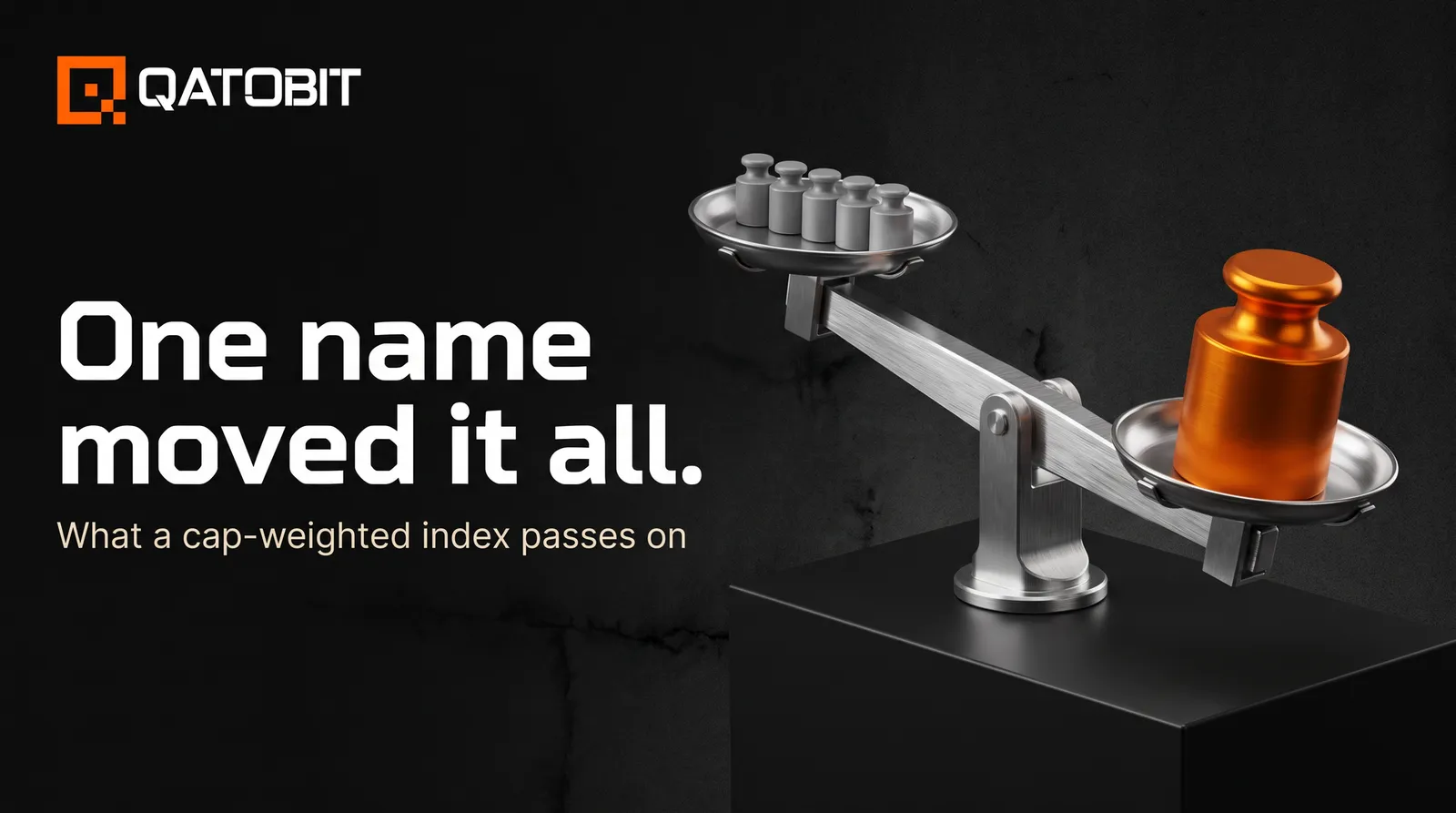
A cap-weighted index gives each company a share in proportion to its market value. A company that grows larger gets a larger weight automatically. If you hold such an index through a US index fund or an ETF, you own Nvidia whether or not you chose it.
Take an illustration with made-up weights, which shows the mechanism and nothing else. Say you hold ₹1 crore in a global equity index and Nvidia is 5 percent of it, which is ₹5,00,000 at the record close. At the 20 November close, with every other holding unchanged, that position is worth ₹5,00,000 multiplied by 0.5247, or about ₹2,62,350.
At the 23 November close the same position is worth ₹2,62,350 multiplied by 1.3148, or about ₹3,44,950. Over the full round trip the position moved by roughly ₹2,37,650 down and ₹82,600 back up, on a single name you never selected.
The weight also drifts. After a fall, Nvidia's slice of the index is smaller than 5 percent, and after the rebound it is larger again. A cap-weighted index does nothing about it, because the rule is to follow market value wherever it goes.
What does a rules-based index with a cap do differently?
It states a ceiling on any one holding in advance, in the methodology, so a single story cannot take over the portfolio. QSI GEQ8 is a Qatobit-designed index of eight global companies at the intersection of technology, digital finance and innovation. NVIDIA is one of five holdings in its Platform sleeve.
QSI GEQ8 sets weights by free-float market cap adjusted by a quarterly score, with hard caps: no holding above 15 percent and none below 3 percent. It rebalances monthly, with a quarterly composition review. QSI GEQ8 holds global equities rather than crypto, and three of Qatobit's four QSI indices hold crypto.
The cap does not prevent a holding from falling, and no rule can. It limits how much of the index one name can be when the move starts. The monthly rebalance then pulls a drifted weight back toward the rule. On the ₹1 crore example, a 15 percent cap means the most any single name can be at a rebalance is ₹15 lakh.
You can read how the rules work in the index methodology guide, what is QSI GEQ8, its composition, methodology and rebalancing. The same logic applies to crypto indexes, covered in how a coin gets in and gets cut under QSI rules.
What can a holder check about key-person risk?
Three checks take ten minutes with the index provider's own documents. First, find the single largest weight today and ask what share of the portfolio it is. Second, look for a stated cap, and whether it applies at every rebalance or only at the annual review. Third, see how often the index rebalances, because a weight that drifts for a year behaves differently from one that resets every month.
Then do the arithmetic on your own position, the way the ₹1 crore illustration does. Multiply the position by the weight, apply a 47.5 percent fall, and read the rupee figure. If that number would change a decision, the weight is the thing to look at, and the news about the person is secondary.
Frequently asked questions
What is Nvidia's market cap, and how is it calculated?
Market cap is the share price multiplied by the number of shares outstanding. The Nation reports Nvidia gained $952 billion in value when its shares closed at $165.05 on 23 November 2026, up 31.48 percent from $125.53.
How much value did Nvidia lose around the CEO's exit?
Euronews reports Nvidia lost about $1.8 trillion in market value since its record close of $239.24 on 6 October 2026. The Nation reports about $1.5 trillion was lost after concerns about Huang's conduct became public on 8 November 2026.
Why did Nvidia shares jump when the CEO returned?
Nvidia's board said it was satisfied with Huang's candor and ability to lead and that his return poses no national security risk. Investors had been pricing a leadership premium, and the shares rose 31.48 percent on 23 November 2026, per The Nation.
Does a rules-based index protect against one company's fall?
No index protects against a fall. A stated cap limits how large one holding can be at a rebalance. QSI GEQ8's methodology caps any holding at 15 percent and floors it at 3 percent, rebalanced monthly.
How do I see how much of my portfolio is in one company?
Open the index provider's fact sheet or methodology and read the top holdings with their weights. Multiply each weight by your position in rupees, then apply a fall of 47.5 percent to see the effect on your money.
Crypto investments are subject to market risk. Not financial advice.
“A better allocation begins with a better explanation.”
Qatobit principle
Published construction. Fixed cadence. Versioned control.