The point
A crypto index lets a coin in through a screen written before the coin applies, and cuts it when the same screen says so. MSCI's October 2026 ruling on non-operating companies shows the principle in equities: five financial ratios, four fails, and a rule decides membership while opinion does not. A basket you can trust is one whose rules you can read first.
Why does an index need written rules at all?
An index needs written rules because membership is the whole product. If a person decides case by case what goes in and what comes out, the basket is that person's view with a methodology label on it.
In October 2026 MSCI published the results of a consultation on non-operating companies. MSCI describes them as corporate issuers that look like investment funds, business development companies and other passive vehicles. MSCI named no company in the announcement, according to citybiz's report of it. Coverage of an earlier simulation flagged bitcoin-holding companies, Strategy and Metaplanet among them, which is why a story about an equity index rulebook landed on crypto front pages.
For a holder, the shape of the rule matters more than the companies in the news. The test was written in advance, and each company either passes it or does not.
What did MSCI's rule actually say?
MSCI's framework sorts each issuer through a quantitative core screen for substantial operating assets. An issuer that fails the screen faces a second test of five financial ratios applied across industries. It becomes ineligible when flagged on at least four of the five.
TFTC's summary of the consultation adds a buffer for companies already in the index: they must fail for two consecutive periods before removal. MSCI scheduled the final list of constituents for 11 November 2026, as part of its November index review, and citybiz reports any removals at the close of 30 November.
That is a full lifecycle written in advance, with an entry test, an exit test, a buffer against flicker and a date. Whether any given company falls out is the output of the rule. The rule itself went out for consultation before anyone knew the answer.
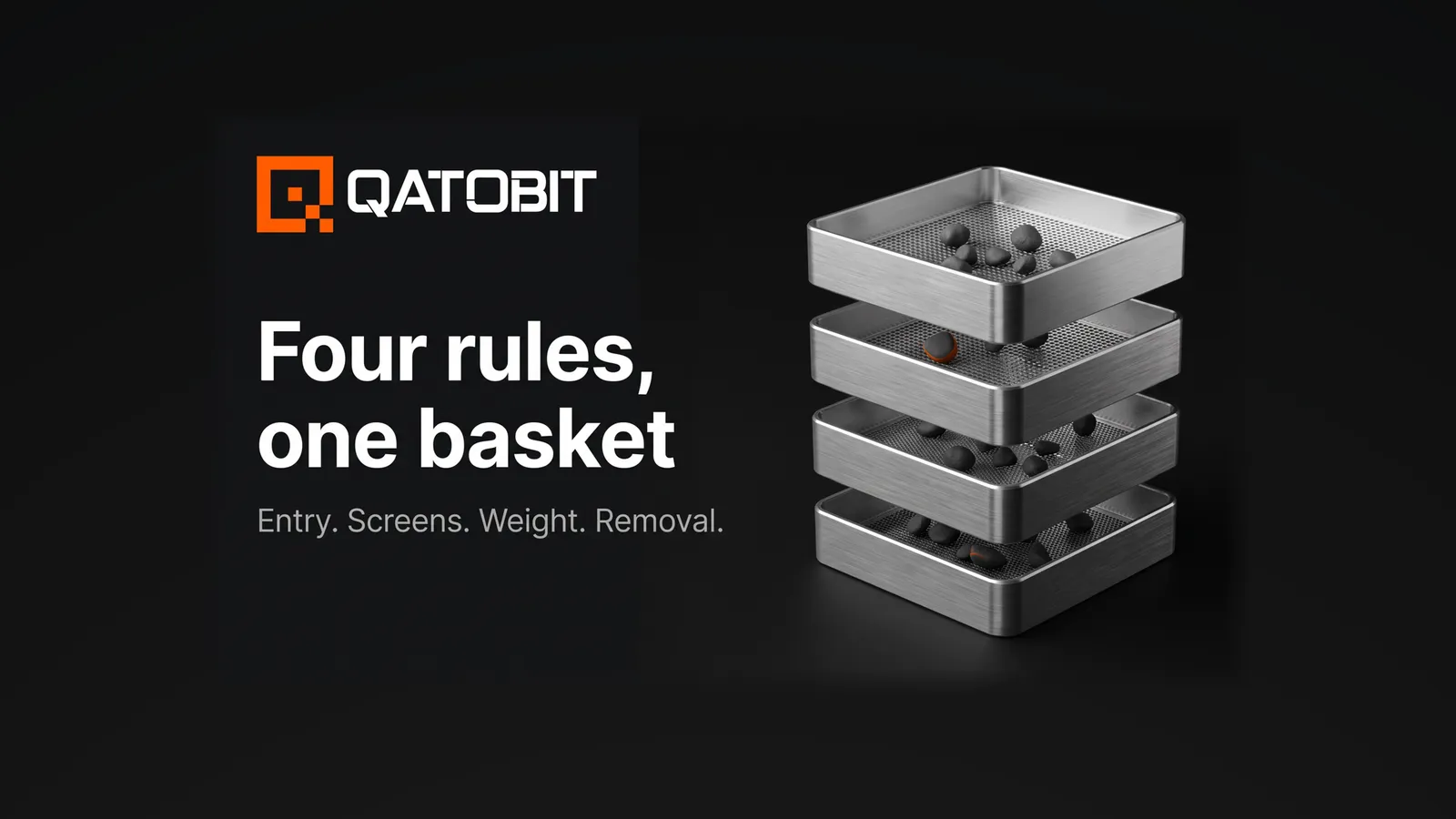
What are the four rules every index has?
Every index, equity or crypto, answers four questions in writing, and the answers are the product. A basket that is vague on any of them has left that decision to somebody's mood.
Entry: who is eligible?
The eligible universe is the list of things the index is even allowed to hold. For a crypto basket that means which assets can be held, custodied and rebalanced at scale, before any question of which ones are good.
Qatobit's published methodology makes this the first of eight governed stages and calls it the most consequential filter. Everything that follows only chooses among the assets this stage lets through.
Screens: what keeps an asset out?
A screen is a test an asset has to pass on a measured property. Qatobit's methodology names the properties it checks before selection: liquidity, market structure, custody, regulatory availability, security, durability and role fit.
An asset that fails the liquidity screen gets no exception because the story around it is exciting.
Weighting: how much of each holding?
Weighting is the rule that turns a list of assets into a basket. The methodology says role, total risk contribution and concentration limits shape every allocation, which is a way of saying a single coin cannot grow into the whole index by itself.
Weights change because prices move. The rule says what the basket should look like, and the rebalance brings it back there.
Removal: when and why does something leave?
Removal is the rule most people never read. It covers what happens to a holding that stops passing the screens, and it matters most in the weeks when a headline is pushing the other way.
The monthly rebalance is where this rule does its work. Qatobit describes it as a calendar-defined reset that trims what has run hot and tops up what has lagged. A change in the basket arrives on a schedule instead of on a reaction.
How does a cut show up in rupees?
A cut shows up as a sale and a purchase on a known date. Take a hypothetical ₹25 lakh crypto sleeve in an index where one coin carries a 10 percent weight. Ten percent of ₹25,00,000 is ₹2,50,000 sitting in that coin.
If the removal rule applies at the next rebalance, that ₹2,50,000 is sold and spread across the holdings that stay, in the proportions the weighting rule sets. If the coin stays, only the drift is corrected. If the weight had drifted to 14 percent, the rebalance trims it back by four points: 4 percent of ₹25,00,000 is ₹1,00,000.
The figures are illustrative and are not any index's real weights. A trim and a cut both follow from the rule, whatever anyone felt about the coin at the time.
Where does Qatobit publish its rules?
Qatobit publishes the methodology as eight governed stages on its QSI methodology page. They are the eligible universe, the screens, role construction, weighting, the monthly rebalance, risk architecture, data and verification, and governance and transparency.
The last stage matters for the question in this piece. Every methodology change is versioned, dated and held under change control, so a rule cannot be rewritten without leaving a record. The four QSI Crypto Indices share that process, and the live weights sit on the index pages.
Which checks work on any index's rulebook?
Check four things.
- Can you find the eligibility test in writing, with the properties it measures?
- Does the rulebook say what removes a holding, not only what adds one?
- Is there a stated schedule for changes, and a buffer so one bad day does not remove anything?
- Is every change to the rules dated and kept?
An index that answers all four lets you hold the basket without holding a view on each coin.
The coins in a basket will change over time, and the rulebook decides how they change.
Start with what a crypto index is and how it works. The five-point framework in how to evaluate any crypto index methodology goes deeper, and who sets the rules of a crypto index covers changes. Concentration risk explains what the weighting rule guards against.
Sources, all read on 17 October 2026: citybiz on MSCI's consultation results, TFTC on the non-operating company framework, and qatobit.com/methodology.
Frequently asked questions
What is a crypto index?
A crypto index is a basket of digital assets chosen and weighted by published rules, then reset on a schedule. You hold the basket and the rules decide what is in it.
How does a coin get into a crypto index?
It passes the eligibility universe and the screens in the index's methodology. For Qatobit's QSI indices those screens cover liquidity, market structure, custody, regulatory availability, security, durability and role fit.
How does a coin get cut from a crypto index?
A holding leaves when it stops passing the written screens, and the change takes effect at a scheduled rebalance. For the QSI indices the rebalance runs monthly.
Why did MSCI's rule make news in crypto?
MSCI's October 2026 framework for non-operating companies screens issuers on five financial ratios, and coverage of a May 2026 simulation flagged bitcoin-holding companies. MSCI named no company in the announcement and scheduled the list for 11 November 2026.
Can an index change its rules?
A well-run index can, but each change is versioned, dated and held under change control. Qatobit's methodology lists governance and transparency as the last of its eight governed stages.
Crypto investments are subject to market risk. Not financial advice.
“A better allocation begins with a better explanation.”
Qatobit principle
Published construction. Fixed cadence. Versioned control.