The point
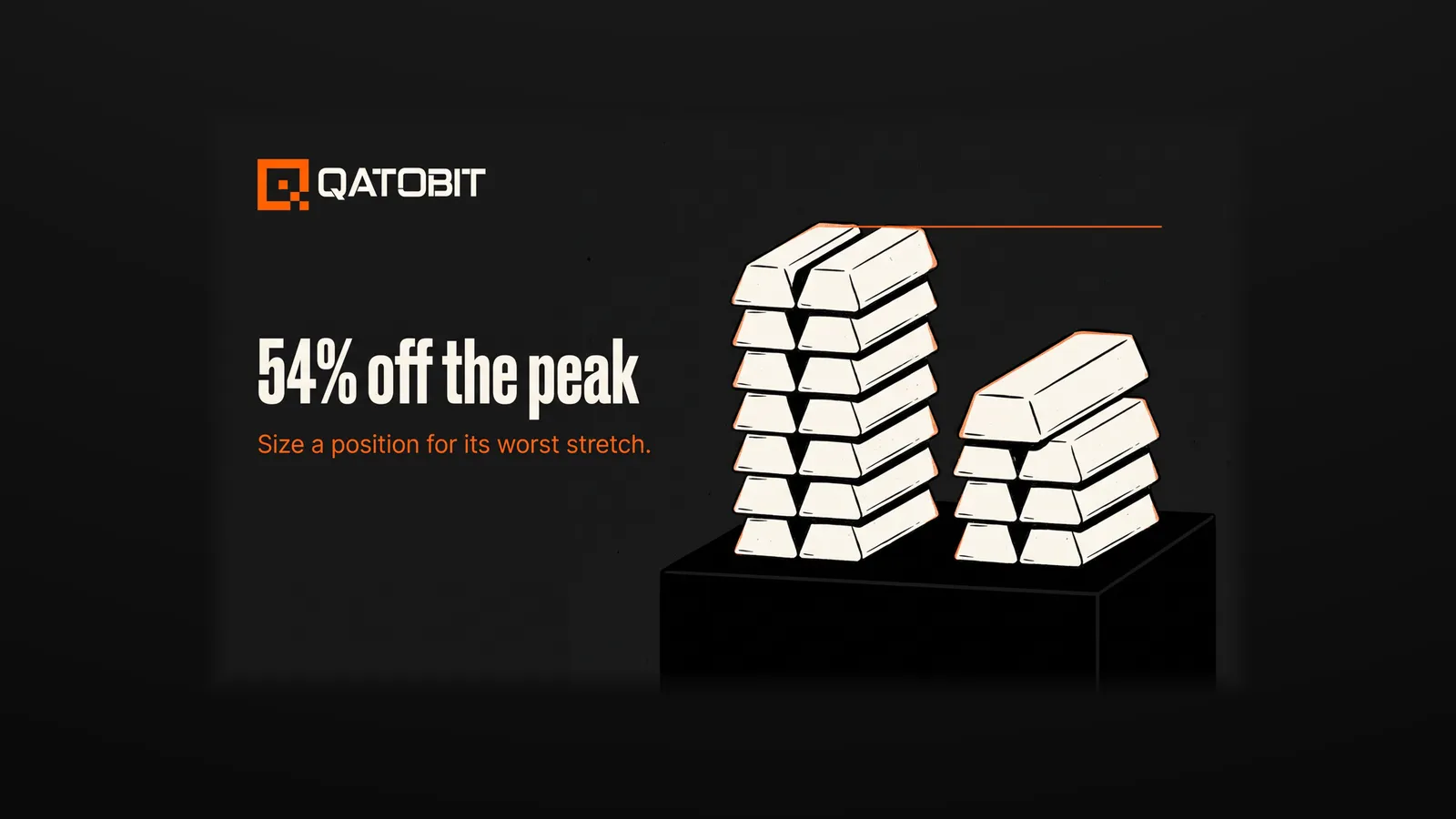
Silver futures on the Multi Commodity Exchange (MCX) closed at ₹1,92,800 per kg on 23 October 2026, 54.1 percent below the record ₹4,20,048 set on 29 January 2026. "Safe haven" is a label people attach to a metal. How far it falls is a measurement, and a position should be sized to the measurement.
What did silver actually do?
The Economic Times reported that silver futures fell ₹6,799 per kg, or 3.4 percent, to ₹1,92,800 on 23 October 2026, an 11-month low. The same report puts the fall at ₹32,955, more than 14 percent, over the previous 10 sessions (Economic Times, as syndicated on fvbb.com, read 24 October 2026).
Work out the full drawdown yourself. A drawdown is the fall from a high to a later low. Here that is ₹4,20,048 minus ₹1,92,800, which is ₹2,27,248. Divide by ₹4,20,048 and you get 0.541, so 54.1 percent.
A second Economic Times report gives the record as ₹4.27 lakh and the fall as nearly 55 percent. The two reports measure from slightly different highs. This piece uses the ₹4,20,048 figure because it names the date and the exact price.
Why does the label mislead?
A label tells you what a holding is for. A measurement tells you what it did. The two come apart exactly when the label is doing the most work in your head.
Silver has been called a refuge for as long as people have kept it in drawers. That reputation is about where it tends to be held when other holdings have a bad stretch. How far the metal itself can fall is a separate question, and the figure above is how far it did.
The reasons given for the fall are also not about fear. Aditya Agarwala, chief investment officer at InvestValue, is quoted as saying "Oil is driving this selloff more than fear is," with Brent crude above $110 a barrel. Higher oil stokes inflation worries, and expectations of higher interest rates reduce the appeal of metal that pays no interest. A refuge that moves with oil and rate expectations is a position with drivers, and drivers can all point the same way at once.
I judge a holding by the worst stretch it has had, and the story attached to it comes second. If you cannot name the worst fall a position has had, you do not yet know how large it should be.
What does a 54 percent fall do to a real portfolio?
Take a ₹1 crore portfolio with 5 percent in silver, which is ₹5,00,000.
A 54.1 percent fall leaves ₹5,00,000 × (1,92,800 ÷ 4,20,048) = ₹2,29,498. The loss is ₹2,70,502. As a share of the whole portfolio, that is 2.7 percent, from a holding that most people file under "the calm part".
A 54.1 percent fall needs a rise of 117.9 percent to get back. The arithmetic is ₹4,20,048 ÷ ₹1,92,800 = 2.179, so the metal has to more than double. Nobody can say if or when that happens. The arithmetic only says that the climb back is far longer than the fall felt.
How do you size a position for its worst stretch?
Start from the loss you can sit through, then divide by the worst fall on record. Both numbers are measurements, and neither needs a forecast.
Name the loss in rupees
Say you can accept a loss of ₹1 lakh from this one holding, which is 1 percent of a ₹1 crore portfolio. That figure is yours and does not depend on the metal.
Divide by the worst fall so far
₹1,00,000 ÷ 0.541 = ₹1,84,837. A position of about ₹1.85 lakh, or 1.85 percent of the portfolio, loses ₹1 lakh if it repeats the 54.1 percent fall.
Treat the worst fall so far as a floor
The record is the worst stretch that has happened, and a worse one can come. So the figure from that division is a ceiling on size, and a smaller position leaves room for the history to be beaten.
Compare that with the 5 percent position above. The ₹5,00,000 holding loses ₹2,70,502 in the same fall, which is 2.7 times the loss the rule accepts. That exposure came from a round number and a reassuring label, and nobody chose it on purpose.
What changes when a rule makes the decision?
The weak moment for any position is the day after the fall, when the story and the number disagree and you are deciding with a bruise. A rule written before that day removes the decision.
A rebalancing rule says in advance what share each holding should hold, checks on a schedule, and moves the holding back to its share. It decides what to do about a holding that has grown too large or shrunk too small, whatever the news says. Silver's fall is the kind of day such a rule is written for.
The QSI indexes at Qatobit are built on that idea. Each index has a documented methodology, rebalances monthly, and publishes its weights on the index pages, so you can work out how much of each asset a given amount buys. The fee is 0.35 percent on each basket transaction, including each rebalance, with no annual management fee and no exit load. You can read how one of them is built in what QSI Growth holds and how it rebalances. If you want that discipline applied to crypto, you can invest in QSI Growth or start a Bitcoin SIP.
Where this argument stops
The sizing rule above does not tell you whether silver is cheap or dear, and it makes no call on what silver does next. It also assumes the worst fall on record is a fair guide, which is weaker for an asset with a short or unusual history.
It holds for one narrower claim. Whatever label a holding carries, the size you give it should come from what it has done, written down before the bad day.
Two earlier pieces cover the tools. One is how a position is sized to survive a drawdown. The other is how rebalancing works when one holding falls.
Sources: Economic Times report on the silver 11-month low, syndicated on fvbb.com, read 24 October 2026. Economic Times report on the fall below ₹2 lakh, syndicated on inkl.com, read 24 October 2026.
Frequently asked questions
How far did silver fall from its January 2026 high?
Silver futures on the MCX closed at ₹1,92,800 per kg on 23 October 2026, against a record of ₹4,20,048 on 29 January 2026. That is a fall of ₹2,27,248, or 54.1 percent.
What is a drawdown?
A drawdown is the fall from a holding's highest value to a later low, shown as a percentage of the high. Silver's fall from ₹4,20,048 to ₹1,92,800 per kg is a drawdown of 54.1 percent.
How do I size a position for its worst fall?
Pick the rupee loss you can accept, then divide it by the worst percentage fall on record. A ₹1 lakh loss limit and a 54.1 percent fall give ₹1,00,000 ÷ 0.541 = ₹1,84,837, or about ₹1.85 lakh.
Does a 54.1 percent fall need a 54.1 percent rise to recover?
No. It needs a rise of 117.9 percent, because the metal has to climb from ₹1,92,800 back to ₹4,20,048 per kg, and 4,20,048 ÷ 1,92,800 is 2.179.
Does Qatobit rebalance its indexes on a schedule?
Yes. The QSI indexes rebalance monthly. The fee is 0.35 percent per basket transaction, including each rebalance, with no annual management fee and no exit load.
Crypto investments are subject to market risk. Not financial advice.
“A better allocation begins with a better explanation.”
Qatobit principle
Published construction. Fixed cadence. Versioned control.