The point
A dividend yield is the dividends a share paid over a year, divided by the share's price today. Because the price is the bottom of that fraction, the yield rises when the price falls, even if the company has not paid one rupee more. A high figure can mean a bigger payout, a lower price, or an expected cut, and the percentage alone cannot tell you which.
How is a dividend yield calculated?
A dividend yield is the annual cash dividend per share divided by the current share price, written as a percentage. Wikipedia gives a plain example. A share priced at US$20 that pays US$1 in a year has a yield of 5 percent (source: Wikipedia, read 2026-10-03).
In rupees, at portfolio scale, the formula works the same way. Take ₹5 lakh in a share priced at ₹100 that pays ₹5 a year. You hold 5,000 shares, the dividends come to 5,000 × ₹5 = ₹25,000 a year, and the yield is ₹5 / ₹100 = 5 percent.
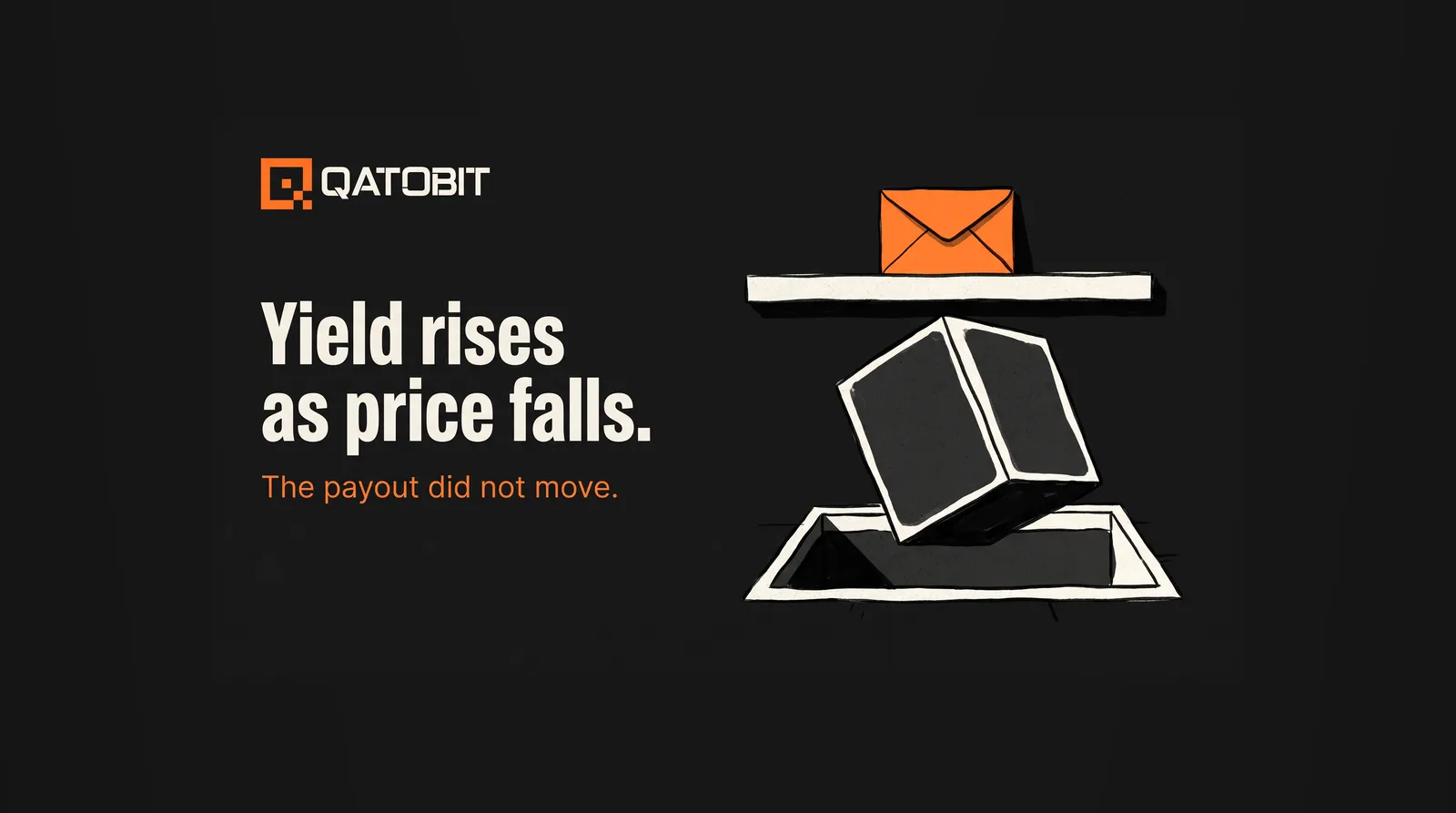
Now the price falls to ₹80 and the company pays the same ₹5. The yield is ₹5 / ₹80 = 6.25 percent. Your dividend is still ₹25,000. Your holding is now worth 5,000 × ₹80 = ₹4 lakh, so you are ₹1 lakh lower on the position and the screen says the yield went up by 1.25 percentage points.
The number improved because the price fell, and nothing about the payout changed. Wikipedia states the same point: yield measures dividend income only, and does not include changes in the share price.
Why do two sources print different yields for the same company?
Published yields are not standardised, so two sources can print different numbers for one company on one day. Wikipedia lists the conventions. A trailing yield uses dividends paid over the previous 12 months. A forward yield uses a projection of the coming 12 months. Some methods count a special one-off dividend and others leave it out (source: Wikipedia, read 2026-10-03).
A ranking of large-cap stocks by yield, published on 2 October 2026 and credited to Mint, shows the effect. It reports a top yield of nearly 6.6 percent for financial year 2025-26. The same article quotes that company's closing price as ₹421.50 on BSE on 1 October and about ₹26.50 a share declared over the last year. That price and that dividend give ₹26.50 / ₹421.50 = 6.29 percent (source: INDIA IPO, republishing Mint, read 2026-10-03).
The two figures come from different calculations, one tied to a financial year and one to a price on a given day. A holder comparing two lists should find out which twelve months and which price went into each before comparing the percentages.
Three questions settle most of the confusion, and a reader can ask them of any yield on any list.
- Which twelve months of dividends sit on top of the fraction: the last twelve paid, or the next twelve expected?
- On which day was the price taken?
- Does the figure include one-off special dividends?
What does the payout ratio say that the yield does not?
The payout ratio is the share of a company's net income paid out as dividends. Wikipedia defines it as dividends divided by net income for the same period. The part of earnings not paid out is kept for investment and future growth (source: Wikipedia, read 2026-10-03). The same page ties the two measures together: the dividend yield equals the payout ratio times the earnings per share, divided by the share price.
That relationship is why the payout ratio is the second number to read. The yield tells you what the price makes of the dividend today. The payout ratio tells you how much room the earnings leave for the dividend to continue.
A worked example uses the same share. Suppose it earns ₹10 a share and pays ₹5. The payout ratio is ₹5 / ₹10 = 50 percent, and half the earnings are kept in the business.
Now earnings fall to ₹6 a share and the dividend stays at ₹5. The payout ratio is ₹5 / ₹6 = 83 percent. If earnings fall to ₹4, the company pays ₹5 out of ₹4 earned, a ratio of 125 percent, and the gap has to come from savings or borrowing. A company can do that until the savings or the lenders run out.
Net income is an accounting figure, and a dividend is paid in cash. A holder can go one step deeper. Compare the dividends paid in a year with the cash the business generated that year, which sits in the cash flow statement.
What is a yield trap?
A yield trap is a high yield that comes from a falling price in a company whose dividend is about to be cut. The percentage looks generous because the price has dropped, and the dividend it is built on has not been cut yet.
Go back to the ₹100 share paying ₹5. At ₹80 it prints 6.25 percent. The company, with earnings down to ₹4, then cuts the dividend to ₹2.50. On a ₹4 lakh holding of 5,000 shares, the dividends become 5,000 × ₹2.50 = ₹12,500 a year, a yield on your ₹4 lakh of ₹12,500 / ₹4,00,000 = 3.125 percent. A trailing yield of 6.25 percent had turned into half that in one announcement.
The yield was a lagging measure. It reported what had been paid and said nothing about what the company could keep paying. My view is that a ranking sorted by yield is the least informative way to read a dividend. It sorts by the price fall as much as by the payout. Stressed companies reach the top for the same reason generous ones do.
What does a holder check before reading a yield?
A holder can run four checks, and each takes a few minutes with the company's own annual results.
- Read the payout ratio for the last three years, and look at its direction as well as its level.
- Compare dividends paid with cash generated in the same year.
- Check whether the price fell before the yield rose.
- Check whether the dividend per share has been held or raised through a bad year.
The checks apply to a position of any size, and they matter more as the position grows. Dividends also go into the year's taxable income. The e-filing guidance lists dividend under income from other sources in the return (source: Income Tax Department e-filing portal, read 2026-10-03). How a particular holding is taxed is a question for a tax professional and the current statute, and this piece gives no rate.
Does the same question apply to crypto yields?
It applies to every quoted percentage. Some crypto products also publish a yield, often for staking or lending, and the question is the same: where does the payout come from? A yield paid from fees earned for a real service differs from a yield paid from new deposits. A number on a screen does not say which. Ask what is being paid, by whom, from what income, and whether the figure is a past payout or a promise.
Qatobit runs four QSI Crypto Indices (QSI Core, QSI Growth, QSI VRION and QSI GEQ8), each rebalanced monthly on a published methodology. A holder who invests ₹25,000 a month in an index works from a rule and a schedule.
Where to go next
A dividend is one cash flow among several that a price discounts. What the 10-year bond yield is and what a rise reprices covers the rate those cash flows are measured against. What inflation is and what it does to money that sits still covers what a payout is worth after prices rise. What a drawdown is and how a position is sized to survive one covers the price fall that lifts a yield in the first place.
Frequently asked questions
What is a dividend yield?
A dividend yield is the annual cash dividend per share divided by the current share price, written as a percentage. A share priced at ₹100 that pays ₹5 in a year has a yield of 5 percent.
Why does a dividend yield rise when the share price falls?
The price is the bottom of the fraction, so a lower price gives a higher figure for the same dividend. A ₹5 dividend is a 5 percent yield at ₹100 and 6.25 percent at ₹80, with the payout unchanged.
What is a good dividend payout ratio?
The payout ratio is dividends divided by net income, and no single level is good for every company. A ratio of 50 percent leaves half the earnings in the business, and a ratio above 100 percent means the dividend is larger than the profit it came from.
What is the difference between a trailing and a forward dividend yield?
A trailing yield uses dividends actually paid over the previous 12 months, and a forward yield uses a projection of the next 12 months. Two lists can print different yields for the same share because of this choice alone.
Is a high dividend yield a sign of a strong company?
A high yield can come from a larger payout, a lower price or an expected cut, so it does not establish strength by itself. The payout ratio and the cash flow behind the dividend show whether it can last.
Crypto investments are subject to market risk. Not financial advice.
“A better allocation begins with a better explanation.”
Qatobit principle
Published construction. Fixed cadence. Versioned control.