The point
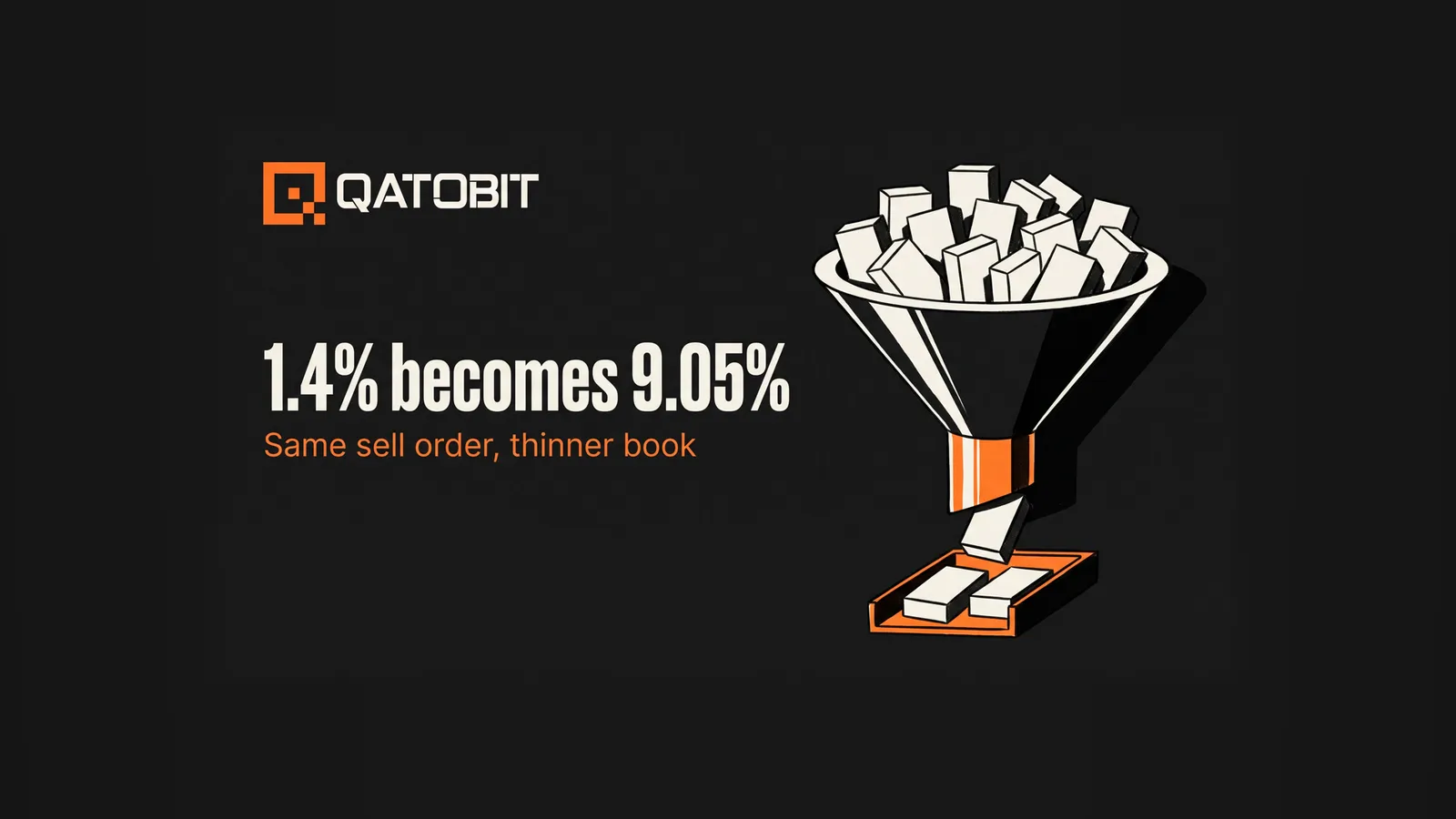
Liquidity in the stock market is how much of a stock you can sell before its price moves against you, and a bad day shrinks it. In the illustrative order book below, a ₹20 lakh sell order gives up 1.4 percent on a calm day, or ₹28,000. On a thin day it gives up 9.05 percent, or ₹1,81,000. The same test applies to a crypto position.
What does liquidity mean on a day the market is falling?
Liquidity is the size of order a market absorbs near the last price. A calm day hides the question, because every order is small against the buyers waiting. A falling day asks it directly: how many rupees of your position can the buyers at each price take?
Our view is that liquidity is a ratio between your exit order and the depth on the other side of the book. It is a property of that pair, whatever the asset class. A ₹3 lakh position, which is three percent of a ₹1 crore portfolio, can leave almost any listed stock quietly. A ₹20 lakh position in the same smallcap may not.
That makes the useful number the cost of leaving, measured before you need to leave. The National Stock Exchange of India calls it impact cost.
How deep is the order book, and what does thin cost?
Four mechanisms decide the cost of leaving, and each behaves differently when the day turns.
Depth, measured as impact cost
The National Stock Exchange of India defines impact cost as the cost of executing a transaction in a given stock for a predefined order size. It is measured against the ideal price, the midpoint of the best buy and best sell. The exchange adds that impact cost is computed separately for buying and selling and depends on the outstanding orders at that moment.
Here is an illustrative order book for a smallcap, with made-up prices. The best buyer is at ₹99.80 and the best seller at ₹100.20, so the ideal price is ₹100. You hold 20,000 shares, worth ₹20 lakh at ₹100.
On a calm day the buyers stand like this: 5,000 shares at ₹99.80, 5,000 at ₹99.20, 5,000 at ₹98.40 and 5,000 at ₹97.00. Selling all 20,000 fills at ₹4,99,000 + ₹4,96,000 + ₹4,92,000 + ₹4,85,000, a total of ₹19,72,000. That is ₹98.60 a share. The shortfall from ₹20,00,000 is ₹28,000, or 1.4 percent.
On a bad day the sellers crowd in and the buyers pull back. The best buyer is at ₹97 and the best seller at ₹103, so the ideal price is still ₹100. The buyers stand like this: 2,000 shares at ₹97, 3,000 at ₹95, 5,000 at ₹92 and 10,000 at ₹88. The same 20,000 shares fill at ₹1,94,000 + ₹2,85,000 + ₹4,60,000 + ₹8,80,000, a total of ₹18,19,000. That is ₹90.95 a share. The shortfall is ₹1,81,000, or 9.05 percent.
The company is the same in both cases. Only the number of buyers within reach of your price changed.
Source: NSE India, Impact Cost page, https://www.nseindia.com/static/products-services/indices-impact-cost, read 27 October 2026. The order books above are illustrative and are not any listed stock.
What stops the price
A listed stock is fenced by rules. The National Stock Exchange of India applies daily price bands of 2, 5 or 10 percent either way to securities, and 20 percent either way to the remaining scrips. Securities with derivative contracts have no band, and the exchange fixes an operating range of 10 percent for them.
Above those sit market-wide breakers. They trigger at 10, 15 and 20 percent moves in the Nifty 50 or the Sensex, whichever is breached first. A 10 percent move before 1:00 pm halts all equity and equity derivative markets for 45 minutes, followed by a 15 minute pre-open call auction. A 15 percent move before 1:00 pm halts them for 1 hour 45 minutes. A 20 percent move at any time ends trading for the rest of the day.
NSE computes the limits daily from the previous close. The Nifty 50 closed at 22,753.20 on 26 October 2026. From there the 10 percent trigger sits 2,275.30 points away and the 20 percent trigger 4,550.65 points.
A band caps the price at which a trade can happen, and a buyer still has to be standing at that price. For a seller, a halt is a fence with the exit on the far side, and the order waits for the market to reopen.
Source: NSE India, Price Bands page, https://www.nseindia.com/products-services/equity-market-price-bands, and Circuit Breakers page, https://www.nseindia.com/products-services/equity-market-circuit-breakers, both read 27 October 2026.
How long until the rupees are in the bank
NSE Clearing states that all settlements are conducted on a T+1 basis, where T is the trade day and holidays, weekends and bank holidays are excluded.
On Qatobit, a sale through Quick Buy/Sell settles to the investor's Qatobit balance, and the rupees can go back to the linked bank account by NEFT, RTGS or IMPS. A single-asset sale carries a 0.4 percent fee and a basket sale or rebalance a 0.35 percent fee. On a ₹5 lakh exit that is ₹2,000 on a single asset and ₹1,750 on a basket. The live price and exact fee show on the screen before you confirm. Withdrawal to the bank has a ₹200 minimum and no fee, and the indexes carry no exit load.
Those costs are known in advance. The price you receive still depends on the book at that moment.
Source: NSE Clearing, Equities page, https://www.nseclearing.in/equities, read 27 October 2026. Qatobit figures from Qatobit's own product documentation.
Who else is selling
Your exit meets everyone else's. Borrowed money makes the crowd larger and less patient. The margin trading facility is broker lending that lets investors buy shares with borrowed money. The Economic Times reports that its book reached a record of around ₹1.6 lakh crore in September, then fell to about ₹1.54 lakh crore by 22 October 2026.
Nearly 46 percent of that book is estimated to sit in smallcaps, roughly ₹72,000 crore of exposure to the segment. The report notes that with liquidity thinning in several counters, shrinking leveraged positions could add to the pressure on stocks that have already corrected sharply.
A holder with no loan can wait. A holder with a loan has someone else deciding the date, and that sale arrives in the same order book as yours.
Source: The Economic Times, "The Rs 1.5 lakh crore MTF problem: How shrinking leveraged positions are deepening India's smallcap sell-off", read 27 October 2026 through its syndicated copy on inkl.com.
How does a crypto order book behave on a bad day?
It thins in the same way, and the measurement is public. CoinDesk Research measured the depth of bitcoin order books across major centralized exchanges, meaning how much capital sits within a given distance of the mid-price.
In early October 2025, just before a leverage wipeout, bitcoin's average cumulative depth within 1 percent of the mid-price was close to $20 million. By 11 November 2025 it was $14 million, a fall of nearly one third. Depth within 0.5 percent fell from close to $15.5 million to just under $10 million, and within 5 percent from more than $40 million to slightly below $30 million.
Ether depth within 1 percent went from just above $8 million to just under $6 million. A composite of SOL, XRP, ATOM and ENS fell from roughly $2.5 million to about $1.3 million within 1 percent overnight. It then recovered most of that quickly, without returning to the earlier level.
CoinDesk Research concluded that the larger assets saw a deliberate and lasting cut in market-maker commitment, a new and lower baseline. The smaller coins were shocked and recovered faster. Its consequence is that routine flows can produce outsized price swings.
The reading is the same as for the smallcap: depth matters against the size of your exit. A ₹5 lakh order is small against a book holding millions of dollars within 1 percent, and an order that is a meaningful fraction of that depth is large.
Source: CoinDesk, "Crypto Liquidity Still Hollow After October Crash, Risking Sharp Price Swings", published 15 November 2025, https://www.coindesk.com/markets/2025/11/15/crypto-liquidity-still-hollow-after-october-crash-risking-sharp-price-swings, read 27 October 2026.
What does this change about sizing a position?
Three habits follow, and none needs a forecast.
First, size the exit before the entry. Take the position in rupees and find the depth within 1 percent of the price in the book you would sell into. Then ask how many times larger your order is than that depth. A ratio well under one is a quiet exit. A ratio over one means you are the market on the way out.
Second, separate the day you choose to sell from the day you are made to. A planned order can be sliced across sessions. A forced one, from a margin call or a bill due, cannot. Money with a date on it belongs where the depth is greatest.
Third, read the fence rules for what you hold. A 5 percent band and a market-wide halt each change what an order does when it cannot fill.
Where to read next
The fence rules have their own piece, how stock market circuit breakers work and why crypto has none. The crypto side of a forced exit is in a crypto liquidation is a sale the holder never chose. For a basket, how a crypto index rebalances during a market crash covers what the rule does when prices fall.
Frequently asked questions
What is liquidity in the stock market?
Liquidity is how much of a stock you can buy or sell without moving its price. The National Stock Exchange of India measures it as impact cost, the percentage you give up against the ideal price for a given order size. In the illustrative book above, selling ₹20 lakh cost 1.4 percent on a calm day and 9.05 percent on a thin one.
Why does liquidity fall on a bad day?
Buyers withdraw their orders or move them to lower prices, while more holders try to sell at once. The book gets shallower, so the same order walks further down it. The ₹20 lakh sale above fills at ₹98.60 a share on the calm day and ₹90.95 on the thin one.
Do price bands and circuit breakers protect a seller?
They cap how far a price can move in a session. The National Stock Exchange of India applies bands of 2, 5, 10 or 20 percent on stocks. Market-wide halts come at 10, 15 and 20 percent moves in the Nifty 50 or Sensex. A band does not create a buyer at the capped price, so a seller may still be left waiting for the market to reopen.
How long does it take to get money out after selling?
Listed shares settle on a T+1 basis, per NSE Clearing. On Qatobit, a sale settles to the Qatobit balance, and the rupees can go to the linked bank account by NEFT, RTGS or IMPS. The minimum withdrawal is ₹200 and there is no withdrawal fee.
What does a sale cost on Qatobit?
A single-asset sale through Quick Buy/Sell carries a 0.4 percent fee, and a basket sale or rebalance 0.35 percent. On ₹5 lakh that is ₹2,000 and ₹1,750. The indexes have no exit load, and the live price and exact fee show before you confirm.
Crypto investments are subject to market risk. Not financial advice.
“A better allocation begins with a better explanation.”
Qatobit principle
Published construction. Fixed cadence. Versioned control.