The point
A crypto liquidation is an exchange closing a position that was bought partly with borrowed money, after the price moved against it. CoinDesk reported $547 million of them in 24 hours on 7 October 2026, and every one was a sale the holder did not choose. A holder with no loan against the position has no liquidation price at all.
What actually happens in a liquidation?
An exchange sells a borrowed-money position on the holder's behalf once the holder's own money in it is nearly gone. The holder does not click anything. The sale happens at whatever price the market gives at that moment.
The borrowed-money part is called leverage. A holder puts in a deposit, called margin, and the exchange lends the rest, so a small deposit controls a larger position. The exchange sets a line, the liquidation price, where the deposit no longer covers the loss with a safe gap. Cross it and the exchange sells.
Here is the arithmetic on a ₹5 lakh deposit at 5x leverage, simplified by ignoring fees and the safety gap the exchange keeps.
- Position controlled: ₹5,00,000 × 5 = ₹25,00,000.
- A 20 percent fall: ₹25,00,000 × 0.20 = ₹5,00,000 of loss.
- Loss equals the deposit, so the position is closed and the ₹5 lakh is gone.
In practice the exchange closes the position a little before that line, so the real trigger is a fall somewhat smaller than 20 percent.
Why does one liquidation lead to another?
A forced sale is a market sell order, and a market sell order pushes the price down a little. That push can carry the price through the next holder's liquidation line, which forces their sale, which pushes the price down again.
This is why liquidation totals jump in clusters. Each sale is small. The chain is what makes the headline number.
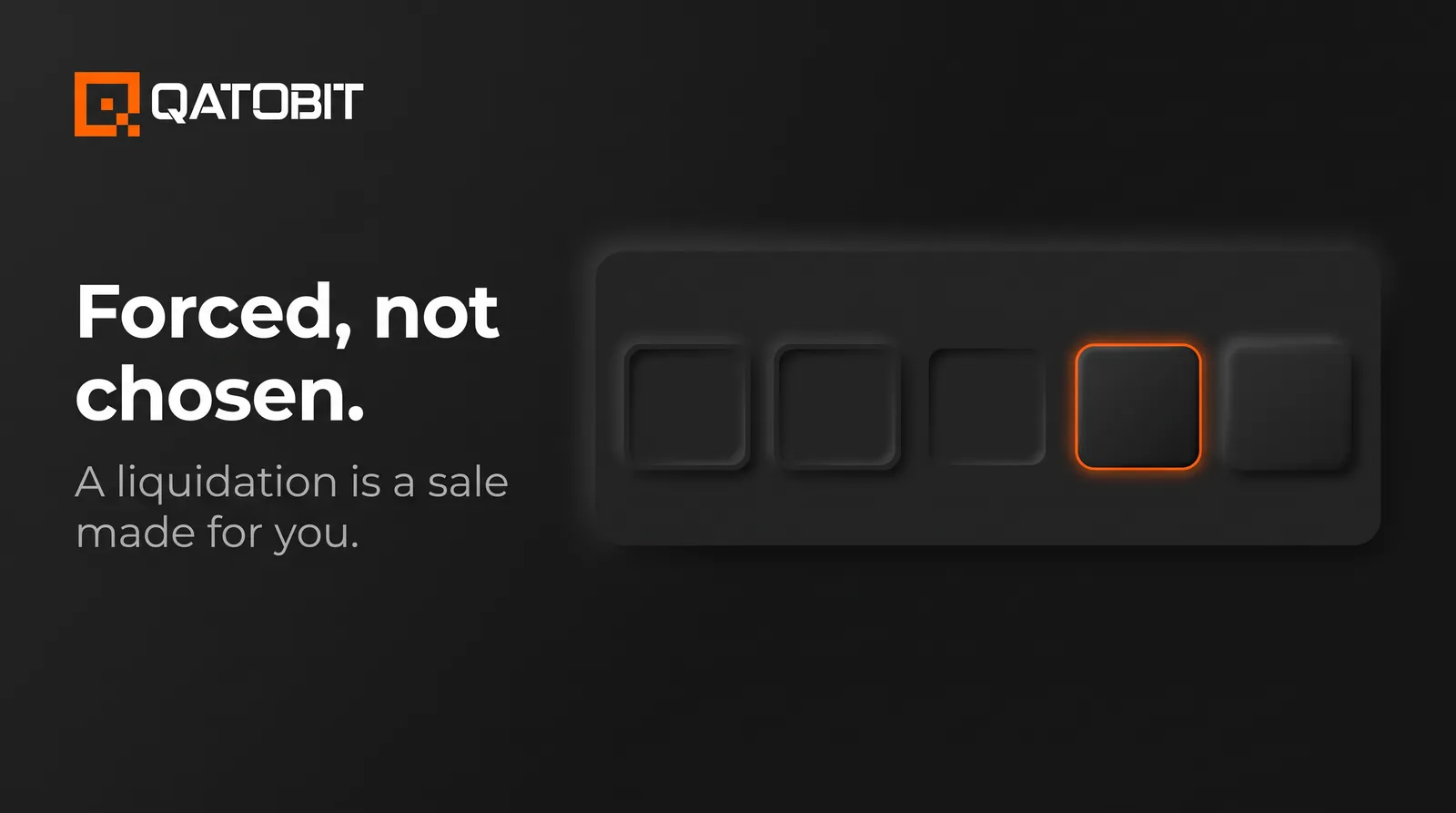
Think of five tiles standing in a row, each one leaning on the next. Nobody has to decide to push the last one. The first tile going over does it. The holders at the far end of the chain made no decision on the day, and their position was closed by someone else's.
CoinDesk's report from 7 October shows the setting for a chain like this. Bitcoin fell below $84,000 after oil climbed on attacks on tankers in the Strait of Hormuz, and smaller tokens fell harder than bitcoin. The CoinDesk 80, an index of a wide basket of smaller tokens, lost nearly 4 percent over 24 hours, against 2.5 percent for the CoinDesk 5.
Source: CoinDesk, Liquidations jump to $547 million as oil rally hits crypto market, 7 October 2026, read on 8 October 2026.
https://www.coindesk.com/markets/2026/10/07/liquidations-jump-to-usd547-million-as-oil-rally-drags-bitcoin-below-usd84-000
What does a number like $547 million count?
It counts the positions that exchanges closed by force in one 24-hour window, according to CoinGlass data as CoinDesk reports it. It does not count the holders who sold by choice, and it does not count anyone who held through the fall.
Three facts from the same report put the figure in proportion, all as of the day CoinDesk published it.
- Liquidations rose 235 percent to $547 million, and Ether positions made up $174 million of that.
- Futures trading volume was $182.85 billion over the same 24 hours.
- Open interest, the total value of futures positions still open, was $152.60 billion.
Divide the liquidations by each. $547 million ÷ $182.85 billion is 0.30 percent of the day's futures volume. $547 million ÷ $152.60 billion is 0.36 percent of the positions still open. The headline is large in dollars and small against the market it sits in.
Totals also differ by cut. The same CoinDesk article gives $547 million in its summary and $548 million, a 216 percent rise, in its derivatives section. That is a one-million-dollar gap between two views of one data set. A liquidation total is a measurement taken over a window, and the window decides the figure.
What the figure measures is borrowed-money positions closing. It says little about what long-term holders did, because a holder with no loan has nothing for an exchange to close.
Why does a holder with no loan have no liquidation price?
Because a liquidation is a lender protecting its loan, and without a loan there is no lender. Nobody holds a claim on the position that gives them the right to sell it.
Take the same ₹5 lakh, bought outright with no borrowing, and the same 20 percent fall.
- Paper loss: ₹5,00,000 × 0.20 = ₹1,00,000.
- Position after the fall, on paper: ₹4,00,000.
- Units held: unchanged. Nothing was sold.
The holder with the loan lost the ₹5 lakh and the position in one move. The holder without it carries a ₹1 lakh paper loss and still owns every unit, and the next decision is theirs. Both faced the same price move. What differed was who had the power to sell.
Read from the outside, a $547 million total is a count of leveraged positions. A holder who borrowed nothing against the position is reading news about other people's loans.
My view is that the useful question on a red day is "who can force me to sell", and the size of the liquidation total comes a long way second. For an unleveraged holder the answer is nobody. That is a structural fact about the position, and it holds whatever the holder's temperament.
What do liquidations mean for the price?
They make a fall steeper while the chain runs, and they say nothing about where the price goes afterwards. A forced sale adds sell pressure that was not a view on the asset. When the chain ends, that pressure is gone, and the price is set by ordinary buyers and sellers again.
That describes how the mechanism works and gives no guide to the next price. Liquidations can follow a fall that continues, and they can follow one that stops. No total tells you which. Reading a liquidation number as a signal to buy or sell is a forecast, and a forecast is exactly what the number cannot give you.
The same report notes that bitcoin's and ether's 30-day implied volatility indices were near their year-to-date lows on the day. A market can look calm on one gauge while borrowed-money positions are closing on another.
How does this apply on Qatobit?
Qatobit's QSI indices are baskets you hold, designed and rebalanced monthly by Qatobit on a published methodology. Each index is a permanent allocation product and not a trading instrument. The investor makes one decision, the thesis that fits their risk appetite and horizon, and the methodology carries it from there.
A basket held on a schedule has a different job from a borrowed-money position. Its job is to be owned through the red day, with no lender's line drawn under it. You can invest in QSI Growth, or start a Bitcoin SIP, an Ethereum SIP or a Solana SIP. The schedule keeps running when a liquidation total is in the headlines.
For how a position is sized to survive a fall, read what a drawdown is and how a position is sized to survive one. For the difference between owning and reacting, read investing vs trading: the two job descriptions. For what a long losing streak asks of a holder, read market correction means a 10 percent fall, not a losing streak.
What a forced sale tells you
A liquidation total tells you how much borrowed-money exposure closed in a window, and nothing about whether you should act. If you hold with no loan against the position, the one person who can sell it is you, and the number on the screen is somebody else's.
Frequently asked questions
What is liquidation in crypto?
Liquidation is an exchange closing a position bought partly with borrowed money, after the price moves against it far enough that the holder's deposit no longer covers the loss. The holder does not choose the sale. On 7 October 2026, CoinDesk reported $547 million of liquidations in 24 hours.
What is a liquidation price?
It is the price at which an exchange closes a borrowed-money position. On a ₹5 lakh deposit at 5x leverage, the position is ₹25 lakh. A 20 percent fall wipes out the deposit, so the real trigger sits slightly before that fall.
Can a holder with no loan be liquidated?
No. Liquidation protects a lender, and a position bought outright has no lender. On a ₹5 lakh position, a 20 percent fall is a ₹1 lakh paper loss, and every unit is still held.
Why do liquidations come in clusters?
Each forced sale pushes the price down a little, and that push can carry the price through the next holder's liquidation line. The chain turns many small sales into one large total, such as the $547 million CoinDesk reported.
Does a large liquidation total mean the price will recover or keep falling?
No. A liquidation total measures borrowed-money positions closed in a window, and it says nothing about the next price. Reading it as a signal to buy or sell is a forecast, and the number cannot support one.
Crypto investments are subject to market risk. Not financial advice.
“A better allocation begins with a better explanation.”
Qatobit principle
Published construction. Fixed cadence. Versioned control.