The point
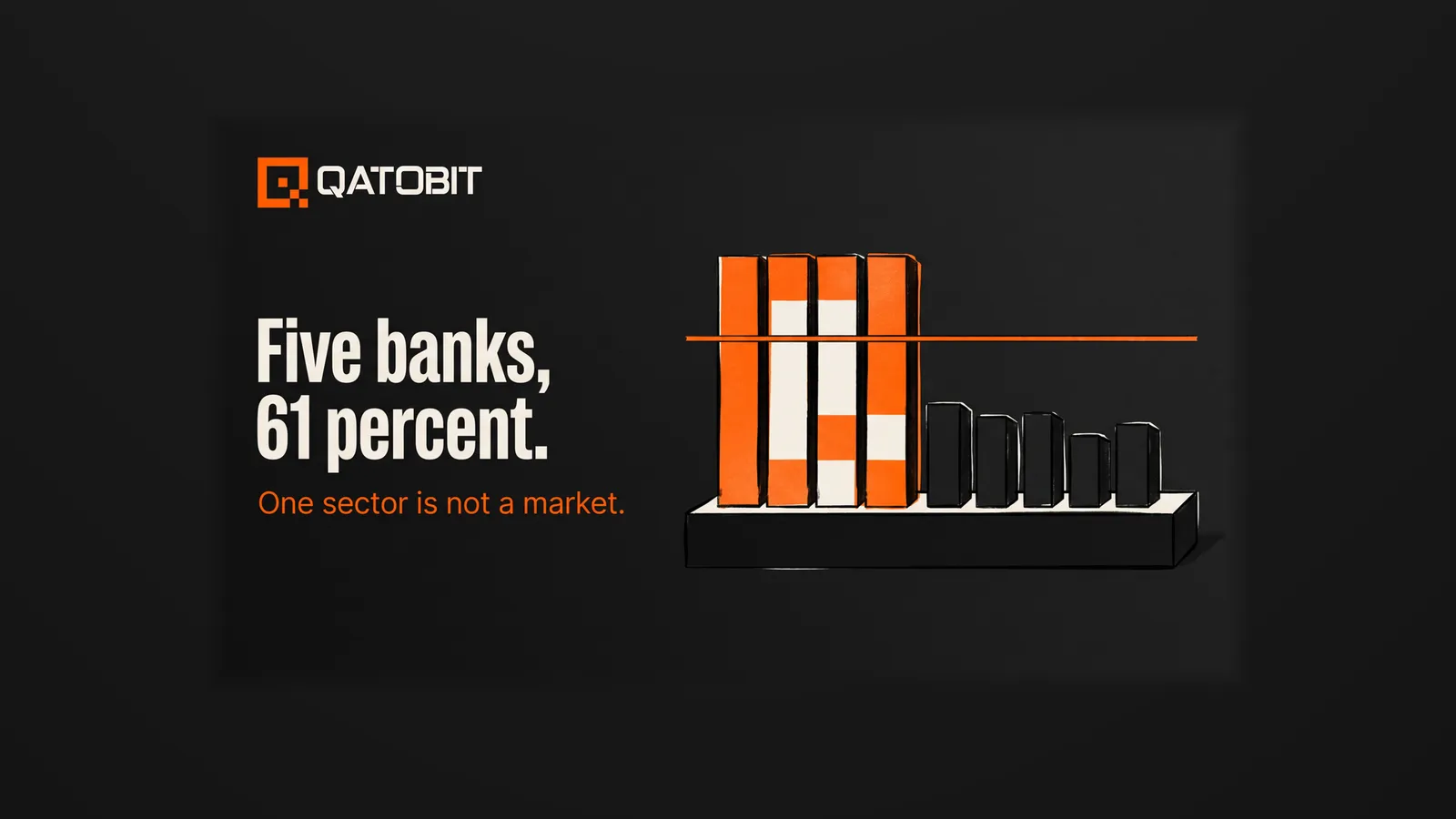
Bank Nifty is the Nifty Bank index, a list of up to 14 large banks listed on the NSE. Each bank is weighted by how much of it the public can actually trade. It moves in thousands of points, so it looks like a market, but it is one sector. As of the NSE-sourced factsheet figures read on 26 October 2026, its five biggest banks make up 61.23 percent of it.
What is Bank Nifty?
Bank Nifty is the common name for the Nifty Bank Index, which tracks large and liquid banking companies listed on the National Stock Exchange. NSE Indices launched it on 15 September 2003. Its base date is 1 January 2000 and its base value is 1,000, so every level you see is measured against that starting point.
It holds banks only. Private sector banks, public sector banks and small finance banks can qualify. Insurers and non-banking lenders do not, however large they are, because they sit in the wider Nifty Financial Services index instead.
The number on the screen is an index level. If it moves from 58,000 to 58,580, the index has risen 580 points, which is 1 percent. That does not mean every bank rose 1 percent. The larger weights drive most of the move.
How does the index choose its banks and weights?
A bank gets in on three tests. It should ordinarily be in the Nifty 500. Its shares must have traded on at least 90 percent of trading days over the previous six months. It needs at least one calendar month of listing history. NSE Indices gives preference to banks whose shares are available in the futures and options segment.
Weight then follows free-float market capitalisation. Free-float market capitalisation is the value of only the shares the public can trade, found by multiplying the full market value by an investible weight factor. A bank worth ₹5 lakh crore with a factor of 0.60 counts as ₹3 lakh crore. Promoter holdings that never trade do not add weight.
The rule then caps the biggest names at rebalancing: the largest bank at 19 percent, the second at 14 percent and the third at 10 percent. The index is reviewed twice a year, using data for the six months ending 31 January and 31 July, with changes taking effect in March and September. For the full mechanics of free float, see our piece on how free float decides a stock's weight in an index.
Source: bajajamc.com, "What Is Bank Nifty", quoting the NSE Indices factsheet and methodology document, read on 26 October 2026. Angel One's Nifty Bank page, read the same day, also describes the index as free-float weighted with up to 14 banks.
Why does one sector swing like a whole market?
Because the index is a concentrated list, and a concentrated list has a short list of decisions inside it.
As of the factsheet figures that Bajaj AMC reproduced on its page, the ten largest constituents carried these weights:
- HDFC Bank Ltd.: 17.02 percent
- ICICI Bank Ltd.: 14.86 percent
- State Bank of India: 10.27 percent
- Kotak Mahindra Bank Ltd.: 9.88 percent
- Axis Bank Ltd.: 9.20 percent
- Federal Bank Ltd.: 7.15 percent
- IndusInd Bank Ltd.: 5.45 percent
- AU Small Finance Bank Ltd.: 4.82 percent
- IDFC First Bank Ltd.: 4.68 percent
- Bank of Baroda: 3.48 percent
Source: Bajaj AMC, quoting the NSE Indices Nifty Bank factsheet, weights as of 31 August 2026, page read on 26 October 2026. Weights drift with share prices between reviews.
Add them up. The top three come to 17.02 + 14.86 + 10.27 = 42.15 percent. The top five come to 42.15 + 9.88 + 9.20 = 61.23 percent. The top ten come to 86.81 percent.
Put that on a ₹5 lakh position in an index that tracks Bank Nifty. HDFC Bank is ₹85,100 of it (5,00,000 × 17.02%), ICICI Bank ₹74,300 and State Bank of India ₹51,350. Kotak Mahindra Bank is ₹49,400 and Axis Bank ₹46,000. Those five banks hold ₹3,06,150 of the ₹5 lakh. Everything the other nine or so banks do together is the remaining ₹1,93,850.
Now take a ₹1 crore portfolio where 10 percent, ₹10 lakh, sits in a Bank Nifty product. If the index falls 3 percent, that sleeve loses ₹30,000, which is 0.3 percent of the whole portfolio. The same 3 percent fall on a ₹50 lakh sector position is ₹1,50,000. The index did the same thing in both cases. What changed is how much of the portfolio rides on one sector.
The reason the whole index moves together is also in the weights. Banks share interest rates, credit growth, bad-loan cycles and the same regulator. When one of those moves, it moves for all of them. A sector index holds one story, told through ten different share prices.
That is why a sector index can look like the market. It has the market's headline size, thousands of points and a daily commentary on television, but only the sector's diversification. A broad index like the Nifty 50 holds 50 companies across several sectors, so one sector's bad week gets diluted. Bank Nifty has nowhere to dilute it.
What a written rule changes about the risk
Every index runs on a rulebook. The rulebook decides who gets in, how much each holding weighs, how big one name can get and when the list is reviewed. Bank Nifty takes no view on banks. A rule picks them, and the result happens to be bank-shaped.
Seeing it as a rule shows where the risk sits. The rule allows 61.23 percent to sit in five names, so five names set the outcome. The caps of 19, 14 and 10 percent are the rule's own limit on that. They bind only at a rebalance, so weights can drift past them in between.
Concentration is a choice you can make on purpose. Holding a sector index as a deliberate position, sized for the portfolio, is a thesis. Holding it because the headline looked like the market is an accident. Our guide to concentration risk explains how to size for the first and avoid the second.
What this means for a crypto basket
A crypto basket has the same question in a different asset. Most of crypto moves with Bitcoin: when it falls, nearly every token falls. A basket that is mostly one story behaves like Bank Nifty on a bad day, however many tickers are inside it.
A published rule is how you see that before you invest rather than after. Qatobit's QSI indices are built on a written methodology and rebalanced monthly. QSI GEQ8, our global equity index, publishes hard caps: no holding above 15 percent or below 3 percent. QSI Growth holds five assets: BTC, ETH, SOL, Gold and a stable reserve, and QSI Core holds four: Bitcoin, Ethereum, Gold and a stable reserve. Read each index's methodology at /methodology and the weights on the index pages before you invest in QSI Growth or any other index. The question to ask of any basket is the one Bank Nifty teaches: what are the top five weights, and what rule keeps them there?
For the rule behind coins joining and leaving a basket, see how a coin gets in and gets cut from a crypto index.
Frequently asked questions
What is Bank Nifty in simple words?
Bank Nifty is the Nifty Bank Index, a list of up to 14 large banks listed on the NSE, weighted by the value of their publicly tradable shares. It tracks banking only, and its level is measured against a base value of 1,000 set on 1 January 2000.
How many banks are in Bank Nifty?
Up to 14 banks, according to Bajaj AMC and Angel One pages read on 26 October 2026. The count has changed over the years, so check the current NSE Indices factsheet for the exact list.
Why does Bank Nifty move so much?
Its top five banks carried 61.23 percent of the index as of the 31 August 2026 factsheet figures, and all banks respond to the same interest rate and credit conditions. One sector decides the whole level, so it swings more than an index spread across many sectors.
Is the Bank Nifty level a share price?
No. It is an index level measured against a base of 1,000. A move from 58,000 to 58,580 is 580 points, or 1 percent, and it does not equal the price of any one bank or of an ETF tracking it.
How is a crypto basket like Bank Nifty?
Both are rules that decide what goes in and how much each holding weighs. The risk of either is read from the top weights and the cap rule, so check those before you invest.
Crypto investments are subject to market risk. Not financial advice.
“A better allocation begins with a better explanation.”
Qatobit principle
Published construction. Fixed cadence. Versioned control.