The point
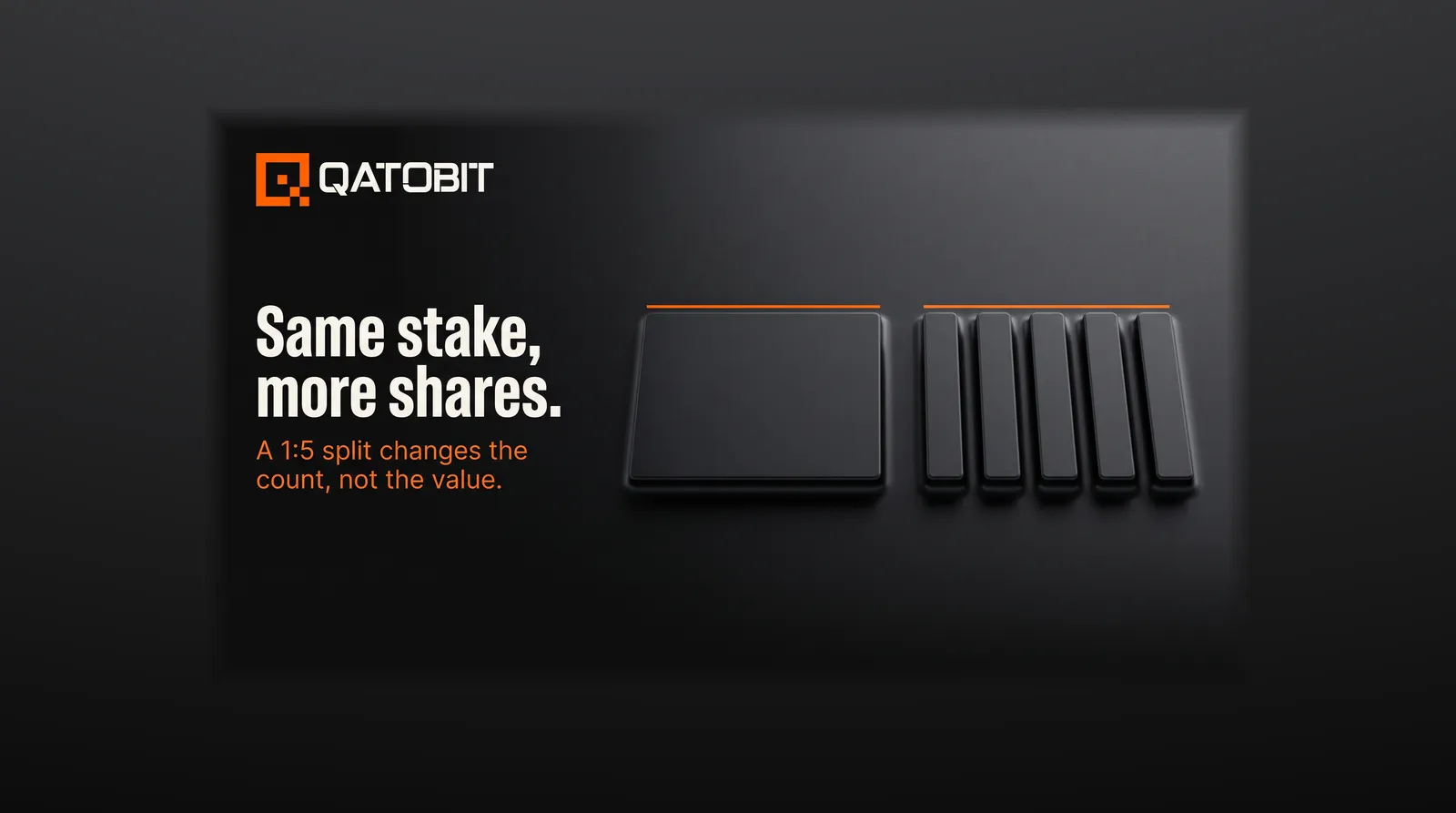
Bosch's 1:5 stock split turns each share of ₹10 face value into five shares of ₹2 face value, and the price per share falls to about a fifth. Your stake does not change: more shares, each worth less, add up to the same total. The three bonus shares per share held work the same way. Neither action adds a rupee to what you own.
What does a 1:5 split change, and what does it leave alone?
A stock split cuts one share into several equal pieces. After a 1:5 split, one share becomes five, and each new share is worth a fifth of the old one.
The Economic Times reported on 6 November 2026 that Bosch's board approved splitting each share of ₹10 face value into five shares of ₹2 face value. The same filing carried a second action. That was a bonus issue of three new shares for every share held on a record date the company would announce later (source: economictimes.indiatimes.com, read this run).
Three things move and four stay still. The share count rises, the price per share falls, and the face value falls in the same ratio.
The company's earnings, its revenue, its total market value and the rupee value of your holding stay where they were. Zerodha's support page puts it as exchanging a ₹2,000 note for ten ₹200 notes: more pieces, the same total.
How does a bonus issue differ from a split?
A split cuts existing shares into smaller ones. A bonus issue gives you new shares on top of the ones you hold, for no payment. The price adjusts down because the company's value is now spread over more shares.
The result looks the same from your demat account: more shares at a lower price and an unchanged total.
Bosch announced both at once. The ET article walks through the order. A holder of 10 shares worth ₹100 each ends the split with 50 shares worth ₹20 each. The three-for-one bonus then gives 150 more shares for the 50 held, which makes 200 shares worth ₹5 each. The total stays ₹1,000 at every step.
One caution on the wording. The ET headline calls the bonus "3:1" and its summary line calls it "1:3". The body text settles it: three bonus shares for every one share held, and the 150 bonus shares on 50 held confirm it.
Business Today reported on 3 November 2026 that Bosch told the exchanges both proposals were subject to approval by shareholders. The terms are the board's proposal until shareholders vote.
What does a ₹5 lakh holding look like at each step?
Here is the arithmetic at portfolio scale. The share price below is made up for the example and is not Bosch's price.
Step 1: before anything happens
You hold 20 shares at ₹25,000 each.
20 × ₹25,000 = ₹5,00,000.
Step 2: after the 1:5 split
Each share becomes five, so you hold 20 × 5 = 100 shares. The price falls to ₹25,000 ÷ 5 = ₹5,000.
100 × ₹5,000 = ₹5,00,000.
Step 3: after the three-for-one bonus
You receive 3 bonus shares for each of the 100 you hold, which is 300 new shares. You now hold 100 + 300 = 400 shares. The price adjusts to ₹5,00,000 ÷ 400 = ₹1,250.
400 × ₹1,250 = ₹5,00,000.
Step 4: what you did and what you paid
You placed no order and paid nothing. You went from 20 shares to 400 shares and your holding is still ₹5 lakh.
If the market then moves the price, your holding moves with it. That is a market move on a later day, and it has no connection to the split arithmetic above.
Why do companies split their shares?
A high unit price makes small purchases awkward and thins out trading. Zerodha's support page lists accessibility and liquidity as the main reasons. Its example is the 2023 Nestlé India 1:10 split, which took a price of around ₹20,000 to around ₹2,000.
It also names two softer reasons: a signal of confidence from management, and a perception that ₹1,500 feels more approachable than ₹15,000 for identical fundamentals.
A split changes nothing about the business, yet a price that looks lower pulls attention. Judging by the size of the unit price, rather than by what the unit is a claim on, is called unit bias.
What will you notice in your account?
Zerodha's page describes the sequence. The record date is the day the company checks its books for eligible holders. With T+1 settlement you must own the shares at least one trading day before it.
On the ex-split date the stock starts trading at the new, lower price. The extra shares are credited to your demat account typically one to two business days after the record date.
In that gap your screen can show the old share count at the new price, so the holding looks smaller for a day or two. Zerodha's own example: 10 shares at ₹500 shows ₹5,000 until the other 10 shares land and the total is ₹10,000 again. You can sell only credited shares, so wait for the credit before you place a sale.
A split is not a taxable event. Capital gains tax applies when you sell, as Zerodha's page says.
Why is a unit price a poor guide in any asset?
A unit price tells you what one unit costs. It says nothing about what you own. Two holdings of ₹5 lakh each are the same size whether one is 400 units at ₹1,250 or 5 units at ₹1,00,000.
The same trap sits in crypto, where unit prices run from fractions of a rupee to tens of lakhs. A coin that costs ₹50 is not cheaper than one that costs ₹50 lakh. A ₹1,250 share after a split is likewise not cheaper than the ₹25,000 share before it. What counts is the share of your allocation each holding takes and what drives it.
That is why a weight is the better guide. A weight says what fraction of the money sits in each holding, and it does not change when a unit price is cut or multiplied.
On Qatobit, the QSI index weights are published on the home and index pages, so anyone can work out how much of each asset a given amount buys. You hold the basket, not the coins, and the basket rebalances monthly. Nobody has to compare a ₹50 coin with a ₹50 lakh one to know what they own.
What this means for your decisions
A split announcement is a good prompt to check your position, and a poor reason to buy or sell. The arithmetic is neutral. Whatever the stock does afterwards will come from the business and the market.
Three checks cost nothing. Count your shares after the credit date. Multiply by the new price and confirm the total matches the old one. Then ask whether the holding still fits the allocation you chose, which is the question a split never answers.
If a concentrated holding worries you, the piece on concentration risk shows how a few holdings come to decide the result. The explainer on what asset allocation decides before any pick covers the sizing question. What a crypto index is explains how a basket sets weights by rule.
Frequently asked questions
Does a stock split make my holding worth more?
No. A 1:5 split gives you five times the shares at a fifth of the price, so the total is unchanged. A holding of ₹5 lakh before the split is ₹5 lakh after it.
What is the difference between a stock split and a bonus issue?
A split divides each existing share into smaller shares. A bonus issue gives you new shares for free in a stated ratio. Both raise your share count, both lower the price per share, and neither changes the total value of your holding.
Do I have to do anything when a company splits its shares?
No. The company credits the new shares to your demat account if you held the stock on the record date. You can sell only the credited shares, so a sale waits until the credit lands.
Is a stock split taxable in India?
No. According to Zerodha's support page, a split is not a taxable event and capital gains tax applies when you sell.
Why does a lower share price not mean a cheaper share?
The price per share depends on how many shares exist. A company can cut the price to a fifth by issuing five times the shares, and every holder still owns the same slice of the company.
Crypto investments are subject to market risk. Not financial advice.
“A better allocation begins with a better explanation.”
Qatobit principle
Published construction. Fixed cadence. Versioned control.