The point
A cold wallet keeps your private keys offline, so a hacker on the internet cannot reach them. It cannot protect a key that someone else already knew before you bought the device. That second case is what Ledger said it was investigating in October 2026, when reports tied more than $86 million in losses to devices sold by one reseller.
What does a cold wallet protect?
A cold wallet is a device or a piece of paper that holds the private key to your crypto away from the internet. The private key is the secret that signs a transaction. Whoever holds it can move the coins.
Ethereum.org, read on 11 October 2026, describes a physical hardware wallet as a device that lets you keep your crypto offline, and calls it very secure. It also says wallet providers do not have custody of your funds. The wallet is a window onto an account that you control through your keys.
That design answers one risk well. A key that never touches a connected machine cannot be copied off it by malware, a phishing page or a breached server. If you hold coins on a connected phone or an exchange login, a cold wallet removes that whole route in.
Where does a cold wallet fall short?
It cannot protect a key that was never secret. It also cannot protect you from yourself. Those are two different failures, and the first is the one in the news.
Ethereum.org puts the second one bluntly: there is no customer support in crypto, and you are responsible for keeping your keys safe. The recovery phrase it describes is the only way to recover a wallet, so a lost phrase is a lost wallet. A cold wallet moves the job of safekeeping from a company to you.
The first failure is a supply-chain problem. CoinDesk reported on 9 October 2026 that Ledger was investigating reports of stolen funds tied to devices sold through CryptoBilis, a reseller in Southeast Asia. A blockchain investigator named Specter said more than $86 million may have been taken from hundreds of wallets, across Bitcoin, Ethereum and Tron addresses. CoinDesk noted that nobody had independently confirmed the amount, the cause or the number of people affected.
What did Ledger say?
Ledger said it had asked CryptoBilis to pause all sales and shipments. It told customers who bought from the reseller in the past 90 days not to start setting up their devices. Customers who had already activated a device were told to consider moving their assets to a new Ledger device with a newly generated recovery phrase.
CoinDesk also reported that there was no confirmed evidence that Ledger's own systems or wallet technology were compromised, and that the investigation concerned devices from a third-party reseller. It described one possible explanation, a supply-chain attack, where a device is tampered with before it reaches the buyer. In that scenario an attacker could supply a device with a recovery phrase they already know and take funds deposited later. CoinDesk was explicit that this was a possibility and not a finding.
The reported thefts, the amount and the cause were all unconfirmed when CoinDesk published. The mechanism holds regardless, because it follows from how keys work.
Why does a pre-known phrase beat a good device?
The device can be built perfectly and still hold a key the attacker wrote down. A recovery phrase is the key in a readable form. Anyone who has the phrase can rebuild the wallet on any other device and move the coins from there.
That is why the order of events matters more than the hardware. A wallet is only offline-safe if the key was generated by you, on the device, after you opened it.
Put rupees on it. Say you add ₹25,000 a month to a cold wallet for 12 months. That is 12 × ₹25,000 = ₹3,00,000 sitting at one address. If the phrase was known to someone else from the first day, nothing visibly goes wrong for a year. Each deposit waits to be taken, at a moment the attacker chooses. The device never malfunctions, and the balance looks fine until it is gone.
A second sizing makes the same point at portfolio scale. A 3 percent position in a ₹1 crore portfolio is ₹3,00,000. A cold wallet does nothing for that position if the key behind it was never private.
How do you check a cold wallet before the first deposit?
These checks cost a few minutes.
- Buy from the maker or an authorised seller named on the maker's own site. A third-party reseller was the common thread in the reports above.
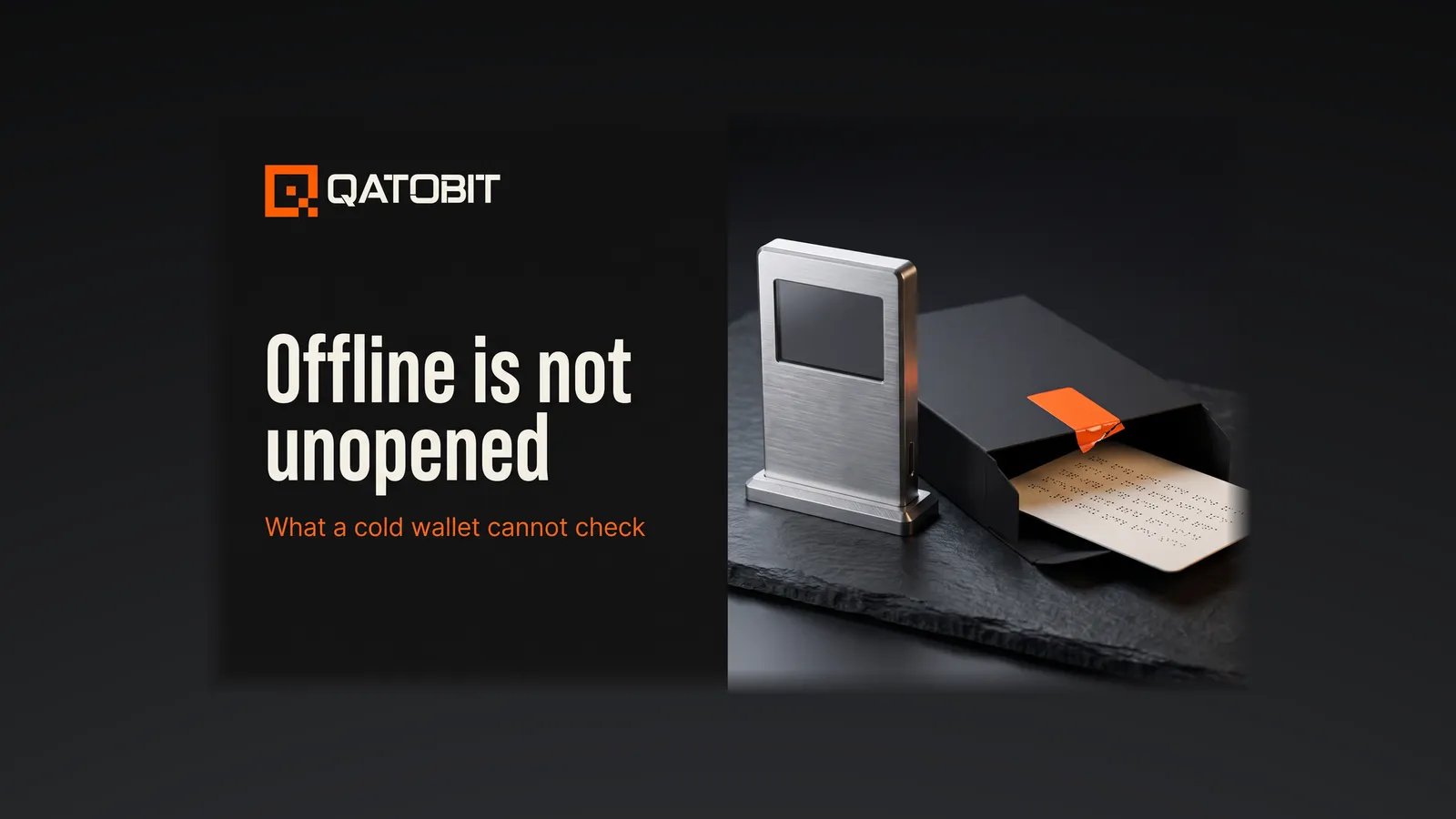
- Open the sealed box yourself and look for signs of a prior opening.
- Let the device generate the recovery phrase on its own screen. A phrase that arrives pre-printed on a card, or one you are asked to type in, is a failed check. Do not use that device.
- Write the phrase on paper and keep it away from any camera, photo or cloud note. Ethereum.org says the same, do not store it on a computer.
- Send a small amount first, and confirm it arrives, before the real position goes in.
- Read the maker's notices. Ledger told affected buyers what to do in public, and the instructions were specific.
Which question does a cold wallet answer?
A cold wallet answers one question well: can anyone online reach the key? It answers a different question poorly, the one most people are asking: is the money safe? The setup moment decides the result. A device bought from the right place and initialised by its owner is strong. The same device from a reseller with a pre-written phrase has a copy of its combination in someone else's pocket.
A holder who wants the offline route should treat setup as most of the job and the device as the smaller part. A holder who does not want to guard a recovery phrase for years has a second route, and it has its own checks.
How is holding an index different?
Holding a Qatobit index is a different arrangement from running a wallet. Qatobit's own answer is that you hold the basket, not the coins, so there is no recovery phrase for you to generate or lose. The assets are held in institutional custody, and Qatobit publishes live Proof of Reserves, available at any time. User assets are insured.
That moves the safekeeping question from your drawer to a custodian. A custodian brings its own questions: who holds the assets, how it reports and what it costs to leave. Leaving a Qatobit index costs nothing at any holding period. The how to read a Proof of Reserves attestation piece shows what such a record does and does not show. The does Proof of Reserves prove a basket is backed piece covers its limits.
Neither route removes market risk. A cold wallet and a custodian both protect against theft of the asset, and neither protects against the price of the asset falling.
Sources and how they were read
These pages were read for this article on 11 October 2026:
- CoinDesk, Ledger investigates wallet tampering after $86 million theft reports, for the reported losses, Ledger's statement and the supply-chain explanation.
- Ethereum.org, Ethereum wallets, for what a wallet is, the hardware wallet description and the key safety guidance.
The rupee figures in the worked examples are invented to show the arithmetic.
Frequently asked questions
What is a cold wallet?
A cold wallet holds your private key offline, on a hardware device or on paper, so malware or a hacked server on the internet cannot copy it. Whoever holds the key can move the coins.
Can a cold wallet be hacked?
Its offline design blocks online theft of the key. It does not help if the device or its recovery phrase was tampered with before you used it, which is the supply-chain risk CoinDesk described in the Ledger reports.
What did Ledger say about the reported thefts?
Ledger said it was investigating reports tied to devices sold by one Southeast Asian reseller and asked that reseller to pause sales. CoinDesk reported that the amount and the cause were unconfirmed and that there was no confirmed evidence Ledger's own systems were compromised.
How do you know a hardware wallet is safe to use?
Buy from the maker, open the seal yourself and let the device generate the recovery phrase on its own screen. A phrase that comes pre-written is a reason not to use the device.
Do I need a cold wallet for a Qatobit index?
A Qatobit index is held as a basket, not as coins, so there is no key or recovery phrase for you to manage. The assets sit in institutional custody with live Proof of Reserves, and market risk stays with the investor.
Crypto investments are subject to market risk. Not financial advice.
“A better allocation begins with a better explanation.”
Qatobit principle
Published construction. Fixed cadence. Versioned control.