The point
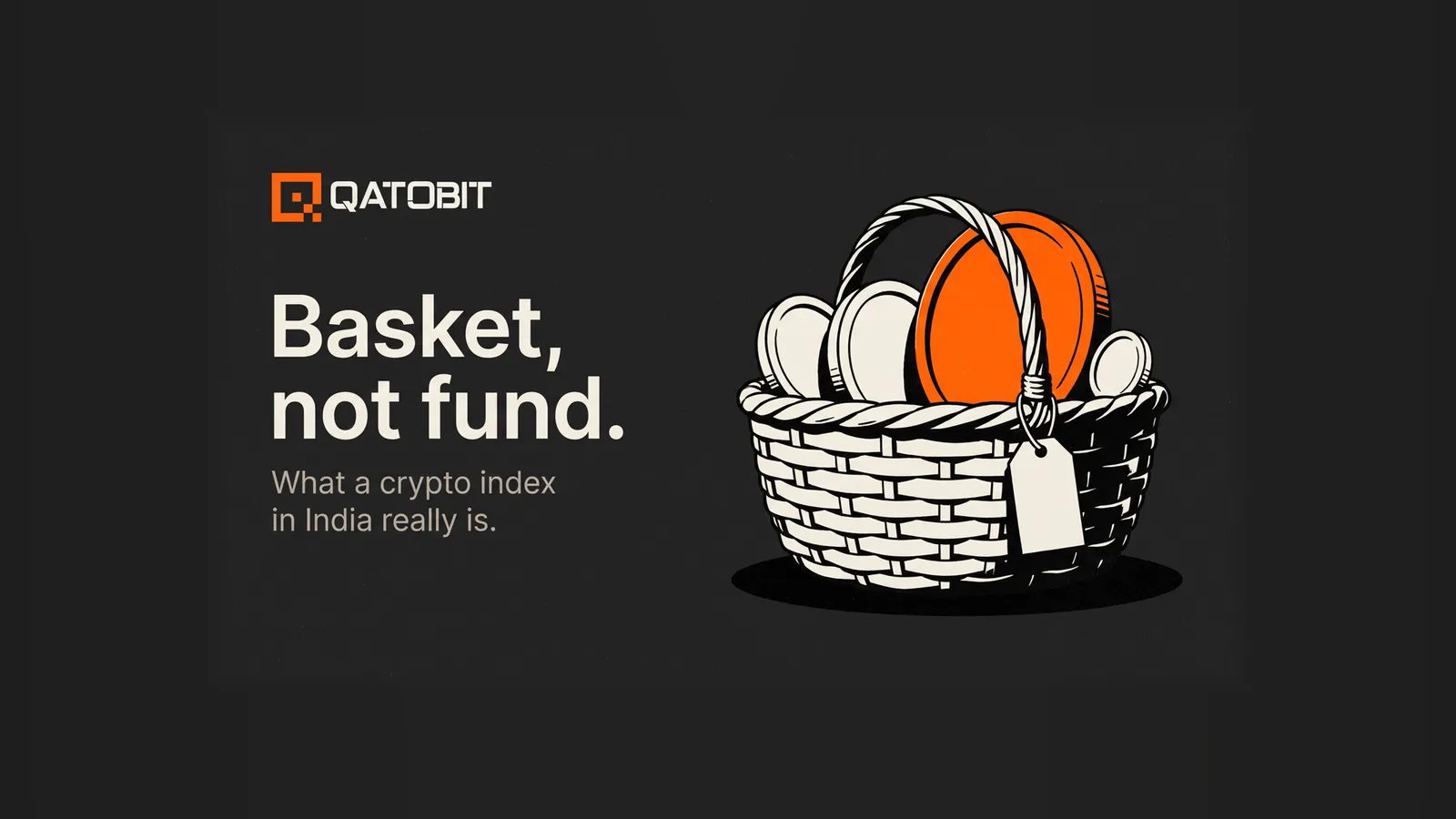
What you can buy in India under the name crypto index fund is a basket of digital assets held on published rules, and "fund" is the wrong word for it. An index decides what goes in and when it resets. A fund implies a structure and a regulator behind it. Only the first is on offer in India. Judge any product on the rule it publishes before the label it wears.
Is there a crypto index fund in India?
Not in the sense the word carries for equities. In India, "fund" names a regulated structure that pools money under a regulator's watch. In its report of 31 December 2021, ET wrote that Sebi had barred mutual fund houses from crypto-related investments until there is a law for such assets. Cafemutual carries that report with its source line.
So what is on offer is an index you hold. An index is a rulebook for what goes in a basket and how much of each. Qatobit's QSI indices are built this way, and we call them indexes or baskets in every sentence about our own products for that reason.
The word matters because it carries assumptions. A reader who sees "fund" assumes a structure and a safeguard that the word does not guarantee for crypto. Strip the label and ask what is there.
What do people mean by an index fund when they search for one?
They mean three things, and each can be checked without any label.
First, passive: a rule picks the holdings, not a manager's mood. Second, rules-based: the same rule applies every time it runs. Third, rebalanced on a schedule: when prices drift the weights away from target, the basket is reset.
Equity investors know this bundle well. The question for crypto is whether a product delivers those three, and whether it shows you how. A basket with a name but no stated rule delivers none of them.
How does a crypto index work?
A crypto index works in four steps, and you can look up each one before investing.
Step 1: A rule fixes the universe
The index starts from what can be held and custodied at scale. Qatobit's methodology page lists the screens as liquidity, market structure, custody, regulatory availability, security, durability and role fit. Anything that fails a screen never reaches the basket.
Step 2: Each holding gets a job
Every asset in a QSI index has a predefined role: anchor, core, growth lever, buffer or reserve. The role, the total risk it adds and a concentration limit set its weight. A coin is in the basket for its job. Last quarter's price has no vote.
Step 3: The weights are published
As of 15 October 2026, the QSI Growth page shows Bitcoin 40 percent, Ethereum 25 percent, Solana 15 percent, Gold 15 percent and a reserve 5 percent. QSI Core shows Bitcoin 40 percent, Ethereum 25 percent, Gold 25 percent and a reserve 10 percent. The live page is the one home of these figures, so read it before you rely on them.
Published weights let you do the arithmetic yourself. Take a ₹5 lakh lump sum into QSI Growth. Bitcoin is ₹2,00,000, Ethereum ₹1,25,000, Solana ₹75,000, Gold ₹75,000 and the reserve ₹25,000. The five add to ₹5,00,000. You know what you own before you pay.
Step 4: The basket resets monthly
Prices move after you buy, so the weights drift. Once a month the index is reset to its published weights. A hypothetical makes the mechanic plain. If Bitcoin runs and your ₹5,00,000 basket holds ₹2,20,000 of it, which is 44 percent, the reset trims ₹20,000 of Bitcoin to bring it back to ₹2,00,000. The rule sells what ran and tops up what lagged, which a mood rarely does.
Qatobit charges 0.35 percent on a basket buy, sell or rebalance. On a ₹5,00,000 buy that is ₹1,750, and the fee is shown before you confirm. The QSI indices carry no annual management fee and no exit load.
Why own the rule instead of choosing coins?
A holder who already runs a full portfolio has a different problem from a person picking coins. The coin pick is the part that does not scale. It needs research on every asset, a view on every cycle and the nerve to act on it when the screen is red.
An index moves that work into the rule. You make one decision, the thesis that fits your horizon, and the methodology carries the rest. That is the reason an allocator gives for owning an index in any asset class: the rule is auditable and the mood is not.
Most of crypto moves with Bitcoin. When it falls, nearly every token falls. A rule that mixes crypto with an asset answering to its own drivers is built to hold up better in that fall. State that as design intent, not as a promise: market risk stays with the holder either way. QSI VRION, with Bitcoin, Ethereum and Solana and no hedge, is the deliberate exception, and it says so on its page.
What should you read on any crypto index page?
Run six checks on any product sold as an index or a fund, ours included.
- Does it publish the rule for what goes in, before you invest?
- Does it publish the current weights, in numbers you can multiply?
- Does it state how often it resets, and what it sells and buys when it does?
- Does it show the fee as a rate, before you confirm, and say whether there is an annual charge?
- Does it say plainly what happens when you leave, and what it costs?
- Does it describe custody in words you can verify, without a partner name standing in for an answer?
A product that answers all six has earned the word index. Whether it has earned the word fund is a separate question about structure that no marketing page can settle for you.
If you want an index run this way, invest in QSI Growth. Read the methodology and the weights first.
For the mechanics of a monthly buy, read how a crypto SIP works. When you are ready, how to start a crypto SIP walks through the setup. Fees get their own guide in how to read a crypto platform's fee schedule. Baskets sit side by side in every crypto basket and index app in India compared.
Frequently asked questions
Is there a crypto index fund in India?
Not as a regulated fund. In its report of 31 December 2021, ET wrote that Sebi barred mutual funds from crypto-related investments until there is a law. What you can buy is an index or basket held on published rules, such as a QSI index on Qatobit.
What is a crypto index?
A crypto index is a basket of digital assets whose holdings and weights are set by a published rule and reset on a schedule. You hold the basket instead of picking each coin. A QSI index rebalances monthly.
How often does a QSI index rebalance?
Every month. The index is reset to its published weights once a month, trimming what has run above its weight and topping up what has fallen below it.
What does a QSI index cost?
Qatobit charges 0.35 percent on a basket buy, sell or rebalance, shown before you confirm. On a ₹5,00,000 buy that is ₹1,750. There is no annual management fee and no exit load.
What is the minimum to invest in a QSI index?
Each QSI index starts at ₹2,000, and a SIP into an index starts at ₹2,000 per cadence.
Crypto investments are subject to market risk. Not financial advice.
“A better allocation begins with a better explanation.”
Qatobit principle
Published construction. Fixed cadence. Versioned control.