The point
An MSTR share is a claim on Strategy Inc, a company that also holds bitcoin. It is not a claim on the bitcoin. In its 10-Q for the quarter ended 30 June 2026, Strategy reported about 846,000 bitcoin and $6.71 billion of long-term debt. Lenders and preferred shareholders sit ahead of an MSTR shareholder on those coins.
What does an MSTR share actually give you?
An MSTR share is common stock in Strategy Inc, the company that was MicroStrategy until August 2025. A common shareholder owns a slice of the whole company: its software business, its debts, and the bitcoin on its balance sheet.
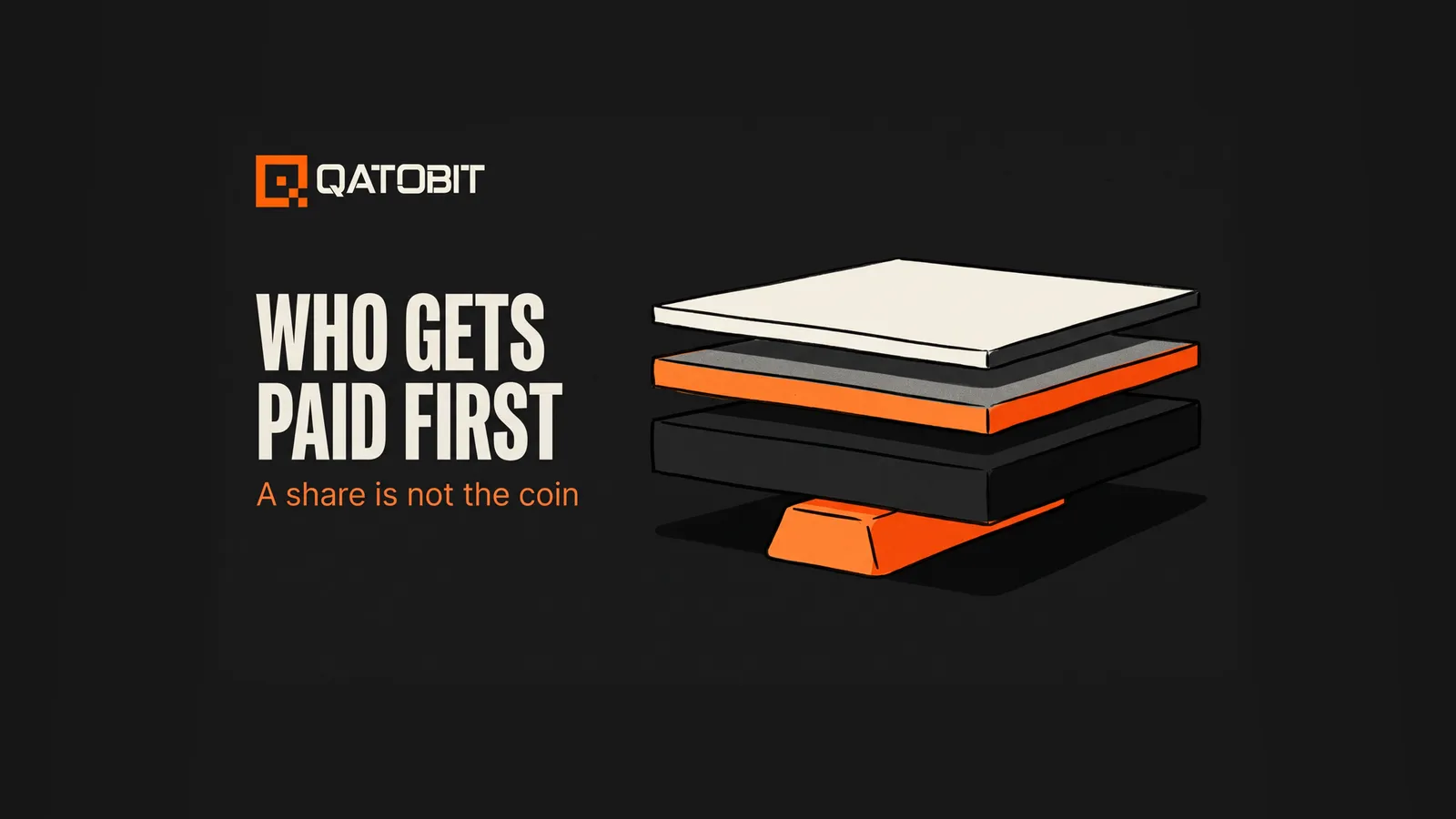
That slice comes last in line. The US Securities and Exchange Commission's investor site sets out the order in a liquidation. Bondholders are paid first, then preferred holders. Common stockholders get whatever is left, which may be nothing.
So the share and the coin are two different things. The coin has one owner and one price. The share has a company wrapped around it, and every layer of that company stands between you and the coin.
What sits ahead of common shareholders?
Three layers sit between an MSTR shareholder and the bitcoin, going by the filings.
The first is debt. Strategy's 10-Q for the quarter ended 30 June 2026 reports long-term debt of $6,709,928,000 at that date.
The second is preferred stock. Strategy has listed preferred series that pay dividends ahead of anything common holders receive. In the first six months of 2026 the company reports $758.2 million of preferred dividends declared in cash, $507.7 million of it in the second quarter. It also reports $7.53 billion raised by issuing preferred stock in those six months.
The third is the common share itself, which carries everything that is left over after the first two are served.
Source: SEC EDGAR company facts for Strategy Inc, read on the day this piece was written, covering the 10-Q period ended 30 June 2026 (data.sec.gov/api/xbrl/companyfacts/CIK0001050446.json). Investor.gov, "Stocks", read the same day, for the order of claims.
How much bitcoin does the company hold, and what is it carried at?
The same filing reports about 846,000 bitcoin. It lists their cost at $63.94 billion and their fair value at $49.67 billion at 30 June 2026. Fair value is the quarter-end market price of the coins, so it moves with every price tick and every new quarter.
The coins are large against the debt: $6.71 billion of long-term debt against $49.67 billion of coins at fair value. The cost figure also sits above the fair value figure at that date. A company that holds bitcoin carries the coin's price swings on its own accounts.
A worked example in rupees
Say ₹5 lakh sits in MSTR shares. Divide the long-term debt by the fair value of the coins, as of 30 June 2026: 6.71 ÷ 49.67 = 0.135. Scale that to ₹5 lakh: 0.135 × ₹5,00,000 = about ₹67,500.
That is a ratio of two filed figures. It shows how much of every ₹5 lakh of coin value on the balance sheet is already matched by a lender's claim, before preferred holders and common holders are counted. It says nothing about what the share is worth.
Preferred stock adds a second prior claim on top of that. Your ₹5 lakh in shares carries the coins' own price risk and sits at the bottom of the order, behind two other groups.
What does the dividend bill do to the picture?
A preferred dividend is a recurring cash bill. For the six months to 30 June 2026 the company paid $629.2 million in cash on preferred dividends, with a further $155.2 million of dividends payable at quarter-end.
Cash has to come from somewhere. A company that holds coins and earns software revenue can meet that bill from sales, from borrowing or from issuing more stock. Dividends are paid in cash, and coins are not cash until they are sold.
Qatobit takes no view on whether Strategy handles this well. The mechanism is the same for any company that funds a coin position with preferred stock, and it explains why an MSTR share and bitcoin can move differently.
Where a basket sits in this picture
A Qatobit index is a different structure. A QSI Crypto Index is a basket of digital assets weighted on a published methodology and rebalanced monthly. You hold the basket, and there is no company layer between you and the assets.
QSI Growth, for example, holds Bitcoin, Ethereum, Solana, Gold and a stable reserve. The only index fee is 0.35% per rebalance, with no annual management fee. Nothing in that structure puts a lender or a preferred holder ahead of you.
Neither route is a guarantee of anything. A basket still carries market risk, and a share can do well while the coin does badly. The two answer different questions: one is a bet on a company's choices, the other is a position in the assets under a rulebook. A reader who wants the position can invest in QSI Growth or start a Bitcoin SIP on Qatobit.
Reading a coin-holding company before you buy it
Before putting money into any company that holds crypto, a reader can run four checks from the filings.
- Find the coin count and the fair value in the latest quarterly report.
- Find the debt and divide it by the fair value of the coins, as above.
- Find the preferred stock and its cash dividend bill for the period.
- Ask what the company would sell, borrow or issue to meet that bill.
Those four numbers describe the company. They do not predict the price of its shares. For related reading, see what a crypto index is and concentration risk.
Frequently asked questions
Does an MSTR share give me ownership of bitcoin?
No. An MSTR share is common stock in Strategy Inc, which holds about 846,000 bitcoin as of its 10-Q for the quarter ended 30 June 2026. The company owns the coins, and lenders and preferred holders have claims ahead of common shareholders.
What does Strategy owe against its bitcoin?
As of 30 June 2026 the 10-Q reports long-term debt of about $6.71 billion against bitcoin at a fair value of about $49.67 billion. It also reports $758.2 million of preferred dividends declared in cash in the first six months of 2026.
Who is paid first if a company is liquidated?
Bondholders, then preferred stockholders, then common stockholders, according to the US SEC's investor.gov guide to stocks. Common holders receive whatever is left, which may be nothing.
Is an MSTR share the same as holding bitcoin directly?
No. A share carries the company's debt, preferred dividends, software business and management decisions as well as the coins. Holding bitcoin directly, or through a basket on Qatobit, carries none of those company layers.
Does Qatobit hold MSTR shares in its indices?
No. QSI Growth holds Bitcoin, Ethereum, Solana, Gold and a stable reserve. QSI Core holds Bitcoin, Ethereum, Gold and a stable reserve. QSI VRION holds Bitcoin, Ethereum and Solana.
Crypto investments are subject to market risk. Not financial advice.
“A better allocation begins with a better explanation.”
Qatobit principle
Published construction. Fixed cadence. Versioned control.