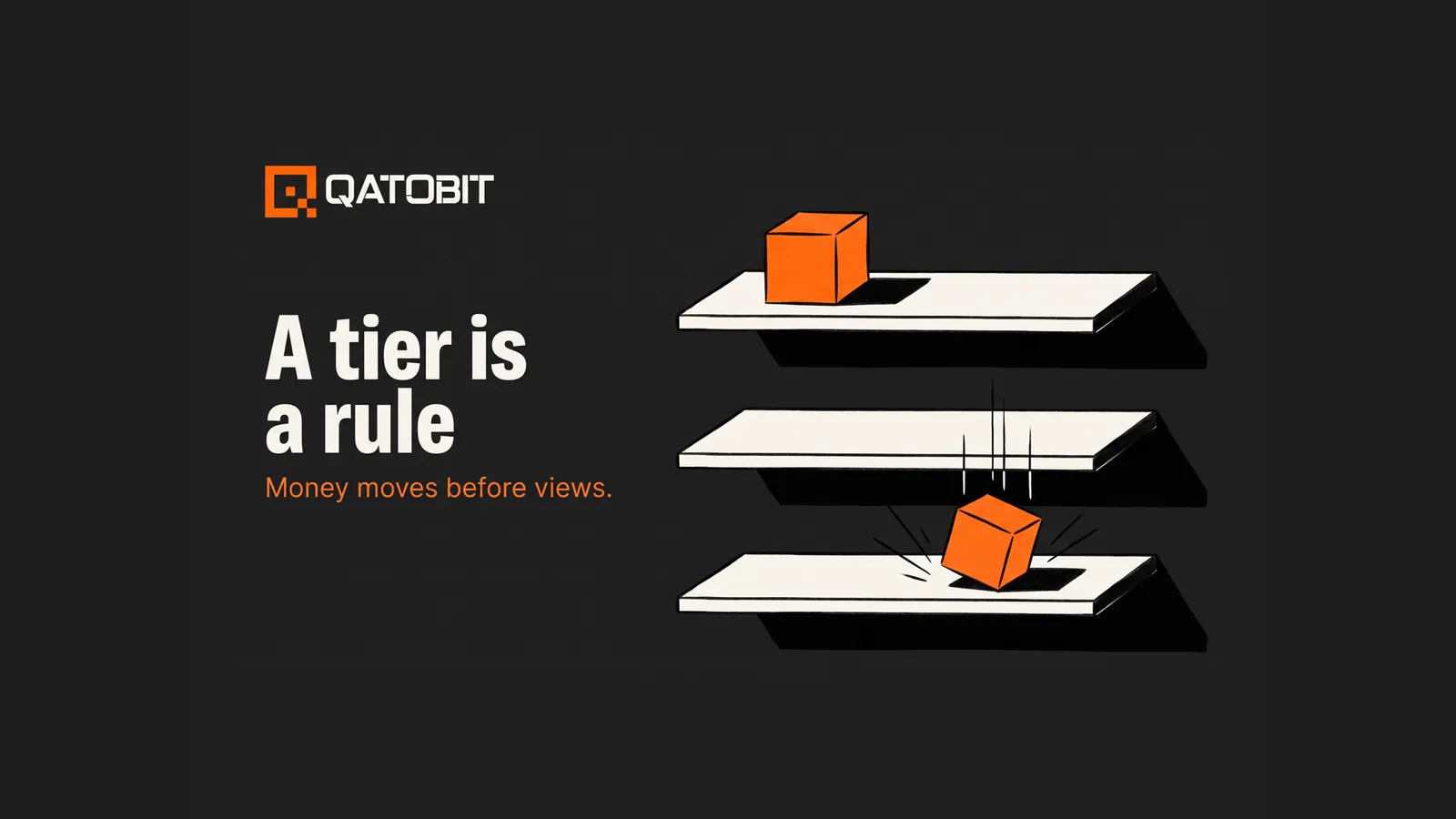
The point
MSCI sorts the world's stock markets into developed, emerging and frontier, with a standalone category for markets that qualify for none of the three. On 15 October 2026 it opened a consultation on moving Indonesia from emerging straight to standalone, skipping frontier. A fund that follows an index has to hold what the index holds, so a change of tier moves money before any investor has changed a view.
What is an MSCI market classification?
It is the label MSCI gives a country's stock market, and the label decides which of MSCI's indexes the market's companies can sit in. A fund built to track the MSCI Emerging Markets index holds emerging-market shares because the index holds them. The index picks each company, and the manager follows it.
MSCI's own framework says the classification of markets is an input into index construction, because it sets the investment opportunity sets the indexes represent. Tier is the first filter. Company selection happens inside it.
How does MSCI decide a market's tier?
The June 2026 edition of the MSCI Market Classification Framework tests a market on three criteria. A country must meet all three to be classified in a given universe.
Economic development
This one applies only to developed status. A country needs gross national income per capita 25 percent above the World Bank high-income threshold for three consecutive years, with the threshold at USD 13,935 in the framework's footnote. MSCI says the test is not used between emerging and frontier because development levels vary too widely within each group.
Size and liquidity
Here the framework gives numbers. To enter the emerging universe, a market needs at least 3 companies meeting the Standard Index criteria at each of the last 8 index reviews. Each company needs a full market capitalisation of USD 3,937 million, a float market capitalisation of USD 1,969 million and a trading-activity score MSCI labels 15% ATVR.
The same test for the developed universe asks for 5 companies, USD 7,874 million, USD 3,937 million and 20% ATVR. For frontier it asks for 1 company, USD 232 million, USD 116 million and 2.5% ATVR.
Market accessibility
This is the criterion about how it feels to invest from outside. It has five parts: openness to foreign ownership, ease of capital inflows and outflows, efficiency of the operational framework, availability of investment instruments, and stability of the institutional framework. The framework's definitions include prompt enforcement of laws and regulations, timely disclosure of float information, and safekeeping of assets through custody.
For the emerging tier the framework asks for significant openness to foreign ownership, significant ease of capital flows and a good and tested operational framework. Most of these are qualitative judgements, reviewed at least once a year.
Source: MSCI Market Classification Framework, June 2026 edition, msci.com, read on 18 October 2026.
What has MSCI proposed for Indonesia?
MSCI's announcement of 15 October 2026, as reported by IDNFinancials and by Metro TV News quoting Antara, opened a consultation on reclassifying Indonesia from emerging to standalone. It is a proposal, and the decision comes later. MSCI says a move to frontier would not adequately reflect the extent of the problems.
The reasons it gives are unclear share ownership structures and suspected coordinated trading, with insufficient and inconsistent progress reported by market participants. It also names an apparent lack of meaningful enforcement. Indonesia's authorities have announced disclosure rules for holders of more than 1 percent. They have also named a list of stocks with high shareholding concentration and set a roadmap to a 15 percent minimum free float. MSCI says those reforms must be implemented consistently, with sustained results.
The timetable is fixed in the announcement. Input is open until 30 April 2027 and the decision comes no later than 30 June 2027. MSCI will proceed with the reclassification unless the consultation identifies clear evidence of material improvements in market governance and functioning.
Standalone is a small group. IDNFinancials, compiling MSCI's classifications, lists Argentina, Jamaica, Panama and Trinidad and Tobago in the Americas. In Europe, the Middle East and Africa it lists Bosnia and Herzegovina, Bulgaria, Lebanon, Malta, Nigeria, Palestine, Ukraine and Zimbabwe, and it finds no Asia-Pacific market in the category.
Source: IDNFinancials, 16 October 2026, and Metro TV News, 16 October 2026, both read on 18 October 2026.
What does the index do while the question is open?
MSCI keeps a freeze on Indonesian stocks until further notice. Four things are suspended. These are increases to a stock's foreign inclusion factor, share-count changes that would raise its weight, additions to the MSCI Indonesia Investable Market Index, and moves to larger-cap segments. MSCI still removes stocks that Indonesia's authorities flag under the high shareholding concentration list.
Each suspended change is one that would raise the market's weight. The index can still remove stocks, so the weight can fall but cannot grow while the question is open, and nobody has to form an opinion for that to happen.
Why does the money move before anyone's view does?
A tracking fund holds each market in proportion to its weight. Take an illustration with an invented weight, not Indonesia's. A market sits at 1.5 percent of an index, and a fund of ₹100 crore tracks it. The fund holds ₹100 crore × 1.5% = ₹1.5 crore of that market.
If the tier changes and the market leaves the index, that ₹1.5 crore has to be sold, whatever the fund's managers think of the companies. An individual with ₹1 crore in the same fund holds ₹1 crore × 1.5% = ₹1.5 lakh of that market, and it leaves the same way.
The classification is a rule, the rule changes which funds are built to hold the shares, and the price meets the change.
The position: a tier is a rule firing, not a verdict
News coverage treats a downgrade as a judgement on a country. The framework reads as a checklist. It lists thresholds, a count of companies over eight consecutive reviews, five accessibility tests and a published calendar. A market falls through a tier when the evidence against those tests accumulates, and the consultation exists so the evidence can be answered.
That is the useful lesson for anyone who owns an index. The holdings decide less than the rule that decides the holdings. Before putting money into an index of any kind, find the rule for who gets in and who gets removed, and read it while nothing is happening. A rule nobody has read still fires on schedule.
Qatobit's four QSI indices work on the same principle. Each follows a documented methodology and rebalances monthly, and the weights are published on the index pages so a holder can see what the rule does before it does it. The reading list below covers how to check any index's rulebook and how the Nifty 50 chooses its members.
Where to read next
For the same question asked of crypto indexes, read how to evaluate any crypto index methodology and four crypto indexes, one methodology. For a market index with a public membership rule, read how the Nifty 50 is calculated and who decides what is in it. For the idea of weighting by something other than size, read what smart beta is and the rule that replaces market cap.
Frequently asked questions
What is an MSCI downgrade?
It is a move of a country's stock market to a lower MSCI tier, such as emerging to frontier or standalone. The country's companies then leave the index of the old tier, and funds tracking that index have to sell them.
What is a standalone market in MSCI's classification?
It is a market that qualifies for neither the emerging nor the frontier category, according to the IDNFinancials report read for this piece. IDNFinancials lists twelve such markets, none of them in Asia-Pacific.
When will MSCI decide on Indonesia?
MSCI's announcement says the consultation is open until 30 April 2027 and the decision comes no later than 30 June 2027. The proposal stands unless the consultation shows clear evidence of material improvements.
Does the Indonesia proposal change how MSCI classifies India?
The announcement as reported concerns Indonesia only. Each market is assessed against the same three criteria, and the reports read for this piece name no other market.
What does MSCI test before it moves a market?
Economic development for developed status, size and liquidity measured over the last 8 index reviews, and five market accessibility criteria. For the emerging tier the size test asks for 3 companies of at least USD 3,937 million full market capitalisation.
Crypto investments are subject to market risk. Not financial advice.
“A better allocation begins with a better explanation.”
Qatobit principle
Published construction. Fixed cadence. Versioned control.