The point
The Nifty 50 fell 1.07 percent on 27 November 2026, and the Sensex lost 989.33 points. That is a real number, but it is a size and not a direction. Technology, banks and autos did most of the falling, while the Nifty Midcap 100 rose 0.10 percent. Read a red session by how much, where and why, then set it against the month around it.
Why did the market fall on 27 November 2026?
The Sensex closed at 83,339.26, down 989.33 points or 1.17 percent from 84,328.59. The Nifty 50 closed at 25,607.20, down 277.30 points or 1.07 percent from 25,884.50, according to the ANI market close report.
Reports gave several reasons at once, and none of them stands alone as the cause. Brent crude was near USD 97 a barrel. Tensions in the Gulf kept a risk premium on oil. A proposed US tariff on Indian goods remained unresolved. And a recovery in global technology shares pulled attention away from Indian IT.
One analyst quoted by ANI called the fall consolidation and profit-booking after a sharp recovery over a few sessions, while also naming crude as an external risk. Two readings of one session sit side by side in the same report, which is itself a hint about how much a single day can prove.
Which parts of the market did the falling?
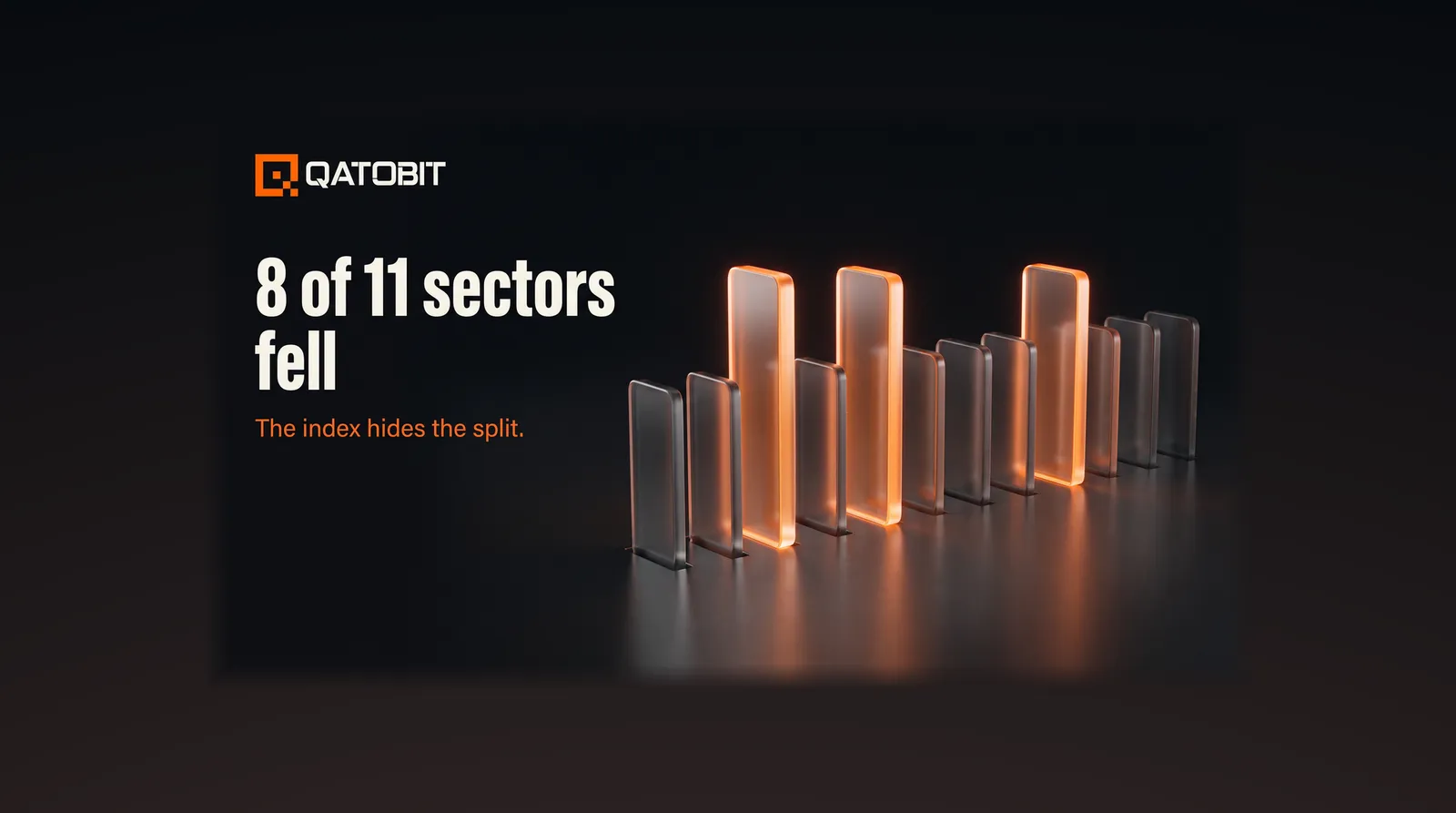
The index number hides a split. Per the DSIJ closing bell report, eight of the 11 sectoral indices ended lower.
- Nifty IT fell 1.88 percent, the worst sector, after a 3.66 percent rise on 26 November 2026.
- Nifty Auto fell 1.48 percent and Nifty Realty fell 1.42 percent.
- Nifty Financial Services fell 1.33 percent and Nifty Bank fell 0.78 percent.
- Nifty Metal rose 1.38 percent, the best sector.
- Nifty Midcap 100 rose 0.10 percent and Nifty SmallCap 100 rose 0.56 percent.
Source: DSIJ closing bell report, 27 November 2026 session, read 28 November 2026.
So the 50 biggest companies fell while the broader market held, the same gap that market breadth measures in a rising market. The Nifty 50 is weighted by size, which means a handful of very large names, including three IT majors and several banks, can move it by themselves. HCL Technologies fell 3.03 percent, Infosys 2.68 percent and TCS 2.57 percent, per the same report. A reader whose portfolio is a Nifty 50 index fund felt all of that. A reader holding a spread of midcaps felt almost none of it.
That is the first check. Before asking why the market fell, ask which market. The answer changes what the number means for your own holdings. The piece on concentration risk explains how a few large weights can decide an index's day.
How big is a 1.07 percent fall for a portfolio?
Put rupees on it. Take a ₹1 crore portfolio with 40 percent in a Nifty 50 index fund. That is ₹40 lakh in the index.
A 1.07 percent fall on ₹40 lakh is ₹40,00,000 × 0.0107 = ₹42,800. On a ₹5 lakh lump sum held entirely in the index, the same fall is ₹5,00,000 × 0.0107 = ₹5,350.
Now set it against the move that came before. DSIJ reports that, even after the fall, the Nifty 50 was still up about 258 points over the past three sessions. If the fall was 277.30 points, the three sessions before it added roughly 258 + 277 = 535 points. The red session gave back about half of a short run, and the index still ended that stretch higher.
The fall still cost real money, and its size matters more than its colour. A figure like ₹42,800 on ₹1 crore is one a portfolio built for a long horizon was designed to absorb.
What do the stated reasons actually tell you?
Take the reasons one at a time, and keep only what the sources say.
Crude oil is the one with a mechanism. A higher oil price raises India's import bill and can push up inflation, which is how the ANI-quoted analyst framed it. The same report quotes a commodity analyst saying there had been no meaningful disruption to physical supply so far, and that the market was pricing the risk of future disruption. So oil moved on a possibility, which is why it can reverse without anything changing on the ground. How oil moves Indian markets is covered in why Indian markets watch Brent first.
The US tariff is a pending item. DSIJ describes a proposed tariff of up to 25 percent, with a possible cut to 17 percent if a trade agreement is concluded. It adds that Commerce Minister Piyush Goyal indicated talks were nearing completion. Uncertainty costs the market something while it lasts, and it can end in either direction.
The rupee was weaker too. DSIJ reports it slipped to ₹92.62 against the US dollar in early trading, with crude and dollar demand named as factors.
Each outlet orders them by what it considers newsworthy, and nobody can prove which one moved a given share in a given hour. A report that says "because of X" about a single session is describing a plausible story, which is as far as one session's evidence goes.
Why is one session the wrong unit?
A day is the smallest unit the news cycle prints, so it is the one people react to. It is also a poor unit for a decision about a portfolio that is meant to be held for years.
Three checks turn a red session into information.
- Size: how many percent, and what is that in rupees on your actual holdings.
- Breadth: did the index fall because everything fell, or because a few heavy sectors did, as IT, banks and autos did here.
- Context: what did the index do over the weeks before it. A fall after a strong run is a different event from a fall after a long slide.
On the third check, the sources show a market that had risen over three sessions. They also show a technology index that had gained four sessions in a row before it turned. That is what a pause after a run looks like. It is not a forecast that the run is over, and nothing in this piece says what the next session will do.
A headline that asks why the market is falling is asking for a cause, and a single session rarely has one. The use is in the sizing and the sector split. You can read both in a few minutes, and they tell you whether your own allocation was the one that moved.
What to do with a red session
If your allocation was set deliberately, the first move is to check it against the rule you set, and not against the day. A rule written in calm months, such as "rebalance when a sleeve drifts five points from target", already says what a fall of this size calls for. A 1.07 percent move in one index is far inside that kind of band.
If you find yourself reaching for the screen every time the Sensex loses a thousand points, the more useful question is whether your position size lets you ignore it. A fall that costs ₹42,800 on a ₹1 crore portfolio is tolerable for the allocation described above. The same fall would be unbearable on a portfolio that is 90 percent in one index, and the fix for that is allocation.
The reasons will change from one red session to the next, so what carries over is the method. Read the size, read the split, name the reasons and then look at the month.
Frequently asked questions
Why did the Sensex fall on 27 November 2026?
The Sensex fell 989.33 points, or 1.17 percent, to 83,339.26. Reports cited Brent crude near USD 97 a barrel, Gulf tensions, an unresolved US tariff and selling in IT, banking and auto stocks.
How much did the Nifty 50 fall on 27 November 2026?
The Nifty 50 fell 277.30 points, or 1.07 percent, to 25,607.20. On a ₹5 lakh holding in a Nifty 50 index fund, that is a fall of ₹5,350.
Does one falling day mean the market is in trouble?
No. One session is a size, and the 1.07 percent Nifty fall came after the index had gained over the preceding three sessions. A trend needs a run of sessions and a reason that persists, and a single day shows neither.
Why do the Nifty 50 and the Nifty Midcap 100 move differently?
They hold different companies. On 27 November 2026 the Nifty 50 fell 1.07 percent, led by large IT and banking names, while the Nifty Midcap 100 rose 0.10 percent.
How do I check how much a market fall cost my portfolio?
Multiply the index's percentage fall by the amount you hold in that index. A 1.07 percent fall on ₹40 lakh is ₹42,800. Do the same for each holding that tracks a different index.
Crypto investments are subject to market risk. Not financial advice.
“A better allocation begins with a better explanation.”
Qatobit principle
Published construction. Fixed cadence. Versioned control.