The point
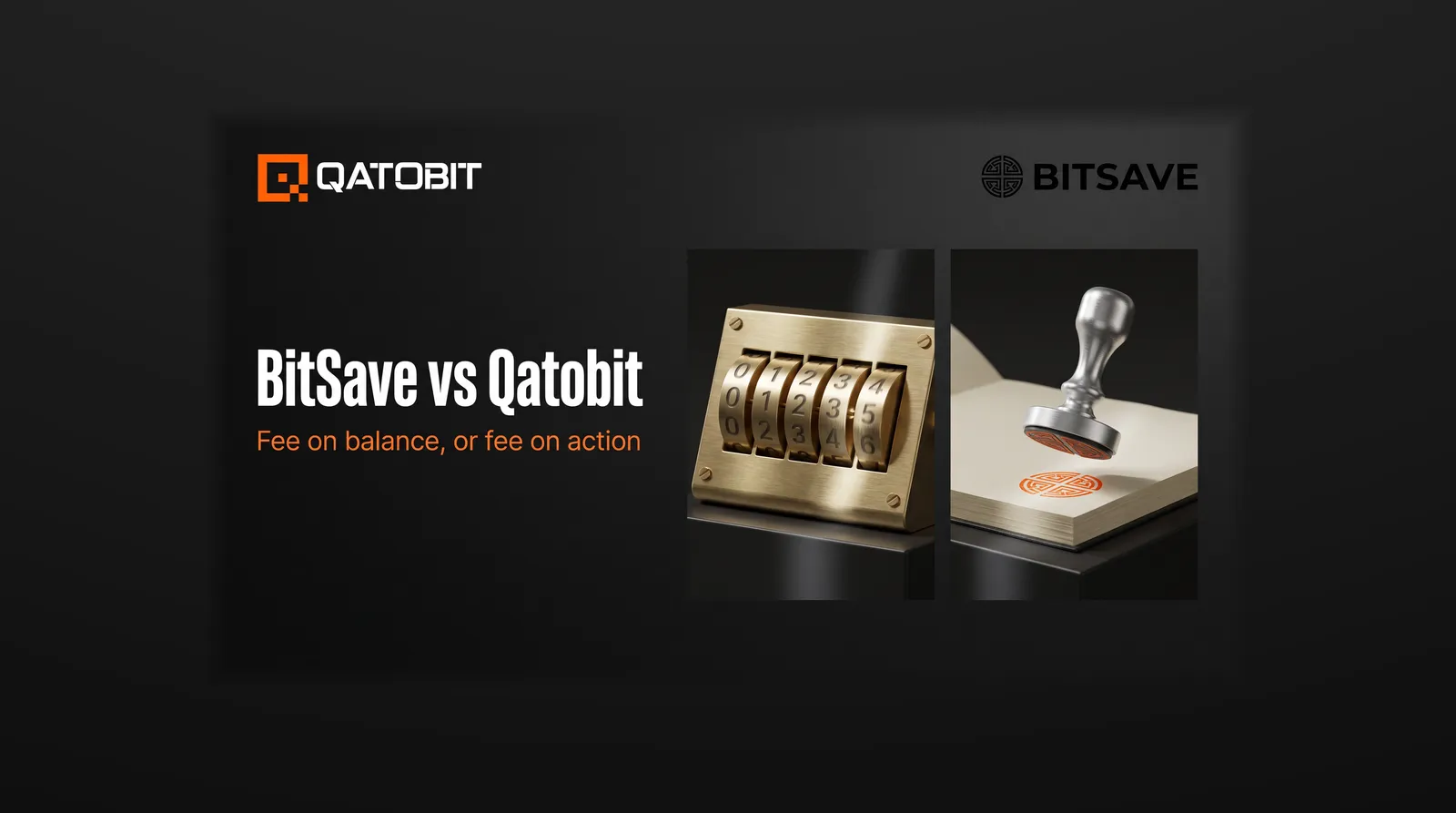
BitSave's Crypto Index Product charges 1.5 percent a year, taken daily from the value held, and tracks the Bloomberg Galaxy Crypto Index. Qatobit's four QSI indices charge 0.35 percent when a basket is bought, sold or rebalanced, with no annual management fee. BitSave suits an investor who wants an externally administered benchmark and a named person on WhatsApp. Qatobit suits one who wants four documented allocations and a cost that arrives only when something moves.
Last verified: 4 November 2026
What each product is
BitSave describes its Crypto Index Product as "a managed crypto investment offering". It "replicates the Bloomberg Galaxy Crypto Index (BGCI)" and is "rebalanced monthly to track real changes in the crypto market". BitSave sells two other products beside it: a Crypto and Gold product and a Bitcoin product. Source: BitSave Crypto Index Product.
Qatobit is a crypto index investing platform in India. An investor holds a curated basket of digital assets, rebalanced monthly on a published methodology, rather than picking coins. Qatobit sells four QSI indices: QSI Core, QSI Growth, QSI VRION and QSI GEQ8.
BitSave Crypto Index Product at a glance against Qatobit QSI
- Minimum: BitSave's homepage and product page list "$50 USD" as the one-time minimum for the Crypto Index Product. Qatobit's minimum is ₹2,000 per index.
- SIP: BitSave lists a minimum SIP of "$10 USD per month", weekly or monthly. Qatobit offers a SIP into an index from ₹2,000 per cadence.
- Annual fee: BitSave lists "1.5% per year, charged daily on the day's NAV". Qatobit charges no annual management fee on any index.
- Fee per rebalance: BitSave's monthly rebalancing sits inside that annual charge. Qatobit charges 0.35 percent of the transaction amount on every basket buy, sell or rebalance, shown before confirmation.
- Exit fee: BitSave lists "1.00% if redeemed within 30 days, none after". Qatobit charges no exit load, lock-in or minimum holding period on any index. Selling a basket costs the same 0.35 percent as buying one.
- What is inside: BitSave lists "up to 15 large-cap crypto assets", selected by Bloomberg from the top 25 by market capitalisation, with live composition in the app. Qatobit names every holding of every index on its product pages.
- Weighting rule: BitSave states that "no single asset exceeds 35% or falls below 1%", set by Bloomberg's methodology. Qatobit documents the methodology per index, with hard caps on QSI GEQ8 of no holding above 15 percent or below 3 percent.
- Rebalance cadence: BitSave rebalances monthly. Qatobit rebalances all four indices monthly.
- INR deposit and withdrawal: BitSave says rupees are received by BitPe Digital LLP and converted to a dollar-denominated stablecoin within India. It lists withdrawals as "Anytime" with processing "within 2 days". Qatobit takes deposits by UPI, IMPS, NEFT or RTGS and withdraws directly to the linked bank, with a ₹200 minimum either way and no fee.
- Custody as each company states it: BitSave says units are "held by a regulated, institutional custodian" in "institutional cold storage". Qatobit states institutional custody.
- Proof of reserves as each company publishes it: BitSave lists "live proof of reserves & liabilities", on-chain and verifiable 24/7. Qatobit publishes live proof of reserves, available at any time.
BitSave sources, all read on 4 November 2026:
Qatobit figures are from Qatobit's own product documentation.
How does BitSave's annual fee compare with a per-rebalance fee?
An annual fee on NAV is a slice of the whole balance, taken a little each day. A per-rebalance fee is a slice of only the money that moves. The two are different shapes, so the comparison needs arithmetic, and every figure below assumes no price movement, so it measures fees alone.
Monthly SIP. An investor puts ₹25,000 a month into an index for twelve months, ₹3,00,000 in all. Assume each instalment lands on the first of the month and the balance stays flat.
- BitSave's 1.5 percent a year works out to 0.125 percent a month on the balance. The balances held are ₹25,000, ₹50,000 and so on up to ₹3,00,000, which sum to ₹25,000 × 78 = ₹19,50,000 of month-balances. ₹19,50,000 × 0.125 percent = about ₹2,437.50 for the year.
- Qatobit's 0.35 percent on each ₹25,000 buy is ₹87.50, and ₹87.50 × 12 = ₹1,050 for the year.
- A rebalance adds ₹35 for every ₹10,000 it moves. For Qatobit's year to cost as much as BitSave's, rebalances would need to move about ₹3.96 lakh in total: (₹2,437.50 − ₹1,050) ÷ 0.35 percent = ₹3,96,429.
Lump sum. An investor puts ₹5 lakh in and holds it for a year.
- BitSave: ₹5,00,000 × 1.5 percent = ₹7,500.
- Qatobit: ₹5,00,000 × 0.35 percent = ₹1,750 to buy, plus ₹1,750 to sell if the investor exits, ₹3,500 in all, plus 0.35 percent of whatever the rebalances move.
Five years. The same ₹5 lakh held for five years costs ₹7,500 × 5 = ₹37,500 under BitSave's schedule on a flat balance. Qatobit's ₹3,500 buy and sell leaves ₹34,000 of room before the schedules match, which is ₹34,000 ÷ 0.35 percent = about ₹97.14 lakh moved across sixty rebalances.
Exit inside 30 days. Selling a ₹5 lakh holding inside a month costs ₹5,00,000 × 1 percent = ₹5,000 at BitSave. On Qatobit it costs ₹1,750, the same as a sale at any other time.
BitSave's cost follows the balance, so it grows as the position grows. Qatobit's follows activity, so it depends on how much a rebalance moves, which each index's methodology sets. How much a rebalance moves depends on how far holdings have drifted since the last one, so the page uses stated amounts rather than a typical one.
Who decides what each index holds?
BitSave states that "Bloomberg's index experts decide what's in the index and at what weight, by a published methodology. BitSave does not choose which assets are in." The benchmark is the Bloomberg Galaxy Crypto Index, which BitSave describes as "market-capitalisation-weighted" and administered by Bloomberg Index Services Limited.
Qatobit designs its own indices. QSI Core holds Bitcoin, Ethereum, Gold and a stable reserve (USDT Earn). QSI Growth holds Bitcoin, Ethereum, Solana, Gold and a stable reserve (USDT Earn). QSI VRION holds Bitcoin, Ethereum and Solana with no hedge layer. QSI GEQ8 holds eight global companies. The methodology is documented per index and published before launch.
An investor choosing between them is choosing whose rulebook to follow. One is written and administered by a third party. The other is written by Qatobit and published in full. For how an index differs from a single-coin buy, see what a crypto index is.
Where BitSave is stronger
BitSave's benchmark is administered by a third party. Its product page calls the product "India's only Bloomberg-indexed crypto investment product". A methodology maintained outside the company is a real check that Qatobit's in-house rulebook does not have.
BitSave describes its assets as held in "regulated & insured cold storage" and publishes a dedicated Trust and Security page covering custody, segregation and audit. It states that client assets are "never lent, staked or rehypothecated". Those are BitSave's own statements, quoted as published.
BitSave assigns every investor "a real person to guide you, assigned on WhatsApp". It also reports that "26 of 26 cybersecurity domains" were assessed and compliant in an audit conducted by Grant Thornton Bharat LLP under CERT-In requirements. Qatobit's Qai answers inside the platform and on WhatsApp, by voice or chat, in Indian languages, with sign-in required. Qai is informational software, where BitSave's contact is a named person.
Where Qatobit is stronger
Qatobit prices every basket action at one rate, 0.35 percent, shown before confirmation. There is no annual management fee. There is no exit load, lock-in or minimum holding period either, so a position held for five years pays nothing for the time it sat.
Qatobit sells four indices, each a permanent allocation with its own documented methodology, so the investor picks the thesis. Every holding is named on the product pages. Rupee rails run through UPI, IMPS, NEFT or RTGS at no fee, and withdrawals go directly to the linked bank. Qatobit publishes live proof of reserves, available at any time.
The QSI indices, in full
Qatobit sells four QSI indices. Three hold crypto and one holds global equities.
QSI Core holds Bitcoin, Ethereum, Gold and a stable reserve (USDT Earn). QSI Growth holds Bitcoin, Ethereum, Solana, Gold and a stable reserve (USDT Earn). QSI VRION holds Bitcoin, Ethereum and Solana with no hedge layer. QSI GEQ8 holds eight global companies in three sleeves: Apple, Amazon, Alphabet, Meta Platforms and NVIDIA (platform), Coinbase and Robinhood Markets (digital finance), and Tesla (innovation). QSI GEQ8 sits outside SEBI regulation and is an index, not a fund.
All four rebalance monthly on a methodology documented per index. The minimum per index is ₹2,000, and a SIP into an index starts at ₹2,000 per cadence. A basket buy, sell or rebalance costs 0.35 percent of the transaction amount, displayed before confirmation. There is no annual management fee, and no exit load, lock-in or minimum holding period on any index. A single-asset buy or sell costs 0.4 percent and a crypto-to-crypto convert costs 0.1 percent. Deposits arrive by UPI, IMPS, NEFT or RTGS and withdrawals go directly to the linked Indian bank account, with a ₹200 minimum each way and no fee.
Who should choose which
BitSave suits an investor who wants one product tracking a published, externally administered benchmark. It also suits one who values a named relationship manager on WhatsApp and is comfortable with a fee taken daily on the balance.
Qatobit suits an investor who wants to choose among four allocations, with every holding named and a fee that arrives only when a basket is bought, sold or rebalanced.
Neither product serves an investor who wants to pick individual coins or trade often. BitSave's own FAQ says "You cannot buy or sell individual coins", and Qatobit's indices are likewise built for holding.
How this page was checked
Every BitSave figure on this page was read from BitSave's own pages on 4 November 2026. Those pages are the homepage, the Crypto Index Product page, the Trust and Security page and the FAQ. A figure that did not appear on those pages was dropped. The BitSave pages are re-read once a month and the Last verified line above is changed in place. Qatobit figures come from Qatobit's product documentation. This page compares no return and no performance.
On the allocation question that comes before the product question, what asset allocation is and what it decides before any pick sets out the framework. Concentration risk shows what a basket is built to limit, and portfolio rebalancing when one holding falls 10 percent walks through a monthly rebalance. A comparison of a crypto SIP into an index with a single-coin SIP covers the recurring-buy side.
Frequently asked questions
What does BitSave's Crypto Index Product charge?
BitSave lists 1.5 percent a year, charged daily on the day's NAV, and a 1 percent exit fee if units are redeemed within 30 days. It lists no exit fee after that, per its Crypto Index Product page as read on 4 November 2026.
What does Qatobit charge for an index?
Qatobit charges 0.35 percent of the transaction amount on every basket buy, sell or rebalance across all four QSI indices, shown before confirmation. There is no annual management fee and no exit load.
Which index does BitSave's Crypto Index Product track?
It tracks the Bloomberg Galaxy Crypto Index. That index holds up to 15 assets from the top 25 by market capitalisation, with a 35 percent cap and a 1 percent floor on any one asset. Bloomberg selects the constituents, and BitSave does not.
Do BitSave and Qatobit both rebalance monthly?
Yes. BitSave rebalances its Crypto Index Product monthly in line with its benchmark. Qatobit rebalances all four QSI indices monthly on a methodology documented per index.
Does Qatobit publish proof of reserves?
Yes. Qatobit publishes live proof of reserves, available at any time. BitSave also lists live proof of reserves and liabilities, verifiable on-chain. For what the record proves, see what Qatobit's proof of reserves is.
Crypto investments are subject to market risk. Not financial advice.
“A better allocation begins with a better explanation.”
Qatobit principle
Published construction. Fixed cadence. Versioned control.