The point
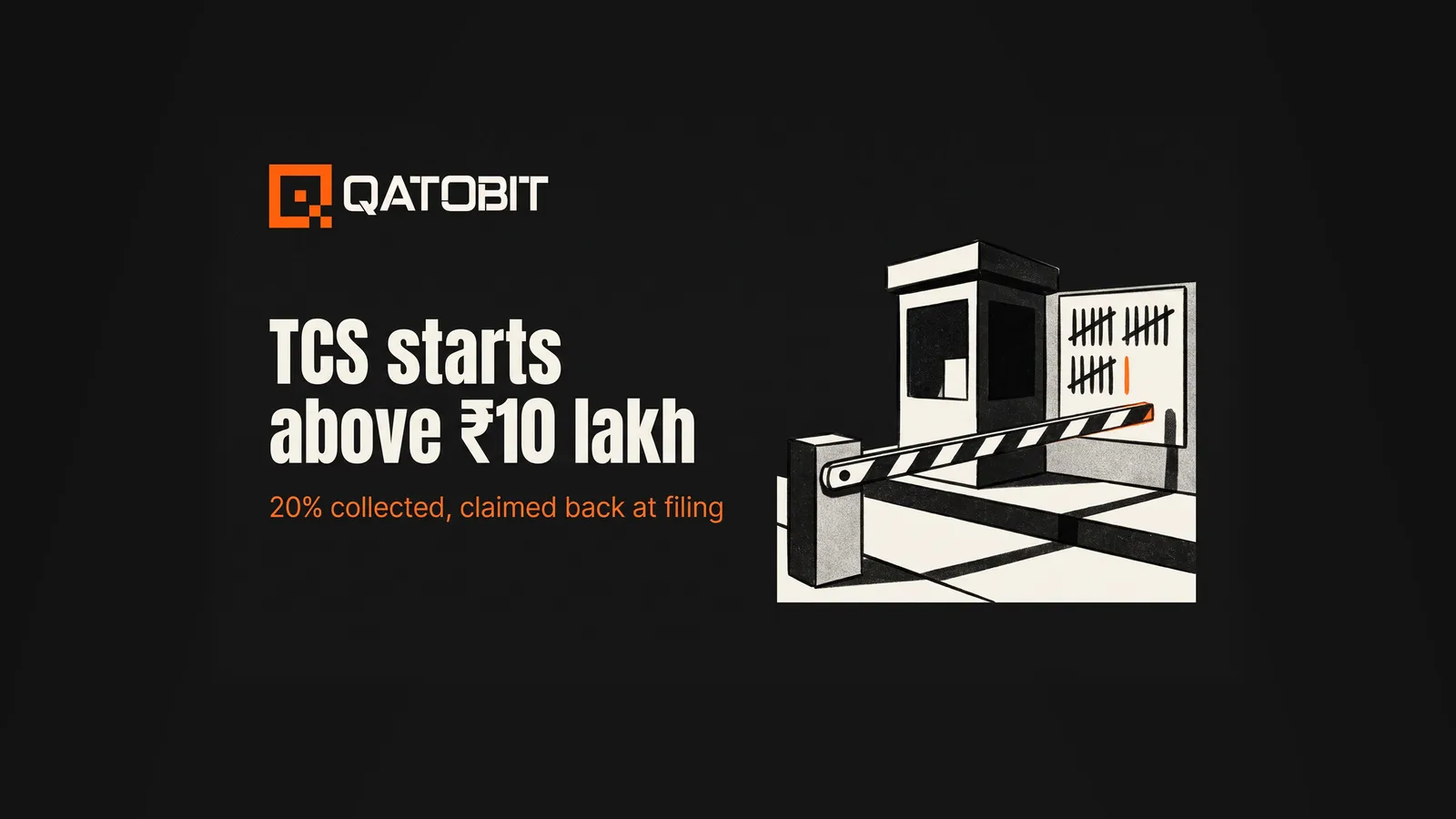
Sending money abroad under the Liberalised Remittance Scheme (LRS) carries no tax collected at source up to ₹10 lakh in a financial year. Above it, the rate is 20 percent. The overall limit is USD 2,50,000 per person per year. The 20 percent is not a final tax, but it is cash you front to the bank until your return is filed.
What is the Liberalised Remittance Scheme, and what is the limit?
The Liberalised Remittance Scheme is the Reserve Bank of India framework that lets a resident individual send money abroad. It covers current and capital account transactions, and buying overseas shares or ETFs (exchange-traded funds, baskets of shares that trade on an exchange) falls in the second group.
Kotak Mahindra Bank's FAQ states the limit. Resident individuals, minors included, can remit up to USD 2,50,000 per financial year, April to March. That covers any permissible current or capital account transaction, or both. A PAN is mandatory for every LRS transaction.
The limit caps the amount. The cost comes from three separate things: tax collected at source, the exchange rate your bank gives you, and the disclosure you owe in your return.
Source: Kotak Mahindra Bank, send-money-abroad FAQ, read 29 October 2026.
How does tax collected at source work on an overseas investment?
Tax collected at source (TCS) is tax your bank collects from you at the time of the transfer and deposits with the government in your name. It is a prepayment, not a fee the bank keeps.
Take a remittance that is not education, medical treatment or a tour package. Kotak Mahindra Bank and RBL Bank both publish the same rule from 1 April 2026. It is nil up to ₹10 lakh in the financial year and 20 percent on the amount above. Kotak Mahindra Bank lists the section as 394(1) of the Income-tax Act, 2025, earlier section 206C(1G) of the 1961 Act.
The ₹10 lakh counts everything. RBL Bank states that all forex taken under LRS in the year goes into the threshold. That includes an outward remittance, a forex card and a debit card. Overseas tour packages and an education remittance paid from a loan are left out.
Source: Kotak Mahindra Bank, send-money-abroad FAQ, and RBL Bank, tax collected at source page, both read 29 October 2026.
What does that cost at three portfolio sizes?
TCS applies only to the part above ₹10 lakh, so the first two examples never meet it.
- ₹25,000 a month is ₹3 lakh in a year. That is below ₹10 lakh, so TCS is ₹0.
- ₹5 lakh sent as one lump sum is also below ₹10 lakh, so TCS is ₹0.
- ₹1 lakh a month is ₹12 lakh in a year. The first ten transfers use up the ₹10 lakh. The eleventh and twelfth carry TCS, so ₹2 lakh above the threshold at 20 percent is ₹40,000.
- ₹25 lakh sent in one year is ₹15 lakh above the threshold. At 20 percent, TCS is ₹3 lakh. You hand the bank ₹28 lakh to send ₹25 lakh abroad.
The ₹3 lakh is not lost, but it leaves your account on the day of the transfer, and it stays with the tax department until you claim it back.
How do you get the TCS back?
You claim it as tax already paid when you file your income tax return. Kotak Mahindra Bank states that the remitter can claim the credit where the PAN was provided. RBL Bank states that the bank does not refund TCS once it has paid it to the tax department, and that the credit and any refund come through the return.
Business Standard quotes Deloitte India's Poorva Prakash on where it goes: the details of the TCS are reported in Schedule TCS of the return to claim credit for it. Credit is set against your total tax for the year. Any excess comes back as a refund after the return is processed, so the timing is set by when you file and when the department processes it.
That is why this piece treats TCS as a loan to the tax department. On a ₹25 lakh transfer, the real question is what that ₹3 lakh would have done in your portfolio for the months it sits there.
Source: Kotak Mahindra Bank and RBL Bank pages above, and Business Standard, published 17 July 2025, read 29 October 2026.
What does the exchange rate cost?
Your bank converts rupees to dollars at its own rate, which sits a little away from the mid-market rate. That gap is the spread, and it is the second cost of the route.
This page does not quote a spread, because it differs by bank and by day and a number read once is out of date by the next transfer. To show the arithmetic only, assume a bank rate 1 percent worse than mid-market. On ₹25 lakh that is ₹25,000. On ₹5 lakh it is ₹5,000. Ask for the rate on the day, in writing, before you send.
Check two things on any quote. First, whether the remittance charge is shown separately from the rate. Second, whether the receiving broker charges to receive an incoming wire. Both add to the real price and neither shows up in the TCS line.
What do you have to disclose after investing abroad?
Disclosure is the third cost, paid in time. Business Standard quotes tax advisers on the position. A resident investor who holds foreign assets or earns income from foreign securities files ITR-2. With business or professional income, the form is ITR-3.
Schedule FA, the foreign assets schedule of the return, carries every foreign holding. Tax2Win's Abhishek Soni is quoted saying that resident and ordinarily resident individuals report under it. That holds whether or not the asset's income is taxable in India. Even dormant or low-value holdings are declared.
Foreign tax paid on dividends or gains can be claimed as a credit in India through Form 67, which is filed electronically on the income tax e-filing portal. The same article quotes advisers on the penalty for not reporting foreign assets or income: a fine of up to ₹10 lakh, and possible prosecution under the Black Money law.
The practical cost is record keeping. Foreign income does not appear pre-filled in your return. Business Standard quotes Economic Laws Practice's Dipesh Jain saying it is missed at times. Form 26AS, the Annual Information Statement and the Taxpayer Information Statement do not capture it. You keep the records yourself.
Source: Business Standard, published 17 July 2025, read 29 October 2026. Filing deadlines move each year, so check the current one on the income tax portal.
Where does the rupee route fit in?
Everything above applies to the route where you move rupees out of the country yourself. A different route is to hold the same kind of exposure in rupees, inside a basket.
QSI GEQ8 is a Qatobit-designed index of 8 global companies in technology, digital finance and innovation: Apple, Amazon, Alphabet, Meta, NVIDIA, Coinbase, Robinhood and Tesla. It rebalances monthly, charges 0.35 percent per rebalance, and has no annual management fee. It sits outside SEBI regulation. On Qatobit, buying and selling is in rupees from one balance.
This piece does not say how any of that is taxed, because the LRS rules above are about remittances and say nothing on it. If your decision turns on tax, read the index methodology and the Qatobit tax FAQ first. Then compare the two routes on the paperwork each one asks of you.
My view: people price this route by the spread because it is the number on the screen. The cost that decides it is the cash held back above ₹10 lakh and the schedules you file every year after.
Where to read next
Both costs are easier to plan around once the date the money is needed is fixed. The piece on the investment horizon sets that out. How a global stock gets its weight in a basket is in free float and a stock's weight in an index. The QSI GEQ8 methodology shows the rules of the index named above. The tokenized assets FAQ covers how rupee-bought tokenized exposure works.
Frequently asked questions
What is the Liberalised Remittance Scheme limit per year?
USD 2,50,000 per financial year, April to March, per resident individual, minors included. Kotak Mahindra Bank states this as the RBI framework for any permissible current or capital account transaction, and a PAN is mandatory.
Is TCS charged on every LRS transfer?
No. For remittances that are not education, medical or a tour package, TCS is nil up to ₹10 lakh and 20 percent above it, from 1 April 2026. RBL Bank counts all LRS forex across products toward that ₹10 lakh.
How much TCS is charged on a ₹25 lakh transfer?
₹3 lakh. The first ₹10 lakh carries none, and 20 percent of the remaining ₹15 lakh is ₹3 lakh. You pay the bank ₹28 lakh in total and claim the ₹3 lakh as credit in your return.
Do I get TCS back?
It is claimed as tax already paid, through Schedule TCS in the return. RBL Bank states the bank does not refund it, so any excess over your tax for the year comes as a refund after the return is processed.
Do I report foreign shares in my tax return?
Yes. A resident and ordinarily resident individual reports foreign holdings in Schedule FA, as Business Standard quotes advisers, whether or not the holding earned taxable income. Foreign tax credit claims use Form 67.
Crypto investments are subject to market risk. Not financial advice.
“A better allocation begins with a better explanation.”
Qatobit principle
Published construction. Fixed cadence. Versioned control.