The point
An AI bubble scare hits a theme basket harder than a broad index, because every holding answers to the same story. On 5 November 2026 Nvidia fell 9.3 percent in one session, and the Nasdaq Composite fell 5.5 percent. A basket built on one theme has no holding that sits outside that story. A basket with weight caps and a monthly rebalance spreads the load.
What happened to AI stocks on 5 November 2026?
US stocks had their sharpest one-day decline in months. According to The Next Web, citing the Associated Press, the S&P 500 fell 4.4 percent. The Nasdaq Composite dropped 5.5 percent to 24,315, which left it 11.9 percent below its October record.
The losses followed a single theme. Nvidia fell 9.3 percent. Advanced Micro Devices fell 17.3 percent, CoreWeave 9.8 percent and GE Vernova 7.5 percent. GE Vernova supplies power equipment to data centres.
The theme did not fall evenly. Microsoft, Meta, Amazon and Alphabet lost between 2 and 4 percent, while AppLovin gained 31 percent after reporting results above analyst expectations. A company that spends on AI fell less than a company that sells to it.
The trigger was political. Midterm results raised doubts about the pace of new data centre approvals, the same article reports, and the market repriced everything that depends on that build-out.
Mint reported that Nvidia rebounded 7.3 percent the next day after the 9.3 percent fall. The stock remained 25 percent below its peak, with investors weighing AI investment costs, regulation and whether the spending will earn enough.
This piece takes no view on whether AI stocks are in a bubble. It looks at what the scare shows about how a basket is built.
Why does a theme basket fall together?
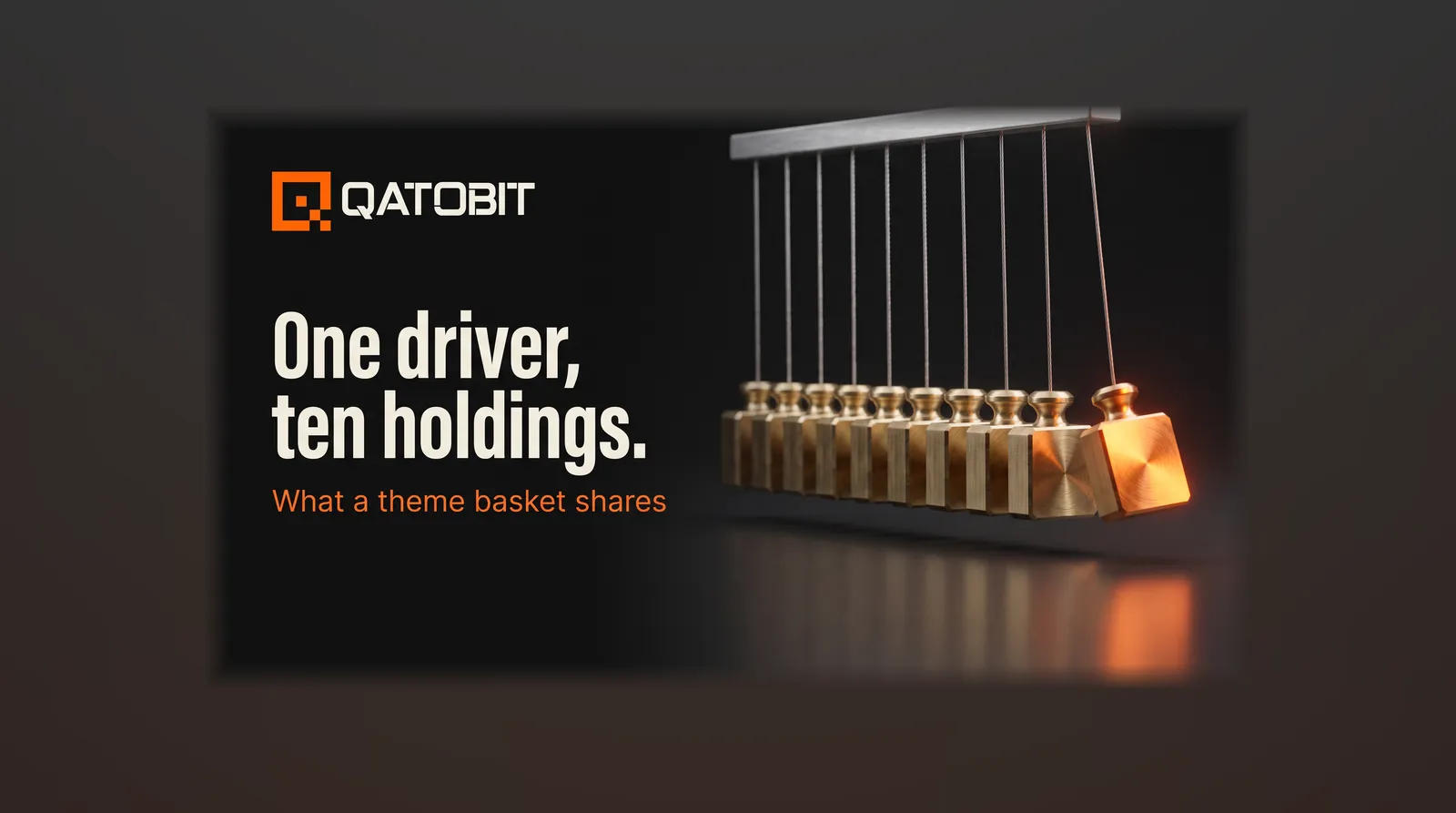
A theme basket picks holdings because they share a story. That is its selling point and its weak spot. When the story is questioned, each holding is questioned for the same reason on the same day.
Diversification works when holdings answer to different drivers. A chip designer, a power-equipment maker and a cloud renter look different on the balance sheet. On 5 November they answered to one driver, the future of the data centre build-out.
The theme can sit in equities or in crypto. A basket of AI-linked tokens depends on one narrative in the same way. What matters is how many separate reasons the basket has to go up, and a theme basket has one.
Mechanism 1: one story sets the direction
If ten holdings each have a different reason to rise or fall, a bad day for one is a quiet day for another. If ten holdings share one reason, a bad day for the story is a bad day for all ten. The number of names stops mattering. The number of drivers is what counts.
Mechanism 2: the leader sets the weight
Many baskets weight by size, so the largest company carries the most weight. After a long run, the company that rose the most is the one with the biggest slice. The drop then lands hardest on the slice that grew the most.
Mechanism 3: nothing forces a reset
A basket that never rebalances lets its winners grow into a larger share of the money. Each week of a rally makes the next fall bigger in rupee terms. Our piece on concentration risk explains how a few holdings come to decide the whole outcome.
What does it look like in rupees?
The arithmetic below is illustrative. It is a mechanic, not a forecast.
Take a ₹5 lakh lump sum in a theme basket of ten equal holdings, ₹50,000 each. Suppose every holding falls 9.3 percent, the size of Nvidia's fall on 5 November. The loss is ₹5,00,000 × 0.093 = ₹46,500.
Now take ₹5 lakh in a ten-holding basket where only four holdings depend on that theme. Four holdings of ₹50,000 each, each falling 9.3 percent, lose 4 × ₹50,000 × 0.093 = ₹18,600. The other six holdings answer to other drivers and are not part of this calculation.
The gap is ₹46,500 minus ₹18,600, which is ₹27,900. The same count of holdings gave a different result because the number of drivers differed.
Weight caps limit the single-holding version of the same problem. With a 15 percent cap on a ₹5 lakh basket, no holding can exceed ₹75,000. A 9.3 percent fall in a capped holding costs at most ₹75,000 × 0.093 = ₹6,975.
What does a rules-based index do differently?
A rules-based index writes its limits down before the market tests them. Qatobit's four QSI indices each run on a documented methodology and rebalance monthly. Our guide to what a crypto index is covers the basics.
QSI GEQ8 is the clearest case. It is a Qatobit-designed index of 8 global companies. They sit in three sleeves: Platform at 45 to 55 percent, Digital finance at 30 to 40 percent and Innovation at 10 to 20 percent. NVIDIA is one of eight holdings in it.
Its methodology sets hard caps, so no holding sits above 15 percent or below 3 percent. It rebalances monthly, with a quarterly composition review. Between rebalances weights drift, and the monthly rebalance resets them to the rules.
The crypto indices apply the same idea with different building blocks. QSI Core holds Bitcoin, Ethereum, Gold and a stable reserve. QSI Growth adds Solana to those four. The Gold and stable reserve sleeves answer to drivers other than crypto's, and that is why they are there.
QSI VRION holds Bitcoin, Ethereum and Solana with no hedge layer. It is the deliberate exception, built for a multi-year horizon, and the investor holds that risk rather than the structure. A rule set does not remove risk. It makes the risk visible before the investor accepts it.
Every basket buy, sell or rebalance carries 0.35 percent, and there is no annual management fee and no exit load. Our piece on portfolio rebalancing when one holding falls 10 percent shows the monthly reset on a worked example.
How should you size a theme position?
Treat a theme as a position inside an allocation, not as the allocation. Our guide to what asset allocation decides before any pick explains that order of decisions.
A workable test has three questions. How many separate drivers does the basket have? What is the largest single weight today? When did a rule last move that weight?
A position of three percent of a ₹1 crore portfolio is ₹3 lakh. If the theme falls 9.3 percent, the loss is ₹3,00,000 × 0.093 = ₹27,900, which is 0.28 percent of the portfolio. Sized that way, a scare is an event the portfolio absorbs. Sized at thirty percent, the same fall costs ₹2.79 lakh.
Sources, both read on 8 November 2026: The Next Web, citing the Associated Press, for the market moves on 5 November 2026, and Mint for the Nvidia rebound. Index facts come from Qatobit's published methodology.
Frequently asked questions
Does an AI bubble scare affect crypto baskets?
A basket of AI-linked tokens depends on one narrative, so a scare about AI spending reaches every holding at once. A basket that mixes assets with different drivers gives the scare fewer holdings to reach.
What is a theme basket?
A theme basket is a set of holdings chosen because they share a story, such as AI. It has few separate drivers, so its holdings tend to move together when the story is questioned.
How does a weight cap limit damage from one holding?
A cap sets the most any one holding can weigh. QSI GEQ8 uses a 15 percent cap, so on a ₹5 lakh position no holding exceeds ₹75,000, and a 9.3 percent fall in it costs at most ₹6,975.
What does monthly rebalancing do after a sharp fall?
It resets weights to the index rules each month. A holding that has grown into a larger share is cut back, and a holding that has shrunk is topped up, so drift does not build unchecked.
Does Qatobit charge to leave an index?
No. There is no exit load on any QSI index at any holding period. The only index fee is 0.35 percent when a basket transaction or rebalance happens, and there is no annual management fee.
Crypto investments are subject to market risk. Not financial advice.
“A better allocation begins with a better explanation.”
Qatobit principle
Published construction. Fixed cadence. Versioned control.