The point
Alphabet fell about 12 percent in a single session on 29 October 2026, its biggest one-day drop since it listed in 2004, according to Marketplace. What that costs you depends on a number you set long before: the position's weight. On a ₹1 crore portfolio, a 12 percent fall costs ₹60,000 at a 5 percent weight, ₹1.8 lakh at 15 percent and ₹3.6 lakh at 30 percent.
What happened to the Alphabet share price on 29 October 2026?
Alphabet fell about 12 percent after its third-quarter results. Marketplace's report on the fall calls it the biggest one-day plunge since the company went public 22 years ago.
Yahoo Finance's account of the quarter gives the figures behind it, as read on 29 October 2026. Earnings per share were $2.12 against $3.01 that analysts expected. Advertising sales were $82.01 billion against $83.5 billion expected.
Google Cloud brought in $30.71 billion against $29.1 billion expected. Free cash flow, the cash left after the company pays for its equipment and data centres, moved from negative $5.85 billion in the previous quarter to negative $9.06 billion.
Outlets differ on the exact percentage because the move was reported at different points in the session, and some mix the two share classes. This page uses the 12 percent that both sources carry.
This page covers the part of a fall you chose in advance, and takes no view on the stock.
What does a 12 percent fall cost at 5, 15 and 30 percent weight?
A fall in one holding reaches your portfolio multiplied by its weight. The same 12 percent produces three very different days on a ₹1 crore portfolio. Only the position's size before the day began has changed.
At a 5 percent weight
The position is ₹5 lakh. A 12 percent fall removes ₹5,00,000 × 0.12 = ₹60,000. That is 0.6 percent of the portfolio.
At a 15 percent weight
The position is ₹15 lakh. The fall removes ₹15,00,000 × 0.12 = ₹1,80,000, or 1.8 percent of the portfolio. You notice it.
At a 30 percent weight
The position is ₹30 lakh. The fall removes ₹30,00,000 × 0.12 = ₹3,60,000, or 3.6 percent of the portfolio.
The climb back is longer than the drop
A 12 percent fall leaves 88 of every 100 rupees. Getting back to 100 needs 100 ÷ 88 = 1.136, a rise of 13.6 percent. At a 30 percent weight, the position falls from ₹30 lakh to ₹26.4 lakh and the portfolio from ₹1 crore to ₹96.4 lakh. The weight itself drops to 26.4 ÷ 96.4 = 27.4 percent, so the name is still more than a quarter of everything you own.
This is arithmetic on a hypothetical portfolio. It forecasts nothing about where Alphabet goes next, and it would read the same for any name that fell 12 percent.
How does one name get to 30 percent without anyone deciding it?
It gets there by being right, which is why it goes unnoticed. Say you buy a ₹10 lakh position in a ₹1 crore portfolio, a 10 percent weight. If that holding doubles to ₹20 lakh while the rest stays flat, the portfolio is ₹1.1 crore and the weight is 20 ÷ 110 = 18.2 percent.
If it triples to ₹30 lakh instead, the portfolio is ₹1.2 crore and the weight is 30 ÷ 120 = 25 percent. Nobody chose 25 percent. The position grew into it while the rest of the allocation stood still.
This is the drift that concentration risk describes, and it is quietest in the holdings you are happiest with. A name you own through the Liberalised Remittance Scheme, such as the ones covered in the routes for buying US stocks from India, gets no automatic rebalance. It stays the size the market made it.
What does a weight rule decide before the day comes?
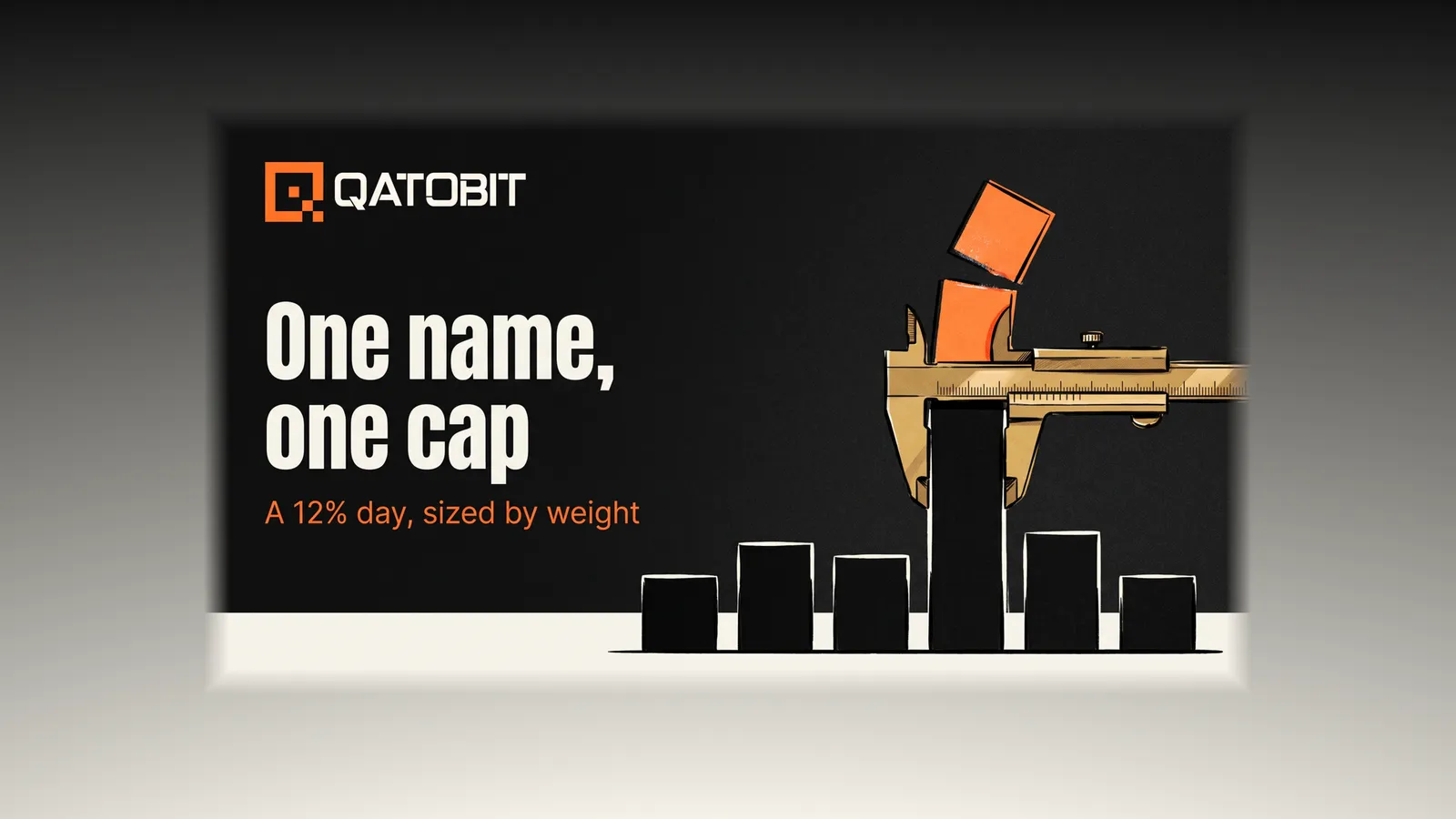
It decides three things in writing, while you are calm: the cap, the trigger and the destination. A cap is the largest weight any one name may reach, such as 15 percent. A trigger is the moment you check, such as a quarter-end or any day a name crosses its cap. The destination is where the trimmed money goes.
Take the ₹1.1 crore portfolio above with the doubled name at ₹20 lakh. A 15 percent cap means a position of 0.15 × ₹1,10,00,000 = ₹16.5 lakh. The rule sells ₹20,00,000 − ₹16,50,000 = ₹3.5 lakh and moves it into the other holdings.
The rule asks one question, whether the position is above its cap, and the answer is arithmetic whatever Alphabet's price looks like. The weight is the one decision about a single name that stays fully in your hands. It deserves a rule written before the position is large and the story about it is good.
A written rule also removes the argument you would otherwise have with yourself on the worst day. A 12 percent fall in a 30 percent position is the wrong moment to decide what 30 percent was supposed to mean. For how rebalancing behaves after a fall, see what rebalancing does when one holding falls.
How does QSI GEQ8 treat a single name like Alphabet?
QSI GEQ8 is a Qatobit-designed index of eight global companies at the intersection of technology, digital finance and innovation. Alphabet is one of the eight, in the Platform sleeve alongside Apple, Amazon, Meta Platforms and NVIDIA.
The methodology sets weights by free-float market cap adjusted by a quarterly score, with hard caps: no holding above 15 percent or below 3 percent. The index is rebalanced monthly, with a quarterly composition review. Weights are published on the index page.
At the 15 percent cap, a 12 percent fall in one name moves the index by 0.15 × 0.12 = 1.8 percent, the same as the 15 percent row above. That describes the rule's ceiling on a single name, not how the index has performed or will perform. You can read the construction in QSI GEQ8's methodology.
Where this leaves the weight you hold
Run the numbers on your own portfolio before a quarterly report lands, not after it. Divide each direct holding's value by the portfolio's value. Any name whose weight times 12 percent is more than you would be comfortable losing is a position without a rule.
How a position is sized to survive a drawdown sets out the sizing side of the same question. Once you have a cap, the next question is the trigger: how often you check, and what makes you act.
Frequently asked questions
Why did the Alphabet share price fall 12 percent?
Alphabet reported third-quarter earnings per share of $2.12 against $3.01 expected, and advertising sales of $82.01 billion against $83.5 billion expected, per Yahoo Finance on 29 October 2026. Marketplace reported a 12 percent drop, the largest one-day fall since the 2004 listing.
How much does a 12 percent fall cost a ₹1 crore portfolio?
It depends on the weight. At a 5 percent weight the loss is ₹60,000, at 15 percent it is ₹1.8 lakh and at 30 percent it is ₹3.6 lakh. The loss is the position's value times 0.12.
How much must a share rise to recover a 12 percent fall?
It must rise 13.6 percent, because 100 ÷ 88 = 1.136. A fall always needs a larger percentage rise to undo, and the gap widens as the fall deepens.
What is a weight cap in a portfolio?
A weight cap is the largest share of the portfolio one holding may reach, such as 15 percent. When a holding grows past it, the excess moves into the other holdings.
Does QSI GEQ8 cap how much one company can weigh?
Yes. QSI GEQ8's methodology sets a hard cap of 15 percent and a floor of 3 percent on any holding, and the index rebalances monthly.
Crypto investments are subject to market risk. Not financial advice.
“A better allocation begins with a better explanation.”
Qatobit principle
Published construction. Fixed cadence. Versioned control.