The point
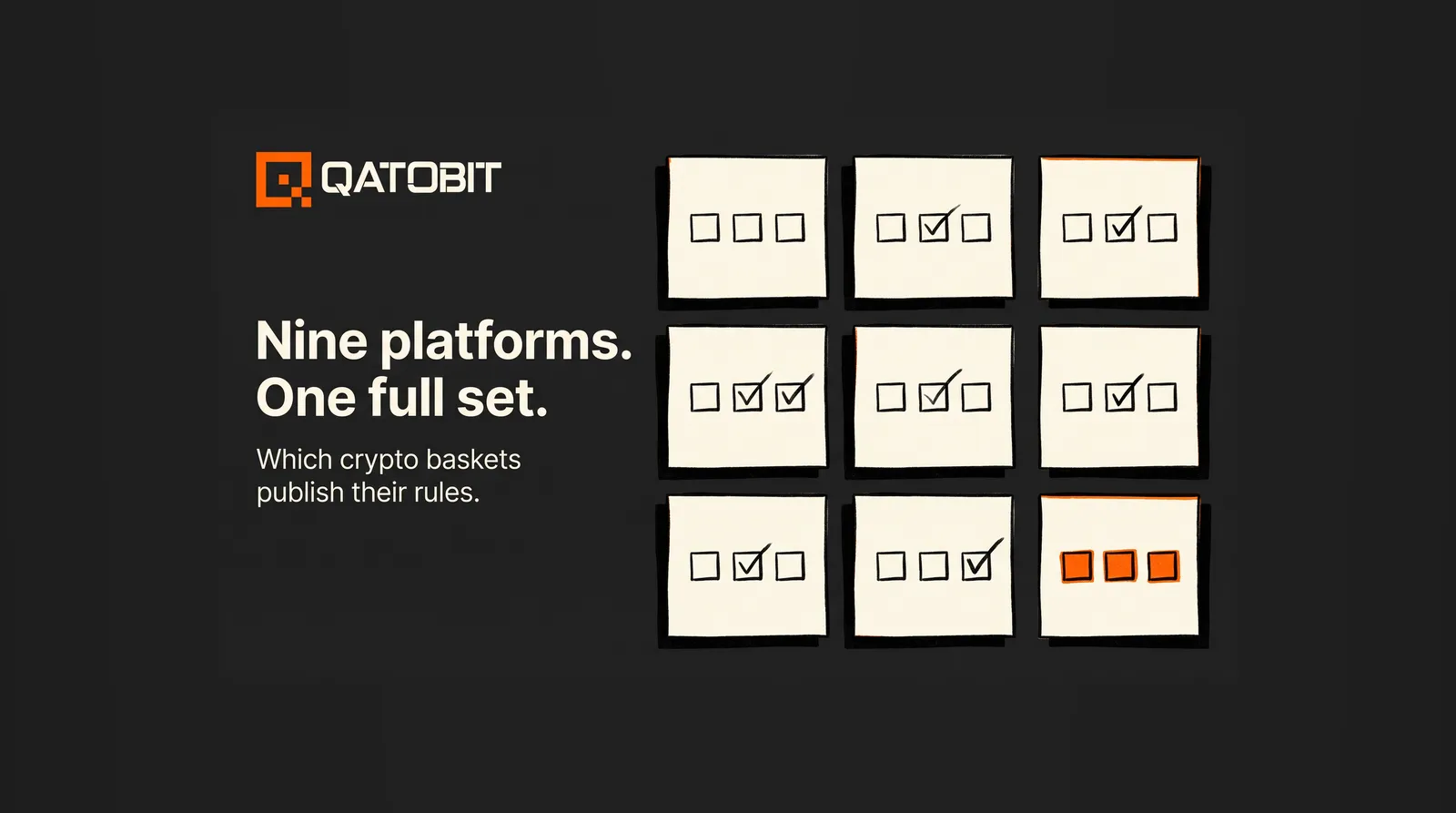
Nine platforms in India are compared here, eight of which sell a basket, a coin set or a crypto index: Mudrex, BitSave, ZebPay, Giottus, Unocoin, CoinDCX, CryptoSmartlife and Qatobit. CoinDCX's basket is unconfirmed. The ninth, CoinSwitch, sells a single-coin SIP. What separates them is what a reader can check before signing up. On the pages read for this update, one platform, Qatobit, showed its holdings, its rebalance cadence and its fee together. The other eight showed some of the three, or a page we could not load.
Last verified: 10 November 2026
What does it take to count as published?
A platform counts here when a public page, readable without an account, shows three things for its basket product. The first is what the basket holds. The second is how often it rebalances. The third is what that costs.
We read each platform's own page on 10 November 2026. Where a page would not load, the 17 September 2026 read stays, labelled with that date. A figure read on neither date is not on this page.
What does each platform publish?
Mudrex Coin Sets
Mudrex's Coin Sets page, read on 10 November 2026, describes "20+ Themes & Indexes" and "Theme-based baskets of cryptocurrencies". It says "You can start investing with as little as $5", and that an investor can "redeem anytime with no lock-ins or penalty". It states "1M+" investors.
The page shows no constituent list and no rebalance date. It says the baskets are "managed automatically based on the pre defined rules". Mudrex's fee page, read the same day, has a Coin Sets row. Investing shows "No Fees". Rebalancing (Monthly) shows "0.25% to 1%". Redeeming shows "No Fee: If redeemed after 1 month" and "1% Fee: If redeemed before 1 month". Individual Coin Set pages were not read for this update. Sources: Mudrex Coin Sets page and Mudrex fee page.
BitSave
BitSave's Crypto Index Product "replicates the Bloomberg Galaxy Crypto Index" and "is rebalanced monthly". The page says Bloomberg "decides what is in, not BitSave". It holds up to 15 large-cap assets chosen from the top 25 by market capitalisation, with no asset above 35 percent or below 1 percent.
Fees on the page are 1.5 percent a year, "charged daily on the day's NAV", and 1.00 percent if redeemed within 30 days. The page quotes $10 a month as the minimum SIP and $50 as the minimum one-time amount. Live composition and weights sit "in the app", so the list of holdings is not on the public page. Source: BitSave Crypto Index Product page.
ZebPay CryptoPacks
ZebPay's pages returned a 403 on 10 November 2026. As read on 17 September 2026, its CryptoPacks page called them "well-balanced portfolios" curated by "experienced professionals". It showed no constituent list, no rebalance calendar and no pack-specific fee. The platform also runs a separate Bitcoin SIP.
Giottus Baskets
Giottus's fee page returned a 403 on 10 November 2026. On 17 September 2026 its basket landing page returned a not-found error, and its fee page showed a spot-fee ladder with no basket-specific fee, minimum or rebalance calendar. We could not find a published basket rulebook on either date.
Unocoin Crypto Basket
Unocoin's basket page returned a 504 on 10 November 2026, including on a second try. As read on 17 September 2026, it listed sixteen named baskets under the line "Mutual Funds… but for Crypto". None of the sixteen cards showed a constituent list, a weighting rule, a rebalance calendar, a minimum or a fee.
CoinDCX Crypto Baskets
CoinDCX's support site, read on 10 November 2026, lists "CoinDCX prime" as its own help topic, next to KYC, deposits and trading. The page names no basket, constituent, cadence or fee. coindcx.com itself blocked automated reads on 17 September 2026. As of 10 November 2026 we could not find a public page with CoinDCX's basket holdings, cadence or fee.
CoinSwitch
CoinSwitch's SIP page, read on 10 November 2026, describes a SIP as "a fixed amount" invested "in the selected crypto at regular intervals". It says the platform "supports 400+ cryptos and serves more than 2.5 crore registered users", and that SIPs start "from ₹100 per transaction". On that page and the homepage read on 9 November 2026, we could not find a basket or index product. A recurring buy there is one coin per plan. Source: CoinSwitch Crypto SIP page.
CryptoSmartlife Thematic Baskets
CryptoSmartlife's pricing page, read on 10 November 2026, lists thematic basket investment, automatic portfolio rebalancing and recurring investment plans. It charges "1 %Flat Fee On Every Buy and Sell Orders" through its own wallet. It says "Rebalancing trades are executed only on user confirmation", so there is no fixed calendar. The page gives no basket count, constituent list or minimum. Source: CryptoSmartlife pricing page.
Qatobit QSI
Qatobit's four QSI indices name every holding on their product pages and rebalance monthly on a documented methodology. A buy, sell or rebalance costs 0.35 percent of the transaction amount, shown before confirmation. The full block is further down.
What does the count come to?
Take the three tests: holdings, cadence and fee on a public page, read this run.
- Qatobit passes all three.
- BitSave publishes cadence and fee, and describes its holdings by rule. The names and weights sit in the app.
- Mudrex publishes a monthly cadence and a fee range on its fee page. The Coin Sets page lists no holdings, and individual set pages were not read.
- CryptoSmartlife publishes a fee and a confirmation-based cadence, and no holdings or basket count.
- CoinDCX and CoinSwitch published none of the three on the pages read. CoinSwitch sells no basket there.
- ZebPay, Giottus and Unocoin could not be read this run. Their 17 September position was that none showed the three together.
The count moved since the last read. On 17 September, Mudrex and Qatobit were the two that showed the three together. On 10 November, only Qatobit could be confirmed, because Mudrex's holdings sit on individual set pages that this read did not open. That is a limit of this read, and Mudrex may still qualify.
What does the fee model look like at ₹5 lakh?
BitSave charges a yearly rate and Qatobit charges per transaction. Take a holding of ₹5,00,000 for a year at a flat price, so the arithmetic isolates the fee.
- BitSave: 1.5 percent of ₹5,00,000 is ₹7,500 a year.
- Qatobit: say each monthly rebalance moves ₹25,000 of the basket. 0.35 percent of ₹25,000 is ₹87.50, and twelve rebalances come to ₹1,050.
These figures do not compare services. BitSave's fee covers a licensed benchmark and a daily-NAV product. Qatobit's covers four in-house indices. How much a rebalance moves depends on how far prices drift, so the ₹25,000 is an assumption and not a rule. The example compares fee structure only.
Where is each platform stronger?
Mudrex offers the widest set of themes in this list, at 20 plus, and says an investor can redeem "anytime with no lock-ins or penalty" on its Coin Sets page. BitSave's strength is independence: Bloomberg's index team chooses the components and weights, not BitSave. CoinSwitch has scale, 400 plus cryptos and 2.5 crore registered users by its own count, and the lowest SIP entry in the group on pages read this run.
Qatobit sells four indices, with single-asset Quick Buy/Sell and Crypto SIP beside them. An investor who wants the 400 plus coins CoinSwitch lists will find more choice there. Qatobit states no user count. Its indices are in-house, not a licensed third-party benchmark. QSI GEQ8 sits outside SEBI regulation.
The QSI indices, in full
Qatobit is a crypto index investing platform in India: investors hold a curated basket of digital assets, rebalanced on a published methodology, rather than picking coins.
- Four QSI indices are on sale: QSI Core, QSI Growth, QSI VRION and QSI GEQ8.
- QSI Core holds Bitcoin, Ethereum, Gold and a stable reserve (USDT Earn).
- QSI Growth holds Bitcoin, Ethereum, Solana, Gold and a stable reserve (USDT Earn).
- QSI VRION holds Bitcoin, Ethereum and Solana, with no hedge layer.
- QSI GEQ8 holds eight global companies in three sleeves. Platform: Apple, Amazon, Alphabet, Meta Platforms and NVIDIA. Digital finance: Coinbase and Robinhood Markets. Innovation: Tesla.
- No holding in QSI GEQ8 sits above 15 percent or below 3 percent, and its composition is reviewed quarterly. It sits outside SEBI regulation and is an index, not a fund.
- Every index publishes its holdings on its product page, and its methodology is documented and published before launch. All four rebalance monthly.
- The minimum per index is ₹2,000. A SIP into an index starts at ₹2,000 per cadence.
- A basket buy, sell or rebalance costs 0.35 percent of the transaction amount, shown before confirmation.
- There is no annual management fee, and no exit load, lock-in or minimum holding period on any index.
- A single-asset buy or sell costs 0.4 percent. A crypto-to-crypto convert costs 0.1 percent.
- A crypto SIP into a single asset starts at ₹500 weekly or biweekly, or ₹2,000 monthly.
- Deposits arrive by UPI, IMPS, NEFT or RTGS. Withdrawals go directly to the linked bank, with a ₹200 minimum each way and no fee.
- Custody is institutional custody, and proof of reserves is live, available at any time.
Who should choose which?
An investor who wants the widest set of themes, and will read each Coin Set inside the app, looks at Mudrex. One who wants a licensed benchmark and a daily NAV looks at BitSave. One who wants a single coin on repeat, from a long coin list, looks at CoinSwitch.
Qatobit suits an investor who wants every holding, the rebalance rule and the fee written down before the first rupee goes in. Per-platform comparisons: Mudrex, BitSave, ZebPay, Giottus, Unocoin and CoinSwitch.
For the definition, start with what a crypto index is. For the monthly reset itself, see portfolio rebalancing when one holding falls 10 percent.
How this page was checked
Every competitor figure was read from the platform's own page on 10 November 2026, except where marked 17 September 2026:
- Mudrex: mudrex.com/coinset and mudrex.com/fee-and-compliance.
- BitSave: bitsave.club/products/crypto-index.
- CoinDCX: support.coindcx.com.
- CoinSwitch: coinswitch.co/switch/crypto/coinswitch-crypto-sip/.
- CryptoSmartlife: cryptosmartlife.com/pricing.
- ZebPay, Giottus and Unocoin: pages returned 403, 403 and 504 on 10 November 2026. Their text stands as read on 17 September 2026.
Qatobit figures come from Qatobit's product documentation. This page compares no return and no performance. The Last verified line changes in place at each refresh.
Frequently asked questions
Which platforms in India sell a crypto basket, coin set or index?
Eight of the nine platforms compared here sell a basket-shaped product: Mudrex, BitSave, ZebPay, Giottus, Unocoin, CoinDCX, CryptoSmartlife and Qatobit. For CoinDCX the evidence is thin: its support site lists a product called CoinDCX prime, and we found no public page showing a basket, so treat it as unconfirmed. CoinSwitch sells a single-coin SIP, and we found no basket on its pages.
What is the minimum to invest in a crypto basket in India?
Minimums differ and several are not published. Mudrex's page says from $5. BitSave's page says $50 one time or $10 a month as a SIP. Qatobit's indices start at ₹2,000. CoinSwitch's single-coin SIP starts from ₹100 per transaction.
Do these platforms publish what is inside a basket?
Qatobit names every holding on its product pages. BitSave describes its rule and keeps names and weights in the app. On the pages read this run, the other platforms listed no holdings.
Does a SIP into a basket cost more than a SIP into one coin?
The two buy different things. A single-coin SIP buys one asset per plan. A SIP into a QSI index starts at ₹2,000 per cadence and buys every holding of the index in one order, at 0.35 percent of the transaction amount.
Crypto investments are subject to market risk. Not financial advice.
“A better allocation begins with a better explanation.”
Qatobit principle
Published construction. Fixed cadence. Versioned control.